
CyberMedia Awards Night 2026: Leadership, Innovation and Impact


CyberMedia Leadership & Awards Night 2026 brought together a distinguished gathering of technology leaders, policymakers, industry veterans and innovators in New Delhi on July 3 for an evening that combined reflection, recognition and forward-looking dialogue. Bringing together the Dataquest ICT Business Awards and the Voice&Data Telecom Leadership Awards under one roof, the event celebrated not only individual achievement, but also the wider arc of India’s digital evolution.
Reading the signals of India’s digital future
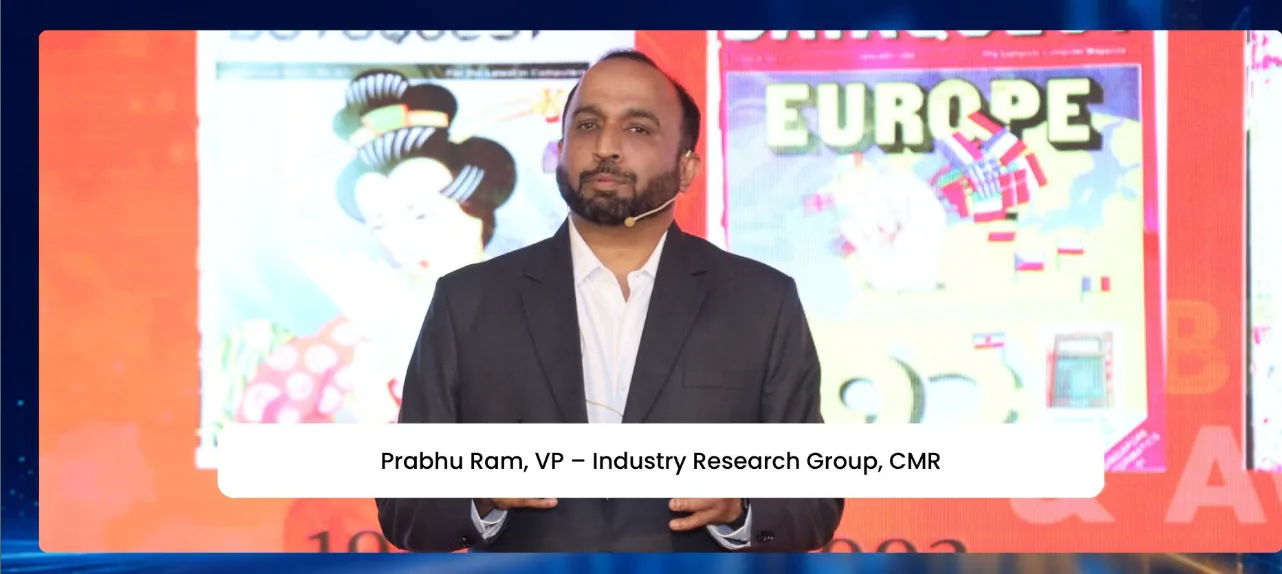
The evening began with an opening perspective by Prabhu Ram, Vice President – Industry Research Group, CMR, on 2025 Reloaded: Reading the Signals of India’s Digital Future. His remarks set the tone by drawing attention to the market, technology and policy forces now converging to shape India’s next phase of transformation. The message was clear: India’s digital story can no longer be read only through the old lens of connectivity and scale. It must now be understood through the lenses of intelligence, trust, resilience and national capability.
As Prabhu Ram argued, technology tends to move in disruptive waves roughly every decade — from the PC to the modern internet, from the dotcom crash to the iPhone, and from there to ChatGPT, which reached 100 million users in just 60 days — with each wave displacing the last and often proving very different from what the market initially expects, as the fading hype around the metaverse shows. He suggested that AI is now unfolding along two major tracks: physical AI, where intelligence acts in the real world through robots, automation and humanoid systems; and personal or cognitive AI, where intelligence acts alongside the user through context-aware, emotion-sensing and multimodal assistants.
Against this backdrop, he positioned India at a potentially historic inflexion point: patent rankings are rising, AI talent outflow is slowing, the Aadhaar–Jio–Jan Dhan digital public infrastructure stack has laid a strong foundation, and the country could emerge not just as a major AI market, but as a leader across innovation, silicon and compute. The larger question, he suggested, is no longer whether AI will reshape the economy, but what India will choose to build — and where it will lead — in this sixth, still wide-open technology wave.
From scale and execution to research and invention
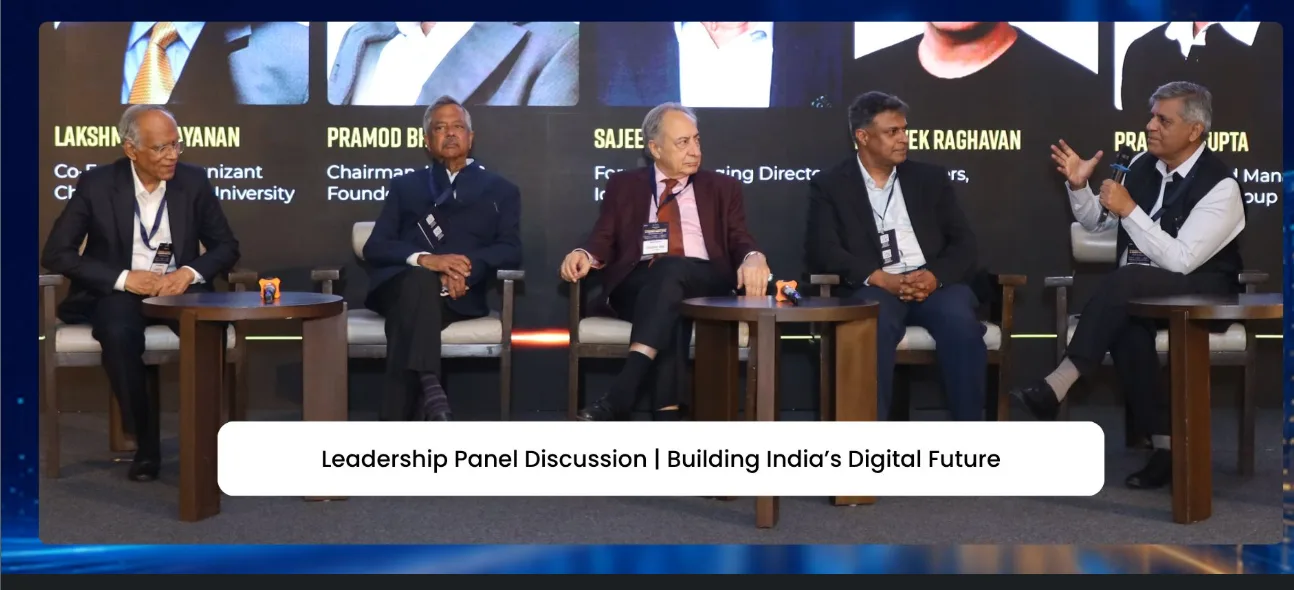
That opening context led naturally into the central conversation of the evening, the leadership panel titled Building India’s Digital Future. Moderated by Pradeep Gupta, Chairman and Managing Director, CyberMedia Group, the discussion brought together Lakshmi Narayanan, Co-Founder, Cognizant, and Chancellor, Krea University; Pramod Bhasin, Chairman, ICRIER, and Founder, Genpact; Sanjeev Aga, Former Managing Director, Idea Cellular; and Dr Vivek Raghavan, Co-Founder, Sarvam AI.
A powerful thread running through the conversation was that India’s next digital chapter cannot be built on scale and execution alone. It must also be built on deeper research, stronger innovation, higher risk appetite and a greater willingness to create original capability.
Lakshmi Narayanan reflected on how earlier generations of Indian technology companies grew in a very different era, when the pace of technological change allowed more room for experimentation. India, he argued, has done well in innovation diffusion and in scaling solutions suited to its own needs. But it still does not invest enough in original research, science and engineering if it wants to move from adoption to invention.
Pramod Bhasin extended that thought from the vantage point of India’s business process industry. Looking back on the birth of what later became Genpact, he spoke of a time when every day involved solving new problems with little precedent. For him, the lesson remains relevant: major industries are often built before their scale is fully visible. As India now confronts AI, it must show a far stronger appetite for risk, R&D and education if it wants to create new industries rather than merely protect older ones.
Speed, disruption and the confidence to build
Sanjeev Aga brought in the telecom perspective, describing a sector shaped by extraordinary speed, pressure and disruption. Telecom, in his telling, taught leaders that scale, execution and strategic clarity matter most in moments of technological upheaval. Those lessons still hold as digital shifts now begin to redraw every sector.
From the next generation of builders, Dr Vivek Raghavan emphasised the importance of confidence and long-term conviction. India, he suggested, must believe that it can do hard things. In a field as fast-moving as AI, success will not come merely from reacting quickly, but from taking long-horizon bets and building with ambition. For him, India’s advantage lies not only in its market scale, but in its ability to adapt quickly and imagine new possibilities.
Trust, resilience and the real meaning of digital capability
Even as the panel focused on innovation and capability, the evening’s larger theme of trust and resilience became sharper in the awards segment.
The Dataquest Jury’s Special Award 2025 was conferred on Dr Sanjay Bahl, Director General, CERT-In, and Controller of Certifying Authorities, for strengthening India’s cyber preparedness, digital trust and national cyber resilience. His recognition gave concrete expression to one of the evening’s central ideas: trusted digital systems are now part of core national capability.
That theme was reinforced by the role CERT-In played during the geopolitical tensions around Operation Sindoor, when the National Stock Exchange website came under an unprecedented cyber onslaught of nearly 400 million attacks. CERT-In worked closely with the NSE to analyse malicious traffic, trace hostile IP patterns, share real-time threat intelligence and coordinate rapid containment, ensuring that the exchange’s public-facing platforms and ring-fenced trading systems remained operational. The episode underscored a reality that was implicit throughout the evening: cyber resilience is no longer a backend technical concern. It is central to economic continuity and public confidence.
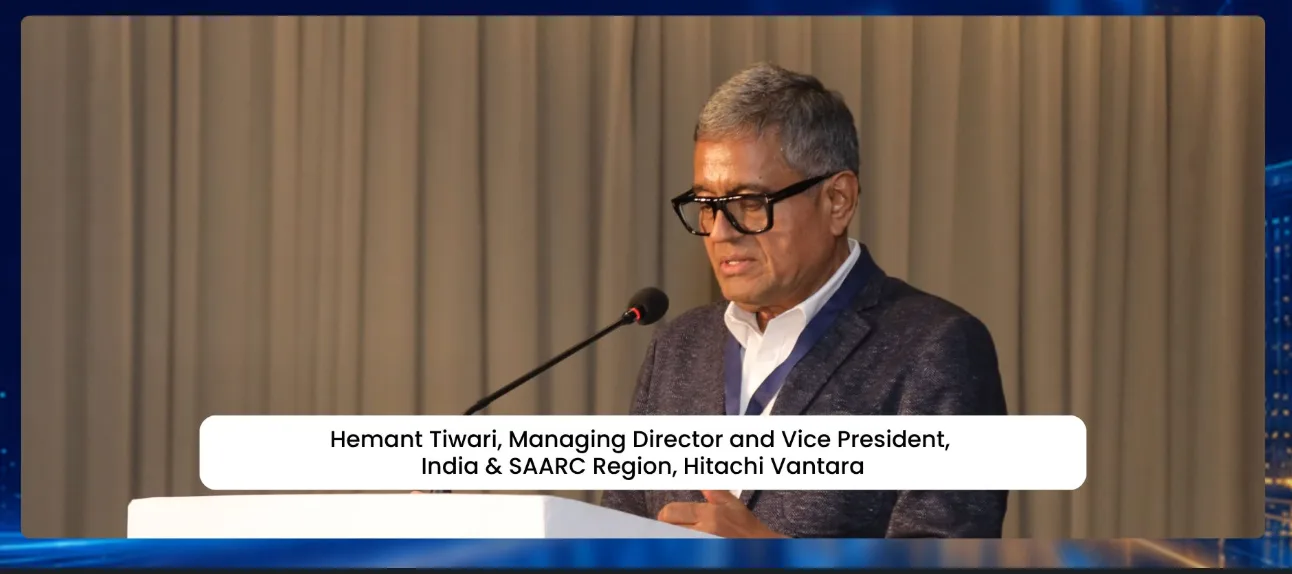
That larger point found an echo in the industry address by Hemant Tiwari, Managing Director and Vice President, India & SAARC Region, Hitachi Vantara, who argued that India’s next leap will depend not merely on digitisation, but on becoming a trusted digital economy built on trusted data, resilient infrastructure, responsible AI and leadership.
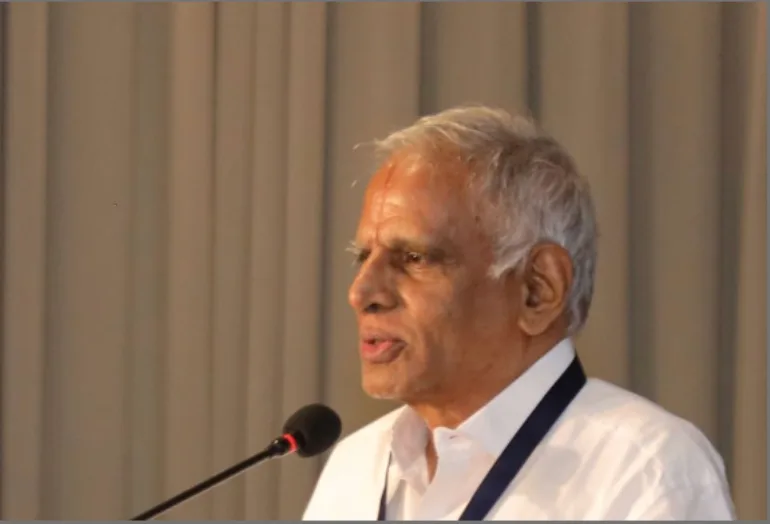
The broader intellectual framing for the evening was reinforced by Prof. S. Sadagopan, Founder Director, IIIT Bangalore, who drew attention to the need for India to trust its young talent and allow it room to experiment and grow.
Prof. Karandikar’s challenge: build the next disruption, don’t chase the last one
If the leadership conversation captured the challenge, Prof. Abhay Karandikar, Member, NITI Aayog, sharpened it in the keynote.
His address deepened the evening’s argument by focusing on three linked issues: research intensity, private-sector responsibility and the need for India to create disruption rather than merely catch up with it. He pointed to the fact that India continues to spend too little on R&D as a share of GDP, and that private-sector participation remains far lower than in many advanced economies. In his view, this is one of the country’s central structural weaknesses.
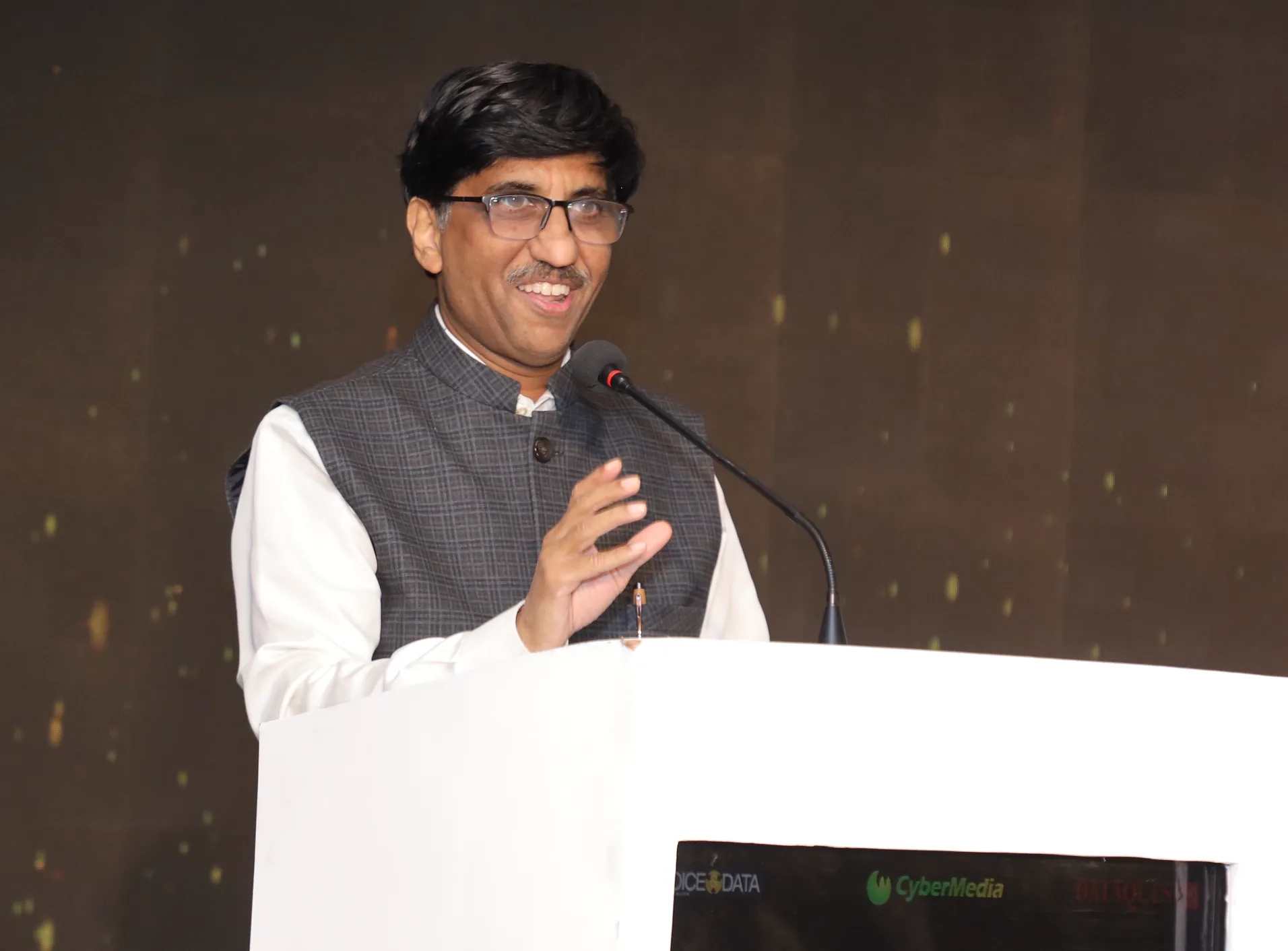
At the same time, he struck an optimistic note. India has the young talent, the policy intent and the beginnings of an enabling ecosystem to create globally competitive technology companies in frontier areas. But the country must stop defining success only as catching up with breakthroughs elsewhere. Instead, it must build the conditions in which the next disruption can emerge from India itself.
Karandikar also stressed that the real measure of digital progress is changing. For years, India’s success was tracked in terms of how many people could be connected. The next test, he suggested, will be whether digital systems can enhance productivity, create economic value and build trusted, intelligent and resilient infrastructure. In that sense, the future will not be determined only by the size of India’s digital economy, but by the quality and trustworthiness of the systems it builds.
The awards reflected the evening’s argument
It was fitting, then, that the awards sequence reflected the very themes debated through the evening.
The Voice&Data Telecom Leadership awards honoured leaders across telecom, infrastructure and communications: Jyotiraditya M. Scindia, Union Minister for Communications & DoNER, Government of India, was recognised as Voice&Data Telecom Person of the Year 2025; Pawan Kumar Chandana, Co-Founder and Chief Executive Officer, Skyroot Aerospace, received the Voice&Data Pathbreaker Award 2025; Ankit Agarwal, Managing Director, STL, received the Voice&Data Special Jury Award 2025; and Sanjeev Aga, Former Managing Director, Idea Cellular, was honoured with the Voice&Data Lifetime Achievement Award 2025.
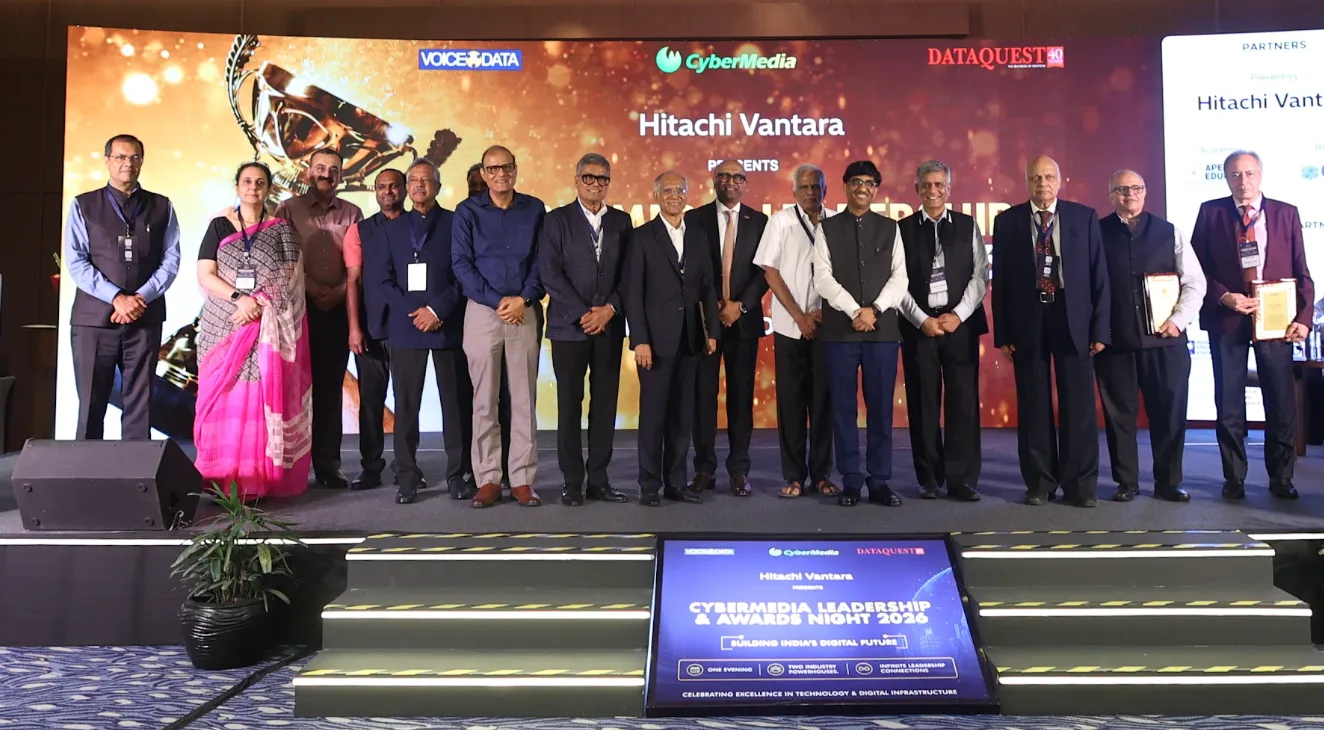
The Dataquest ICT Business awards then recognised leadership across IT, AI and cyber resilience: Dr Vivek Raghavan and Dr Pratyush Kumar, Co-Founders, Sarvam AI, received the Dataquest Pathbreaker Award 2025; Dr Sanjay Bahl, Director General, CERT-In, and Controller of Certifying Authorities, received the Dataquest Jury’s Special Award 2025; and the Dataquest Lifetime Achievement Awards 2025 were conferred on Pramod Bhasin, Chairman, ICRIER, and Founder, Genpact, and Lakshmi Narayanan, Co-Founder, Cognizant, and Chancellor, Krea University.
A night that looked ahead as much as it looked back
Taken together, CyberMedia Awards Night 2026 made one thing clear. India’s digital future will not be built by technology alone. It will be built by leaders who can convert technology into trust, capability and long-term national advantage.
In that sense, the evening was not only a celebration of achievements already made. It was also a reminder that India now stands at a more demanding threshold - one that calls for greater research ambition, stronger institutions, bolder risk-taking and a deeper commitment to building trusted digital systems for the future.
CyberMedia Leadership & Awards Night 2026 brought together a distinguished gathering of technology leaders, policymakers, industry veterans and innovators in New Delhi on July 3 for an evening that combined reflection, recognition and forward-looking dialogue. Bringing together the Dataquest ICT Business Awards and the Voice&Data Telecom Leadership Awards under one roof, the event celebrated not only individual achievement, but also the wider arc of India’s digital evolution.
Reading the signals of India’s digital future
The evening began with an opening perspective by Prabhu Ram, Vice President – Industry Research Group, CMR, on 2025 Reloaded: Reading the Signals of India’s Digital Future. His remarks set the tone by drawing attention to the market, technology and policy forces now converging to shape India’s next phase of transformation. The message was clear: India’s digital story can no longer be read only through the old lens of connectivity and scale. It must now be understood through the lenses of intelligence, trust, resilience and national capability.
As Prabhu Ram argued, technology tends to move in disruptive waves roughly every decade — from the PC to the modern internet, from the dotcom crash to the iPhone, and from there to ChatGPT, which reached 100 million users in just 60 days — with each wave displacing the last and often proving very different from what the market initially expects, as the fading hype around the metaverse shows. He suggested that AI is now unfolding along two major tracks: physical AI, where intelligence acts in the real world through robots, automation and humanoid systems; and personal or cognitive AI, where intelligence acts alongside the user through context-aware, emotion-sensing and multimodal assistants.
Against this backdrop, he positioned India at a potentially historic inflexion point: patent rankings are rising, AI talent outflow is slowing, the Aadhaar–Jio–Jan Dhan digital public infrastructure stack has laid a strong foundation, and the country could emerge not just as a major AI market, but as a leader across innovation, silicon and compute. The larger question, he suggested, is no longer whether AI will reshape the economy, but what India will choose to build — and where it will lead — in this sixth, still wide-open technology wave.
From scale and execution to research and invention
That opening context led naturally into the central conversation of the evening, the leadership panel titled Building India’s Digital Future. Moderated by Pradeep Gupta, Chairman and Managing Director, CyberMedia Group, the discussion brought together Lakshmi Narayanan, Co-Founder, Cognizant, and Chancellor, Krea University; Pramod Bhasin, Chairman, ICRIER, and Founder, Genpact; Sanjeev Aga, Former Managing Director, Idea Cellular; and Dr Vivek Raghavan, Co-Founder, Sarvam AI.
A powerful thread running through the conversation was that India’s next digital chapter cannot be built on scale and execution alone. It must also be built on deeper research, stronger innovation, higher risk appetite and a greater willingness to create original capability.
Lakshmi Narayanan reflected on how earlier generations of Indian technology companies grew in a very different era, when the pace of technological change allowed more room for experimentation. India, he argued, has done well in innovation diffusion and in scaling solutions suited to its own needs. But it still does not invest enough in original research, science and engineering if it wants to move from adoption to invention.
Pramod Bhasin extended that thought from the vantage point of India’s business process industry. Looking back on the birth of what later became Genpact, he spoke of a time when every day involved solving new problems with little precedent. For him, the lesson remains relevant: major industries are often built before their scale is fully visible. As India now confronts AI, it must show a far stronger appetite for risk, R&D and education if it wants to create new industries rather than merely protect older ones.
Speed, disruption and the confidence to build
Sanjeev Aga brought in the telecom perspective, describing a sector shaped by extraordinary speed, pressure and disruption. Telecom, in his telling, taught leaders that scale, execution and strategic clarity matter most in moments of technological upheaval. Those lessons still hold as digital shifts now begin to redraw every sector.
From the next generation of builders, Dr Vivek Raghavan emphasised the importance of confidence and long-term conviction. India, he suggested, must believe that it can do hard things. In a field as fast-moving as AI, success will not come merely from reacting quickly, but from taking long-horizon bets and building with ambition. For him, India’s advantage lies not only in its market scale, but in its ability to adapt quickly and imagine new possibilities.
Trust, resilience and the real meaning of digital capability
Even as the panel focused on innovation and capability, the evening’s larger theme of trust and resilience became sharper in the awards segment.
The Dataquest Jury’s Special Award 2025 was conferred on Dr Sanjay Bahl, Director General, CERT-In, and Controller of Certifying Authorities, for strengthening India’s cyber preparedness, digital trust and national cyber resilience. His recognition gave concrete expression to one of the evening’s central ideas: trusted digital systems are now part of core national capability.
That theme was reinforced by the role CERT-In played during the geopolitical tensions around Operation Sindoor, when the National Stock Exchange website came under an unprecedented cyber onslaught of nearly 400 million attacks. CERT-In worked closely with the NSE to analyse malicious traffic, trace hostile IP patterns, share real-time threat intelligence and coordinate rapid containment, ensuring that the exchange’s public-facing platforms and ring-fenced trading systems remained operational. The episode underscored a reality that was implicit throughout the evening: cyber resilience is no longer a backend technical concern. It is central to economic continuity and public confidence.
That larger point found an echo in the industry address by Hemant Tiwari, Managing Director and Vice President, India & SAARC Region, Hitachi Vantara, who argued that India’s next leap will depend not merely on digitisation, but on becoming a trusted digital economy built on trusted data, resilient infrastructure, responsible AI and leadership.
The broader intellectual framing for the evening was reinforced by Prof. S. Sadagopan, Founder Director, IIIT Bangalore, who drew attention to the need for India to trust its young talent and allow it room to experiment and grow.
Prof. Karandikar’s challenge: build the next disruption, don’t chase the last one
If the leadership conversation captured the challenge, Prof. Abhay Karandikar, Member, NITI Aayog, sharpened it in the keynote.
His address deepened the evening’s argument by focusing on three linked issues: research intensity, private-sector responsibility and the need for India to create disruption rather than merely catch up with it. He pointed to the fact that India continues to spend too little on R&D as a share of GDP, and that private-sector participation remains far lower than in many advanced economies. In his view, this is one of the country’s central structural weaknesses.
At the same time, he struck an optimistic note. India has the young talent, the policy intent and the beginnings of an enabling ecosystem to create globally competitive technology companies in frontier areas. But the country must stop defining success only as catching up with breakthroughs elsewhere. Instead, it must build the conditions in which the next disruption can emerge from India itself.
Karandikar also stressed that the real measure of digital progress is changing. For years, India’s success was tracked in terms of how many people could be connected. The next test, he suggested, will be whether digital systems can enhance productivity, create economic value and build trusted, intelligent and resilient infrastructure. In that sense, the future will not be determined only by the size of India’s digital economy, but by the quality and trustworthiness of the systems it builds.
The awards reflected the evening’s argument
It was fitting, then, that the awards sequence reflected the very themes debated through the evening.
The Voice&Data Telecom Leadership awards honoured leaders across telecom, infrastructure and communications: Jyotiraditya M. Scindia, Union Minister for Communications & DoNER, Government of India, was recognised as Voice&Data Telecom Person of the Year 2025; Pawan Kumar Chandana, Co-Founder and Chief Executive Officer, Skyroot Aerospace, received the Voice&Data Pathbreaker Award 2025; Ankit Agarwal, Managing Director, STL, received the Voice&Data Special Jury Award 2025; and Sanjeev Aga, Former Managing Director, Idea Cellular, was honoured with the Voice&Data Lifetime Achievement Award 2025.
The Dataquest ICT Business awards then recognised leadership across IT, AI and cyber resilience: Dr Vivek Raghavan and Dr Pratyush Kumar, Co-Founders, Sarvam AI, received the Dataquest Pathbreaker Award 2025; Dr Sanjay Bahl, Director General, CERT-In, and Controller of Certifying Authorities, received the Dataquest Jury’s Special Award 2025; and the Dataquest Lifetime Achievement Awards 2025 were conferred on Pramod Bhasin, Chairman, ICRIER, and Founder, Genpact, and Lakshmi Narayanan, Co-Founder, Cognizant, and Chancellor, Krea University.
A night that looked ahead as much as it looked back
Taken together, CyberMedia Awards Night 2026 made one thing clear. India’s digital future will not be built by technology alone. It will be built by leaders who can convert technology into trust, capability and long-term national advantage.
In that sense, the evening was not only a celebration of achievements already made. It was also a reminder that India now stands at a more demanding threshold - one that calls for greater research ambition, stronger institutions, bolder risk-taking and a deeper commitment to building trusted digital systems for the future.
A report by - Shrikanth Govindarajan, Editor, Dataquest




 2 Min read