/dqc/media/agency_attachments/2026/08/21/2026-08-21t061716244z-dq-channels-logojpg-2026-08-21-11-47-17.jpeg)

/dqc/media/media_files/2026/09/10/dq-channels-whatsapp-2026-09-10-17-07-48.png)

 Follow Us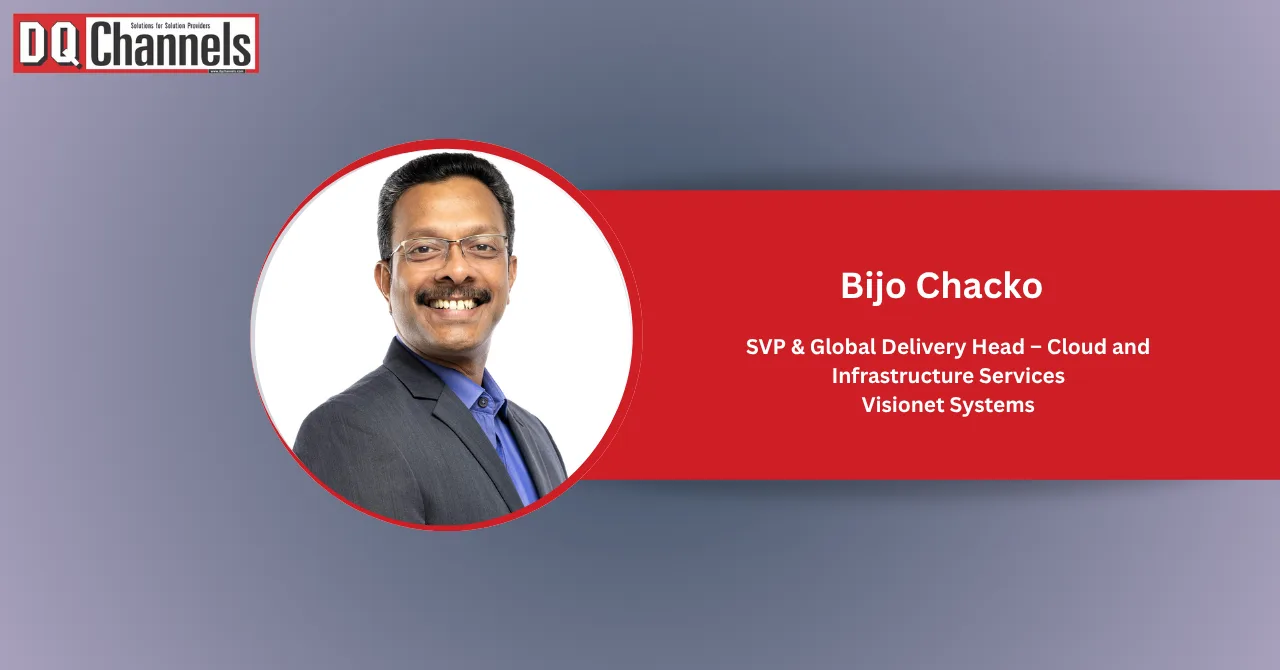
The Indian IT channel is moving into a phase where AI, Cloud, cybersecurity and automation are no longer separate conversations. Customers are increasingly looking for partners that can operate these technologies together, manage their complexity and demonstrate measurable business value. For system integrators (SIs) and managed service providers (MSPs), this is changing both the opportunity and the economics of recurring services.
In an interaction with DQ Channels, Bijo Chacko, SVP & Global Delivery Head for Cloud, Infrastructure and Security at Visionet Systems, outlines why partners need to rethink recurring revenue, automation, delivery efficiency and the role of the technology ecosystem.
Recurring revenue is not the same as recurring profit
Moving customers to managed services can create predictable revenue, but that alone does not guarantee healthy margins. Chacko identifies operational discipline, pricing, automation and the decision to build or buy capabilities as critical factors.
“Recurring revenue does not guarantee recurring profit. That is the single most expensive assumption in this market.”
Partners can run into trouble when they commit to aggressive SLAs and pricing without fully understanding the skills, effort and automation needed to deliver consistently.
Trying to build every capability internally can create another burden. Chacko argues that partners should focus on areas where they have a genuine advantage and use the ecosystem for the rest.
Automation needs to be part of the operating model from the beginning. Manual delivery increases costs as customers are added, while automation, observability and AI can help improve operational efficiency.
The starting point should also be the customer's desired outcome — whether that is availability, security, Cloud cost, productivity or delivery speed — rather than simply selling a service.
Smaller SIs can compete on relevance
Scale is often seen as a barrier for mid-sized system integrators looking to build sophisticated managed services operations. Chacko takes a different view.
“Do not compete on scale. Compete on relevance, agility and the depth of your customer relationships.”
Partners do not need to build a large managed services organisation immediately. Instead, they can identify a few areas where they have strong expertise and where customers have a clear need. Those services can then be made repeatable and efficient before scaling.
The ecosystem can help fill capability gaps. Cloud providers, OEMs, distributors and larger service providers can offer capabilities that may be expensive to develop internally.
Automation is equally important. Monitoring, ticketing, reporting and routine operations can be automated to improve consistency and change the cost curve.
Pricing and SLAs also need discipline. Understanding the true cost to serve and defining the outcomes for which the partner is accountable are essential before setting prices.
AI, Cloud and security are converging
The next recurring revenue opportunity may not sit within one technology category.
“Stop looking at AI, cloud, security and automation as four markets. The money is in converging them.”
Chacko sees the strongest opportunities at the intersection of these technologies. As enterprises move AI workloads into production, they need ongoing support covering infrastructure, monitoring, security, governance, cost optimisation and model operations.
Cloud operations also remains relevant, particularly around FinOps, optimisation, observability and hybrid Cloud management. Cybersecurity has a recurring-service nature because managed detection and response, identity, Cloud security and compliance require continuous attention.
Automation connects these areas.
For partners, the opportunity is therefore shifting from selling individual technology services towards operating an integrated environment and demonstrating measurable value.
“The strongest opportunities will sit at the intersection of cloud, AI, security and automation.”
For Indian channel partners, this points to a model where technical capability, ecosystem partnerships and efficient delivery come together. The goal is not simply to add more services, but to build repeatable managed services that can generate recurring revenue without allowing delivery costs to rise at the same pace.
Read More:
Outcome-led IT operations: How partners can move beyond monitoring
How automation is becoming the backbone of profitable managed services