
Outcome-led IT operations: How partners can move beyond monitoring


As managed services move beyond conventional infrastructure monitoring, customers increasingly expect partners to take responsibility for availability, performance, resilience and user experience. That changes what happens behind the SLA. A technical alert alone is no longer enough. Partners need to understand what happened, identify the affected service, assess the business impact, decide what action is safe and prove that the intervention restored the expected outcome.
This is where observability, AIOps, service mapping, automated remediation, security controls and service-level engineering need to work together.
The operating model is simple: observe, understand the impact, assess the risk, act safely, verify the result and prove the value. The challenge is making that process work consistently across complex customer environments.
Observability needs to explain, not just alert
Traditional IT monitoring remains useful for identifying when a threshold has been crossed. Modern IT environments, however, need more context.
Operations teams need to know why behaviour changed, what is affected and whether users are experiencing an issue. This is where observability becomes important.
Modern observability brings together metrics, logs, traces, events, network information, endpoint signals, security telemetry and user-experience data.
Metrics can show changes in latency, throughput, errors, queue depth, CPU, memory and transaction success. Logs provide evidence of failures and changes, while traces can follow a request across several services to identify where a delay begins.
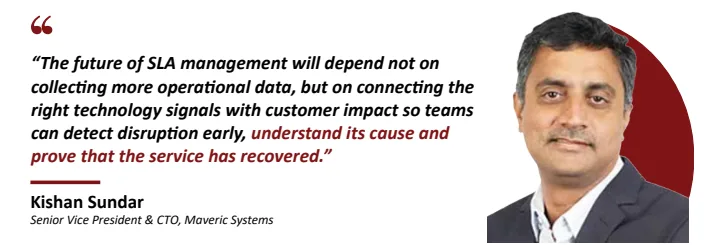
Events add another layer of context. A performance problem appearing after a deployment means something different from the same problem appearing when there has been no recent change.
Digital experience monitoring adds the view that matters most: what happened to the user?
But collecting more data does not automatically create better understanding. A partner can have huge volumes of telemetry and still struggle to explain why a customer checkout is failing.
Correlation is the real challenge
Hybrid IT environments make correlation difficult because different tools can describe the same resource in different ways. Timestamps may not align, services can have different names across platforms, and logs may be unstructured.
Partners therefore need a common operational context.
Services, applications, hosts, users, devices, requests and incidents need stable identifiers. Deployments and configuration changes should be traceable. Telemetry needs enough metadata to identify the environment, owner and criticality of the affected service.
This enables more useful questions: Which customer journey is affected? Which dependency is involved? What changed recently? Is a reliability or security threshold at risk?
The ability to answer these questions is a stronger measure of observability maturity than the volume of telemetry collected.
There is also a commercial consideration. Collecting and storing everything costs money. Managed service providers need enough data for diagnosis, reliability and audit without allowing telemetry costs to erode their managed services margins.
Service mapping gives technical signals business meaning
Observability shows what is happening. Service mapping helps explain why it matters to the business.
A useful service inventory should capture business purpose, criticality, ownership, service-level objectives, recovery requirements and dependencies.
Dependency mapping can then connect applications with databases, APIs, queues, networks, identity services, Cloud resources and third-party platforms. This helps reveal the potential blast radius of a failure.
A database showing high latency may look like a routine infrastructure problem. But if that database supports checkout, payment authorisation and inventory reservation, its priority changes immediately.
The reverse is also possible. A major infrastructure alert may affect an internal reporting system while a smaller technical issue is slowing customer checkout.
Business context allows operations teams to decide which problem matters more. The service map must also remain current because Cloud resources change, applications are updated, and dependencies move. A stale service map can create false confidence.
AIOps should speed up judgement, not replace it
The sheer volume of operational data makes AIOps useful for machine-assisted analysis.
Anomaly detection can identify behaviour that differs from a service's normal pattern rather than relying only on fixed thresholds. Event correlation can group related symptoms into a single incident.
A database problem, for example, may create API timeouts, queue growth, application errors and user-experience alerts. Without correlation, different teams may investigate these symptoms separately.
Predictive analysis can identify approaching capacity limits, recurring failures or rapidly consuming error budgets. Root-cause recommendations can combine telemetry, topology, recent changes and historical incidents to suggest likely explanations.
But AIOps is not an oracle.
A recent change may coincide with an outage without causing it. Telemetry may be incomplete. A service map may be outdated. New workloads may behave differently from historical patterns, and some incidents may have several interacting causes.
AIOps therefore works best as an aid to engineering judgement rather than a replacement for it. The useful progression is to detect, correlate, investigate, recommend, validate and then automate where appropriate.
Automation needs brakes as well as speed
Once a known problem is identified, automated remediation can reduce the time required to begin recovery.
A full disk can be cleared, a failed stateless service can be restarted, or bounded capacity can be increased automatically. Known configuration drift can also be corrected without waiting for manual intervention.
This is where self-healing IT becomes attractive. But it is also where operational risk increases.
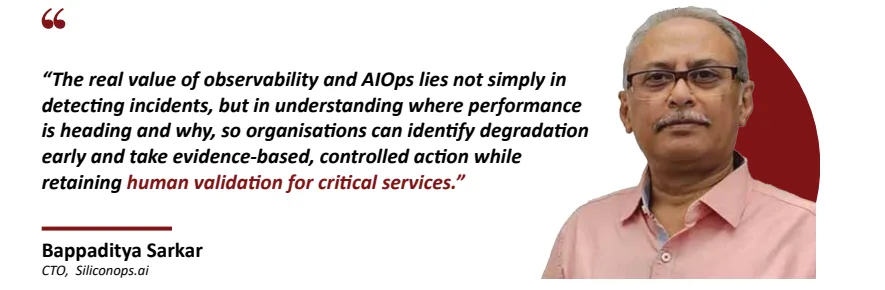
Automation can make a good action faster. It can make a bad action faster too.
A mature automated runbook therefore needs preconditions, permissions, retries, timeouts, success criteria, verification and rollback. More complex recovery may require orchestration so that actions happen in the right order and different workflows do not conflict.
Not every action should have the same level of autonomy. Low-risk and reversible actions may be fully automated, while sensitive changes can require approval. In high-impact situations, automation may be better used to recommend an action rather than execute it.
Good automation is not automation without humans. It is automation that knows when human judgement is required.
Security and SLOs must remain part of the workflow
As automation gains more authority, IT security controls need to become part of the same operating model.
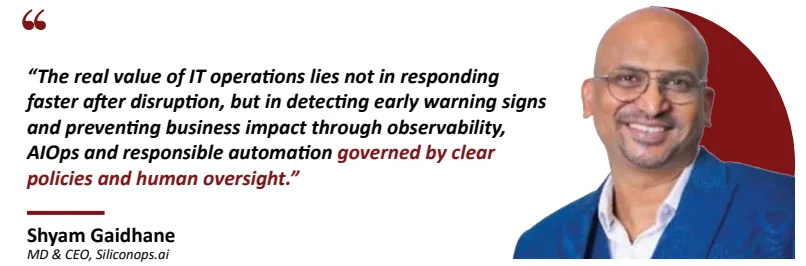
Automated actions require tightly scoped identities, limited permissions, secrets protection and complete audit records. Policies can restrict how many systems are changed at once, block sensitive actions during freeze periods and require stronger approval for production, identity or data changes.
Automation must therefore know not only how to act, but when not to act.
Service-level engineering brings the operating model back to the customer. Service-level indicators and service-level objectives define what reliable service actually means, while error budgets show how much unreliability can be tolerated.
Instead of reporting only infrastructure uptime, partners can measure whether a critical customer journey completed successfully within the expected time.
For a retailer, checkout success may be more meaningful than whether every server remained technically available. For another customer, authentication, order processing, or appointment booking may be the better measure.
Proof of value needs an evidence chain
Once a partner owns an outcome, ticket counts and uptime percentages are not enough. Customers need evidence connecting an intervention to a result.
Detection measures can show how quickly problems were identified. Response measures can track restoration time and the use of tested automation. Reliability measures can show SLO attainment and incident recurrence.
Efficiency can be reflected in reduced manual effort. Business impact can be shown through customer journeys preserved, transactions protected or customer-impact minutes avoided.
The strongest reporting connects these measures into one clear evidence chain. That is far more meaningful than simply saying that AI reduced alert noise.
Start with one important customer journey
Outcome-led IT operations do not have to begin across the entire customer estate.
Smaller and mid-sized partners can start with one or two important customer journeys. The starting point should be something the customer genuinely cares about, such as payment processing, checkout or appointment booking.
Define acceptable availability, latency and transaction success. Then ensure that the supporting metrics, logs and traces are reliable.
A smaller partner that can clearly demonstrate measurable improvement across two critical services may have a stronger outcome story than a larger provider with dozens of dashboards but no clear link to customer impact.
From fixing systems to protecting business journeys
The biggest change in outcome-led operations may be the unit of management itself.
Infrastructure teams traditionally focused on servers, networks and devices. Service management put greater attention on the incident. Outcome-led operations move the focus closer to the customer journey.
Can the user sign in? Can a payment be authorised? Can an order be submitted? Can the business process continue within the expected level of reliability?
Once operations are viewed this way, the different pieces begin to fit together.
Observability follows the journey. Service mapping reveals dependencies. AIOps helps prioritise what matters. Automation acts within defined limits. Security controls protect the intervention, and SLOs show whether the customer experience recovered.
That is when managed services begin to move beyond infrastructure monitoring. They start protecting outcomes.
And that may be the clearest test for the next generation of channel-led IT operations: not how many alerts were processed or scripts were run, but whether the customer's business kept working.
Read More:
Why RST expects RFID to add new mileage to its TSC Auto ID business
What is changing for Sennheiser channel partners in India's AV market
RFID business in India gains momentum as channel sees new opportunities
What keeps a TSC Auto ID partnership going for nearly two decades?







 2 Min read