What is changing for Sennheiser channel partners in India's AV market

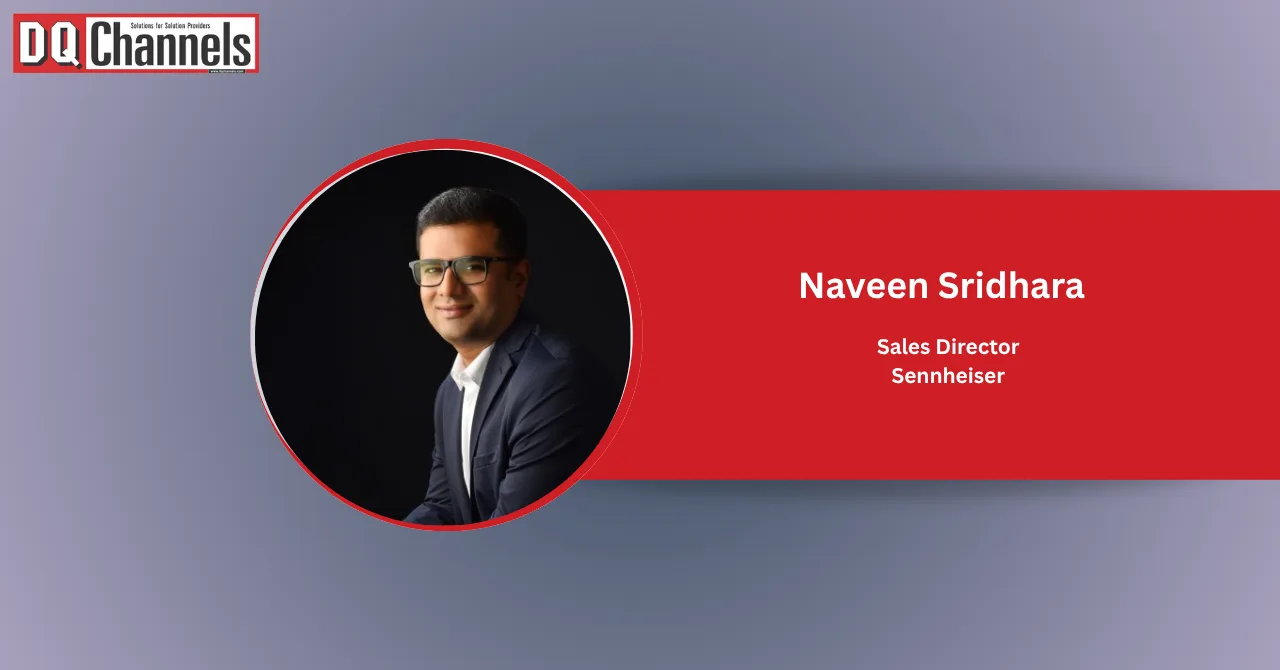
The AV industry is moving into a phase where audio is no longer a standalone requirement. Corporate offices, GCCs, higher education institutions, live events, rental companies and broadcast environments are asking for simpler, more connected and easier-to-manage audiovisual systems. For channel partners, that shift is creating a different kind of opportunity, one that goes beyond selling hardware. Naveen Sridhara, Sales Director, Sennheiser, explains how the company is bringing its portfolio together, working more closely with AV system integrators and using new technologies such as Spectera and TeamConnect Ceiling Medium Plus to address changing customer needs.
Sennheiser is bringing its AV portfolio closer together
Sridhara has spent about 26 years in the audio industry, including more than three years with Sennheiser. Before that, he worked with Beyerdynamic, Bose and Apple. His career has remained focused on audio, giving him a long view of how the market and its channels have changed.
One major change inside Sennheiser is what the company calls “One Sennheiser”. From July 1, the organisation brought its professional audio and business communication portfolios together around four focus segments: corporate, higher education, live and rental, and broadcast and recording.
The reasoning is straightforward. A corporate customer may now need more than a conference-room microphone. GCCs, for example, may use their event spaces for town halls, streaming, recording and internal podcasts. That means a customer entering through one requirement can have several other audio needs.
“We said, you know, with this One Sennheiser, that when we go to a customer, we will only look at the segment of the customer and provide him with all possible audio solutions from Sennheiser rather than, you know, a professional and a business communication.”
For channel partners, this creates a broader conversation with the customer rather than a product-led one.
Spectera could change the equation for rental partners
Wireless audio deployment is another area where Sennheiser sees room for channel growth. Sridhara points to Spectera, which he says was launched for rental companies and has already been used for several shows. The proposition is less about adding another piece of equipment and more about reducing the complexity of setting up wireless audio.
According to Sridhara, Spectera can provide 64 channels, with 32 transmitting and 32 receiving in one rack. The system also uses Ethernet connectivity, including Cat 5 between the device and antenna. For rental companies, he says, this can reduce cable-related issues and make setup easier.
Setup time matters in the rental business because equipment has to be tested before an event. Reliability matters too. Sridhara sees the combination of hardware and software as a key part of the proposition.
“This is something which, you know, we are selling convenience. Technology, no doubt.”
The platform can also be expanded through software licensing. Sridhara explains that customers can add channels using the same hardware instead of buying additional hardware each time. He also connects the smaller physical footprint with sustainability, noting that a 32- or 64-rack-unit setup can be consolidated into one new rack.
AV system integrators have a bigger role to play
Sennheiser's partner opportunity is not limited to traditional audio resellers. Sridhara specifically points to Audio Visual System Integrators, or AVSIs, which work across audio, immersive video, network operation centres, convention centres, auditoriums, training rooms and boardrooms.
For these partners, the company is positioning its systems around integration and ease of deployment. Sridhara says Sennheiser's systems are Teams-certified and Zoom-certified, with the company working on the backend to support certification.
The TeamConnect Ceiling Medium Plus is another example. Sridhara says it offers wider coverage than the earlier TCCM and improved active dynamic beamforming for camera tracking. The idea is what Sennheiser calls “touchless audio”, where a microphone can pick up the speaker and send the signal to the camera without an operator intervening.
The integration story extends to other technology platforms. Sennheiser has partnered with Q-SYS through PartnerLink and plans to extend such alliances to Crestron and other partners. In large GCC deployments with 100 or 200 rooms, Sridhara believes reducing deployment time can be a significant advantage.
From hardware sales to easier deployment and remote management
For AV integrators, the opportunity also lies in simplifying systems for customers that do not have specialist AV teams.
Sridhara points to large corporate meeting setups where facility managers may not be AV experts. Complex cabling, multiple antennas and boosters can make audio difficult to manage. Spectera, he says, can simplify the setup and also allow remote management.
That changes the partner conversation. Instead of only installing equipment, an integrator can be involved in deployment, configuration and ongoing management of the audio environment.
Sennheiser is also putting more effort into partner education. Its programme includes classroom training across three cities, hands-on demonstrations at partner offices and the Sound Academy portal. Partners can access material covering applications, presentations and configurations and receive certification after completing a test. The company also has a tie-up with AVIXA for RU points.
GCCs, education and public sector emerge as key opportunities
Sridhara does not rank every segment in the same way because demand can change with the business cycle. Within corporate, however, he identifies GCCs as the fastest-growing segment. He points to organisations that may start with 50 or 100 people and expand to 2,000, creating a need for new technology and better internal customer experiences.
Higher education is another opportunity, particularly B-schools and Institutes of National Importance. Rental companies remain important as well, with demand extending beyond conventional entertainment into corporate events and employee programmes. Public-sector organisations are also identified as a focus area for audiovisual technology.
Timing, however, differs by segment. Sridhara says rental activity can pick up between October and December around festivals and events, while multinational companies may slow down towards December and see investment increase in the first quarter. Government spending can also be stronger between January and March.
Sennheiser wants to be an ecosystem partner
The wider strategy is not to build every part of an AV system. Instead, Sennheiser wants to concentrate on the areas where it believes it has specialised audio capabilities while working with other ecosystem players.
“For us, it is about us continuing to be the leaders when it comes to audio. And we want to be an ecosystem partner.”
That approach is also visible beyond traditional professional audio. Sennheiser is working on automotive applications where its contribution is software and algorithms for ambient and immersive sound rather than loudspeaker hardware. Sridhara says the company is working with global car manufacturers, while any future engagement with Indian manufacturers would depend on those OEM relationships.
For India's AV channel, the message is fairly clear. The opportunity is shifting from selling individual audio products to helping customers deploy systems that are simpler, more integrated and easier to manage. Sennheiser's strategy places AVSIs, rental companies, distributors and dealers within that broader ecosystem, while business development and partner training are being used to create demand.
The next phase of AV may therefore be less about the box being sold and more about what happens after it reaches the customer.
Read More:
RFID business in India gains momentum as channel sees new opportunities
What keeps a TSC Auto ID partnership going for nearly two decades?
TSC Auto ID expands channel focus as RFID opens new opportunities
Online Vs. Offline: Nehru Place comments on E-commerce business model







 2 Min read