
Salesforce Partners: Why AI is changing the channel opportunity

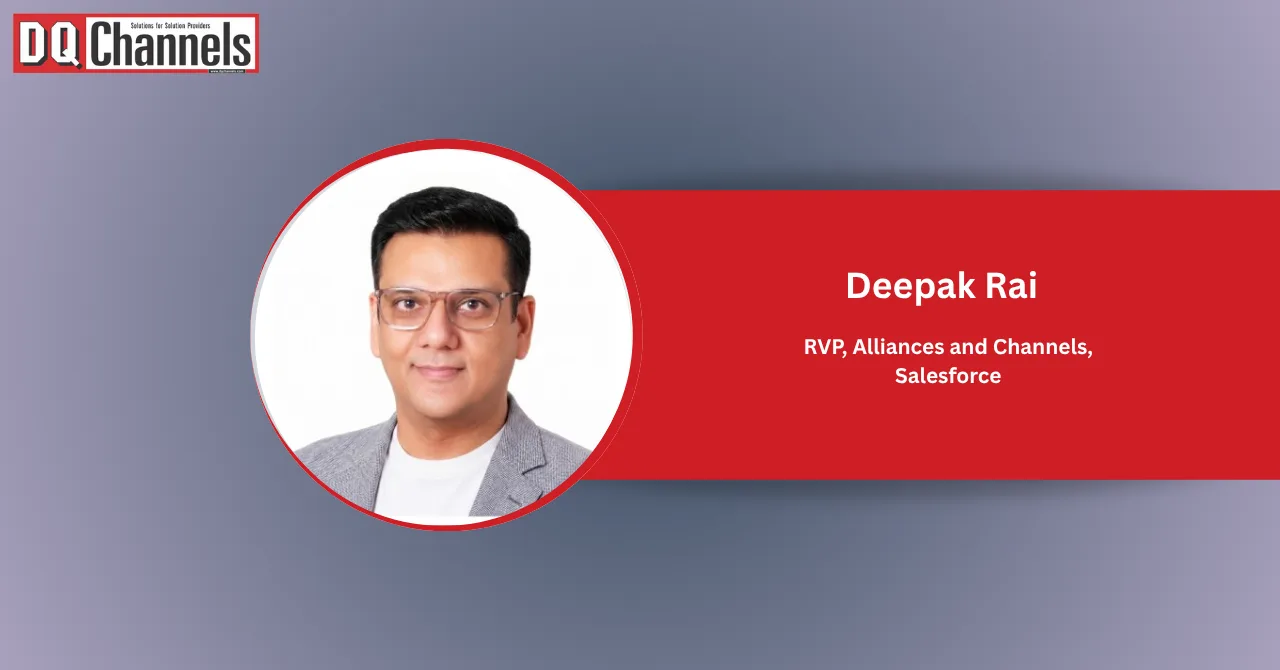
AI is moving enterprise technology conversations beyond software procurement. For Salesforce partners in India, the opportunity is increasingly tied to data, integration, business processes, governance and measurable outcomes. Deepak Rai, RVP, Alliances and Channels, Salesforce, says partners now need to rethink their role as enterprises move from AI pilots towards production deployments.
Rai has been with Salesforce since 2018. He joined as an alliances manager and later led the partner relationship management team. In his current role, he works across partner relationships and drives partner GTM, strategy and business for Salesforce India.
AI adoption is becoming an execution challenge
According to Rai, Indian enterprises have responded positively to AI. But enthusiasm alone will not be enough to scale deployments.
Enterprises need to establish where their data sits, whether it is connected and how AI will integrate with core workflows. They also need to consider how employees will adapt to the technology and whether governance and guardrails are in place.
Rai says Salesforce research in India found that around 38% of the Indian workforce had seen unsuccessful targets while 34% said the results lacked business context. His broader point is that AI has to be connected to business context, data, processes and people to become relevant.
AI will become relevant when it is stitched into the context, stitched into data, stitched into processes, and people start working on it.
That creates a larger role for partners. Rai believes the partner lifecycle now starts at the advice stage and extends through architecture, deployment, integration and measuring success. Partners can also help customers extend successful deployments into newer functions.
Salesforce partners need to look beyond procurement
The availability of Salesforce products such as AgentForce and Data360 through AWS Marketplace in India could make procurement easier for customers. Rai, however, does not see procurement as the end of the partner opportunity.
He says customers will still need help deploying the technology, integrating it into their environments and ensuring that they achieve business value after purchase. The conversation can therefore move from procurement mechanisms towards questions around transformation, unified data and AI outcomes.
For system integrators and managed service providers, this means there is room to remain involved well after a product has been procured.
Rai also expects commercial relationships between partners and customers to become more strategic as partner responsibilities expand across data, cybersecurity, integration, workforce enablement, governance and adoption.
Data could become a major partner opportunity
One of Rai's strongest messages for Salesforce partners is around data.
He says organisations often do not lack data. The bigger problem is that data remains fragmented across multiple systems without a unified view. This creates an opportunity that goes well beyond basic data management.
Partners can support the wider data lifecycle, including data discovery, ingestion, integration, migration, modernisation, governance, identity, activation and data quality management.
Strong, trusted, unified data becomes the main key strategy for any enterprise customers to gain value out of AI.
Governance will become particularly important as AI agents begin taking actions. Rai points to the need for controls around permissions, identity, privacy, security, auditability and human escalation.
For channel partners, this opens a wider services opportunity around data integration, governance and ongoing management.
AI production creates a post-deployment opportunity
Indian enterprises are now looking beyond AI pilots and considering production deployments. Rai says customers are approaching this transition carefully.
They are looking for well-defined use cases, a trusted data strategy, workflow integration, guardrails for agent actions and measurable business outcomes.
For partners, the opportunity does not end once a use case goes live. Rai sees significant potential in expanding successful workflows by connecting additional data sources, adding new use cases and automating adjacent processes.
The sky becomes the limit once the workflow starts working for one use case.
He cites a large lending organisation where an agent platform implementation reduced the turnaround time for processing an application by 80%, from around 20 days to 30 minutes. The implementation is ongoing, with expectations of reducing errors in loan processing by 75% and cutting manual handovers by around 35%-37%.
The next Salesforce partner will combine technology and domain expertise
Rai believes partners now need to re-pivot rather than wait for the market to settle.
This is not the time where partners need to wait and see how things are moving, because then they will miss the bus.
He sees the next generation of leading Salesforce partners combining product and solution capabilities with domain knowledge and business process expertise. Knowing how to deploy technology will not be enough. Partners will need to understand where agents get their data, which processes they can automate, which use cases make sense, what business outcomes can be delivered and what guardrails are required.
IP-led offerings will also matter. Rai points to industry-specific use cases, repeatable assets, solution-based assets and accelerators that can shorten deployment cycles and help customers realise value faster.
His longer-term view is clear: the strongest Salesforce partners will move from being system integrators towards digital transformation and managed services roles.
Partner enablement becomes part of the transition
Salesforce is also focusing on partner enablement and skill development, according to Rai. The programmes cover areas including sales, resale and implementation. Salesforce also conducts partner open houses and uses its internal Slack channel to share updates, information and customer use cases.
Rai says Salesforce Days enabled around 75,000 learners last year, largely around understanding Salesforce, its direction and its evolution.
For India's channel ecosystem, the message is therefore less about selling another AI capability and more about building the expertise needed to make AI work inside real enterprises.
The strongest Salesforce partners will be the ones who evolve from being system integrators, to being the digital transformation and managed services partners for the customers, who bring out the true value for the customers.
Read More:
Warranty under pressure: Nehru Place channel raises questions






 2 Min read