
Nutanix explains how hybrid multi-cloud services will define channel growth

The enterprise infrastructure landscape is becoming increasingly complex. Organisations today operate workloads across private data centres, public clouds and edge environments while simultaneously preparing for AI-driven applications and cloud-native architectures. This growing complexity is reshaping the role of channel partners, who are now expected to simplify operations, modernise infrastructure and help customers build long-term digital resilience rather than simply deploy technology.
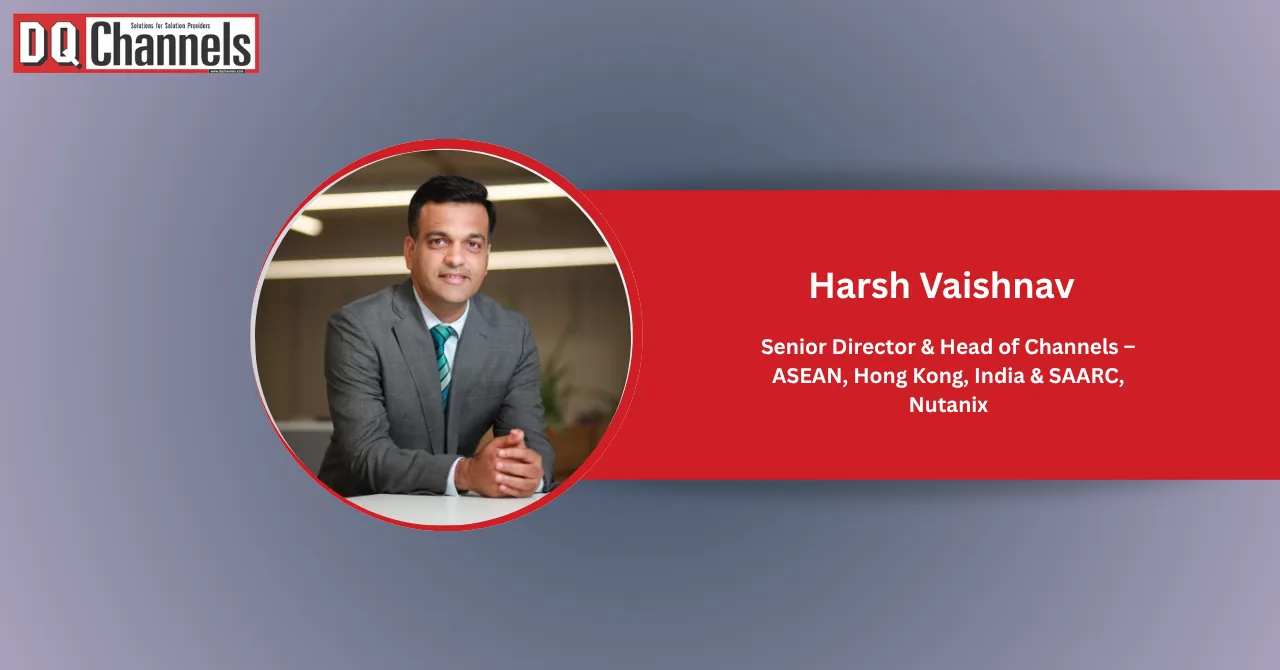
Speaking to DQ Channels, Harsh Vaishnav, Senior Director & Head of Channels – ASEAN, Hong Kong, India & SAARC, Nutanix, said the next phase of channel growth will belong to partners that focus on customer outcomes rather than infrastructure transactions.
"Selling subscriptions can only become successful when you move beyond selling a box. Partners have to focus on owning customer outcomes."
Hybrid multi-cloud complexity is expanding the partner opportunity
According to Vaishnav, enterprises are increasingly operating applications across private cloud, public cloud and edge environments, making consistency across infrastructure more important than ever.
He believes organisations need a common operating model that simplifies deployment and management regardless of where applications and data reside.
"You need something that gives consistency across private cloud, public cloud and the edge, with seamless deployment across fragmented environments."
Alongside hybrid multi-cloud adoption, enterprises are also accelerating investments in AI infrastructure and application modernisation. This combination is creating what Vaishnav described as an "infrastructure reality gap", where organisations require modern platforms without undertaking disruptive architectural changes.
He believes channel partners are ideally positioned to bridge this gap by helping customers modernise infrastructure while controlling operational complexity.
Simplification is becoming the partner's biggest value proposition
Vaishnav argues that one of the biggest challenges facing enterprises today is infrastructure fragmentation, which increases operational overheads and affects profitability for managed service providers.
Rather than introducing additional management tools, partners should focus on reducing complexity through consistent operating models spanning virtual machines, containers and AI workloads.
"The biggest role partners are playing today is helping simplify increasingly fragmented environments."
He explained that Nutanix enables customers to manage workloads across on-premises environments, edge locations and public clouds through a unified operating model.
This reduces the number of tools, specialised skills and operational processes required to deliver managed services, allowing partners to improve service efficiency while protecting margins.
Automation is becoming central to profitable managed services
As managed services continue expanding, automation is becoming increasingly important for partners looking to scale operations without proportionally increasing costs.
Vaishnav highlighted Nutanix Cloud Manager as an example of how routine operational tasks, capacity planning and lifecycle management can be automated to reduce manual intervention.
He also pointed to the company's Kubernetes platform, which supports production-grade lifecycle management, governance and monitoring across hybrid and multi-cloud environments.
"Partners can standardise operations and deliver Kubernetes as a managed service with very little operational overhead."
Beyond platform capabilities, Nutanix continues expanding integrations with ecosystem providers across infrastructure monitoring and observability, enabling partners to deliver comprehensive managed service offerings while maintaining operational consistency.
Recurring revenue requires aligned commercial models
Vaishnav acknowledged that moving from project-based engagements to recurring revenue creates financial challenges for partners, particularly as they invest in new skills, service capabilities and cloud platforms before revenue is fully realised.
He believes technology vendors must support this transition through subscription-based offerings, partner incentives and continuous enablement.
"Success in a recurring revenue world requires more than just a great platform. It requires alignment between commercial models, partner programmes and ecosystem investment."
According to Vaishnav, Nutanix has aligned its platform portfolio around subscription and consumption models, enabling partners to build recurring managed services around hybrid cloud, cloud-native applications and enterprise AI rather than relying on one-time infrastructure deployments.
The company has also expanded technical training, specialisation programmes and joint go-to-market initiatives to strengthen partner capabilities across high-growth technology areas.
Customer retention begins long before renewal
While acquiring new customers remains important, Vaishnav believes subscription businesses increasingly depend on customer retention and long-term adoption.
He explained that Nutanix begins renewal planning approximately six months before contracts expire, giving partners sufficient time to assess customer adoption, identify expansion opportunities and strengthen engagement before formal renewal discussions begin.
"Every renewal begins long before the renewal date."
Partner tools also provide visibility into upcoming renewals, certifications, incentives and adoption insights, enabling partners to move beyond transactional renewals towards broader account expansion.
According to Vaishnav, this structured approach has helped strengthen customer retention while supporting long-term recurring revenue growth.
Platform services will create the strongest growth opportunities
Looking ahead, Vaishnav expects opportunities to emerge across multiple technology areas rather than a single market segment.
Hybrid multi-cloud operations, AI infrastructure, disaster recovery, cloud-native applications and containerisation will all contribute to future partner growth.
He believes AI adoption will significantly accelerate demand for container-based applications while increasing the need for governance, security, infrastructure optimisation and workload management.
"Partners who change their approach from being infrastructure-centric to becoming platform-centric are the ones who will benefit in a big way."
Rather than concentrating on infrastructure deployment alone, partners should focus on helping customers operate, optimise and continuously evolve increasingly complex technology environments.
Building long-term partnerships through expertise
Vaishnav also stressed that successful partner ecosystems depend on capability rather than scale alone.
While Nutanix continues expanding its partner ecosystem, he said the company's emphasis remains on developing deeper relationships with partners that demonstrate strong technical expertise, customer commitment and the ability to support long-term transformation initiatives.
He believes revenue is ultimately the outcome of skills, customer understanding and execution rather than the primary qualification for partnership.
The future belongs to platform-first partners
Harsh Vaishnav's perspective reflects a broader shift across enterprise infrastructure. As hybrid multi-cloud environments, AI infrastructure and cloud-native applications become increasingly interconnected, channel partners are moving beyond technology deployment towards continuous platform management and business transformation. The strongest opportunities will belong to partners that simplify operational complexity, automate service delivery and help customers continuously modernise their environments. In an increasingly subscription-driven market, long-term profitability will depend not on selling infrastructure but on delivering measurable business outcomes through platform-led managed services.
Read More:
Why AI security is becoming the biggest growth opportunity for channel partners
From ERP to ERX: How AI Is Turning Planning into Intelligent Execution








 2 Min read