
Warranty under pressure: Nehru Place channel raises questions


India's technology channel has a simple expectation when it sells a product: if the product carries a manufacturer's warranty, that commitment should remain clear when the customer needs it.
But conversations during a visit to Nehru Place suggest that this basic expectation is becoming harder to manage.
In discussions at their offices, Swaran Singh, General Secretary, ADCTA, and K.S. Oswal, Director, RR Systems and a key body member of ADCTA, and Vineesh Agarwal, Broadway Computers, described warranty as one of the growing pain points for distributors and dealers. Other channel voices spoken to during the visit also echoed concerns around warranty.

There are issues in general. Several brands are reportedly taking a longer period of time to address the issues related to warranty. Customers feel betrayed when the replacement or repair issues are mitigated, taking a longer period of time than the usual expected turnaround time.
But the issue becomes particularly sharp around a recent issue of Crucial, where questions were raised over imported stock, warranty eligibility and what happens to products already sold through the channel when policies or business arrangements change.
The concerns are coming from the channel. They should therefore be viewed as channel perspectives and claims from the people interviewed, rather than established findings against any company. Swaran Singh, General Secretary, ADCTA, stated -
“The issue is that the warranty part of the company is also not available.”
When warranty becomes the dealer's problem
For Swaran Singh, the problem starts with the process itself.
According to him, customers can be asked to register for warranty and then wait for the request to be processed. The process can become time-consuming, leaving the customer dependent on the dealer who sold the product.
“First send a mail request. Then a number will be generated from there.”we quoted Swaran.
That creates a familiar situation in the channel. The manufacturer owns the warranty, but the dealer owns the customer relationship.
When something goes wrong, the customer often comes back to the seller.
Vineesh Agarwal also shared his perspective,
"The process itself is tedious to register the complaint for the cusomers."
He explained that customers with limited tech knowledge can't follow the long process of registering the complaint with the customer service agents, where they are asked several technical questions. Hence, they reach out to the resellers or distributors for assistance.
For a distributor or dealer operating on relatively tight margins, this adds another layer of work to the transaction.
The concern is not simply about whether a warranty exists. It is about how easily the customer can use it. Swaran shared one of these concerns -
“If someone's hard drive is shut down, then people will keep waiting. He will have to buy a new one. This is not a system."
The Crucial question: genuine product, but what about warranty?
The most pointed part of the discussion concerns Crucial, a brand owned by Micron Technology.
In addition to this, Oswal referred to material that he says was purchased through the market and to a communication from Crucial concerning imported material and warranty eligibility.
His concern is straightforward: if a product is genuine but has entered the market through an import route that the manufacturer does not recognise for warranty, who carries the responsibility once that product reaches the customer?
That question becomes particularly important for distributors who may not have visibility into every stage of a product's supply chain.
Oswal also stresses that legitimate distributors have an incentive to avoid such uncertainty.
His comments also show that the issue is not simply about blaming vendors. He acknowledges that imported and unauthorised products can create problems for the channel itself.
The distinction matters:
Counterfeit product, grey import and genuine product sold outside an authorised route are not necessarily the same thing.
The conversation does not independently establish the status of the specific Crucial material discussed. The issue raised by Oswal is about warranty eligibility and responsibility, and that is how it should be understood.
“Whatever I sold, I sold it to the company. So that the customer gets a warranty for all over India.”
What happens when the policy changes?
The bigger concern goes beyond one product.
Oswal questions what happens when a company changes its business or distribution policy after products have already entered the channel.
Here, the point to be noted is that Micron announced that they have phased out the Crucial consumer memory brand in February, 2026.
Crucial has revised the warranty period for its Crucial Basics (CB) memory modules based on the purchase date. They have shared an official letter with their dealers and distributors.
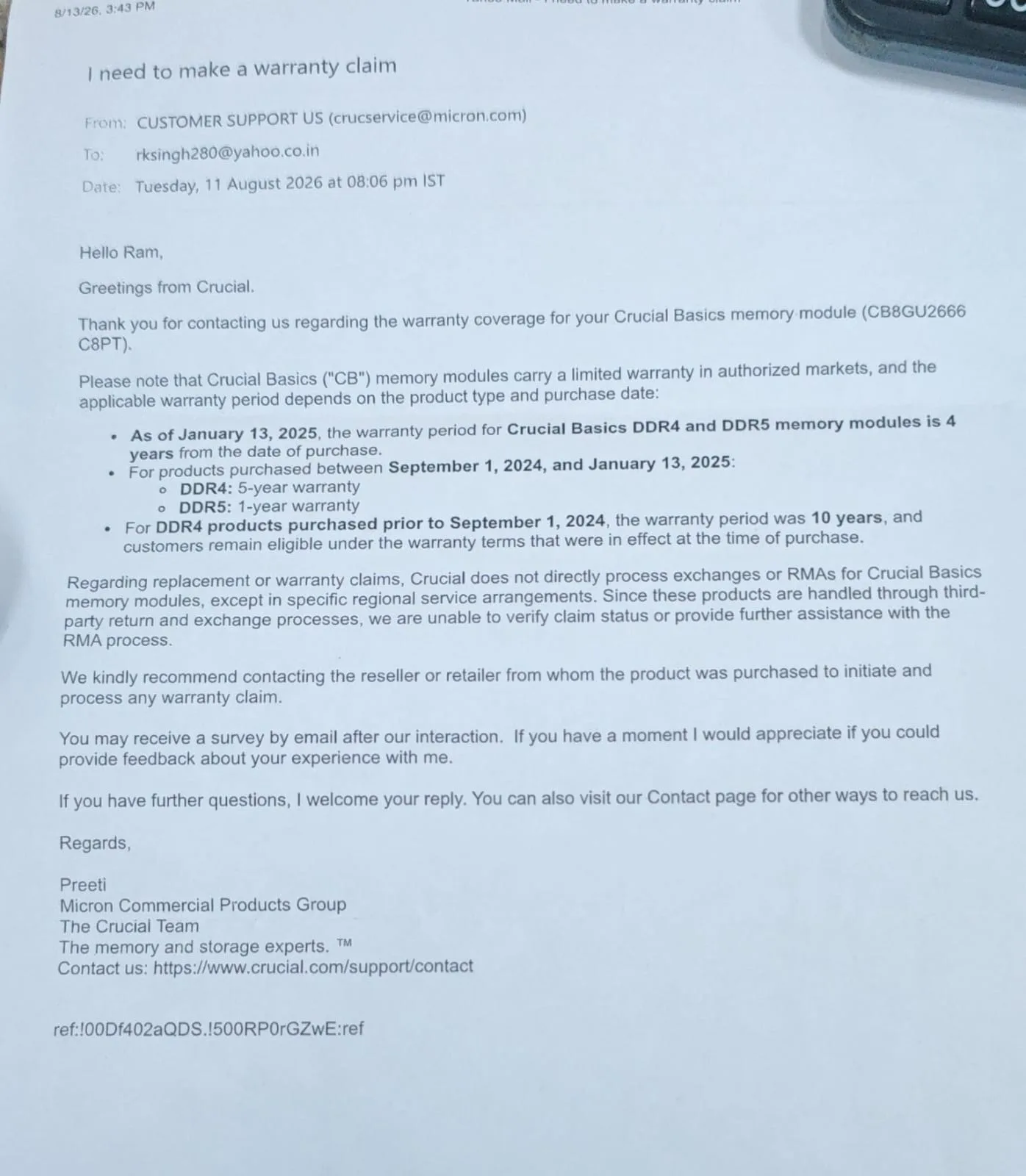
As mentioned in the official letter above, from 13 January 2025, both DDR4 and DDR5 modules carry a four-year warranty from the date of purchase. For products purchased between 1 September 2024 and 13 January 2025, DDR4 carries a five-year warranty, while DDR5 carries a one-year warranty. DDR4 products purchased before 1 September 2024 remain covered under the 10-year warranty terms that were applicable at the time of purchase. For warranty claims, Crucial advises customers to contact the reseller or retailer from whom the product was purchased, as Crucial does not directly process exchanges or RMAs for Crucial Basics memory modules except under specific regional arrangements.
Now this also raised concerns among the distributors that, at the time of sale of the products, they didn't have this information, and they sold the DDR4 and DDR5 according to the previous terms of a 10-year warranty, and now they have reduced this duration.
Now this leads to a trust issue for the customers, and it is the resellers and distributors who will be questioned by the consumers.
In this context, Oswal argues that a distributor may have bought stock under one set of warranty expectations and sold it to customers on that basis. If the policy subsequently changes, the distributor can be left facing the customer.
“If the company is shutting down, it doesn't mean that you can suddenly change your policy.”
This is where the channel's inventory problem comes into focus.
Products do not always move from manufacturer to customer immediately. Stock can remain with distributors and dealers before being sold. If the warranty clock runs independently of the actual sale, channel inventory can become a risk.
Oswal argues that the warranty should be linked to the sale transaction, particularly when the product has been legitimately stocked and sold by the channel.
For the dealer, the issue is practical. The customer does not necessarily care when the distributor received the product. The customer looks at the invoice and the warranty promised at the time of purchase.
The dealer often becomes the warranty desk
Singh, Oswal, and Agarwal's comments converge on another important issue: the dealer frequently ends up doing work that technically belongs to the manufacturer.
Customers may not understand:
How to register a warranty claim
Which technical details to provide
How to explain a hardware failure
Where to submit the product
Which service centre to approach
Whether an imported product qualifies
Oswal says many customers simply do not have the technical knowledge to explain a hardware problem in the way an online warranty process expects.
“How can the customer explain in such detail?”
The dealer, meanwhile, already understands the customer's system and the product purchased.
So the customer returns to the dealer.
That makes warranty support part of the dealer's customer-service responsibility, whether or not the manufacturer formally recognises that role.
Singh puts the channel's experience more directly:
“All the businessmen and corporates when they buy things, they don't even know how to get a warranty. Then they come back to our dealer network.”
The channel wants a simpler model
Oswal's preferred approach is relatively straightforward: the customer presents the product and the purchase invoice, and the warranty process begins from there.
He points to models where warranty is honoured based on the sale documentation and argues that this is easier for both the customer and the channel.
“The warranty should be like this. And the process should be simplified.”
His broader demand is for a standardised and India-friendly warranty process.
That means fewer technical hurdles, clearer documentation and less ambiguity over who is responsible for the claim.
For distributors, simplicity matters because every additional step can eventually return to them as a customer-service issue.
The distribution chain matters
The conversations also raise a wider question about how manufacturers manage their distribution networks.
The channel operates through multiple layers - national distributors, regional distributors, resellers and dealers. Each has a role in moving products and supporting customers.
When a warranty problem emerges, however, the customer often starts at the bottom of that chain.
That makes clear rules important.
The channel wants to know:
- Who is responsible for warranty?
- Does that responsibility change when distribution arrangements change?
- How can a customer verify warranty eligibility?
- What happens to stock already sitting with distributors?
- How should imported products be treated?
- Who supports the dealer when the manufacturer rejects a claim?
These are not merely operational questions. They affect channel confidence and the willingness to stock a product.
Crucial's position
According to an unofficial statement from our resources during the conversation, the company’s position was that resellers should purchase products through its authorised distribution network. The spokesperson referred to authorised distributors and indicated that warranty support is linked to products moving through the appropriate distribution channel.
The response is important because it provides the vendor-side context to the concerns raised by the ADCTA representatives. While the channel is asking for greater clarity around warranty eligibility, imported products and verification, Crucial's position, as captured in the conversation, points customers towards its authorised distribution network.
Why this matters beyond Crucial
The Crucial discussion is the immediate trigger for the concern, but the issue raised by the Nehru Place channel is broader.
A distributor makes an investment when it carries inventory. A dealer makes another investment when it sells that inventory and takes responsibility for the customer relationship.
If warranty terms are unclear, the commercial risk can move down the chain.
That is why Singh's and Oswal's comments are significant from a channel perspective. Their concern is ultimately about accountability.
The manufacturer promises the warranty. The distributor moves the product. The dealer sells it. The customer expects the promise to be honoured.
When that chain works, everyone benefits. When it breaks, the customer usually knows only one thing: the product was bought from the dealer.
And that is where the pressure lands. K.S. Oswal stated,
“Warranty and liabilities lies with the principal company.”
For the Nehru Place channel, the demand is therefore not complicated. It is for clearer warranty commitments, simpler processes, better product traceability and greater certainty over who carries responsibility when something goes wrong.
The warranty-related concerns put that demand under a sharper spotlight. But the larger message from the market is about trust: if the channel is expected to sell and support a product, it needs confidence that the manufacturer's warranty commitment will remain intact after the sale.
Disclaimer: The Crucial-related claims in this article are attributed to the channel representatives interviewed during the Nehru Place visit.
Read More:
Building Delhi’s digital muscle: A dialogue between PCAIT and CM Rekha Gupta
ASIRT Synergy Biz Conclave 2026: From trusted relationships to new business opportunities
ASIRT Synergy Biz Conclave 2026 Highlights Cybersecurity, Networking and Channel Opportunities





 2 Min read