/dqc/media/agency_attachments/2026/08/21/2026-08-21t061716244z-dq-channels-logojpg-2026-08-21-11-47-17.jpeg)

/dqc/media/media_files/2026/09/10/dq-channels-whatsapp-2026-09-10-17-07-48.png)

 Follow Us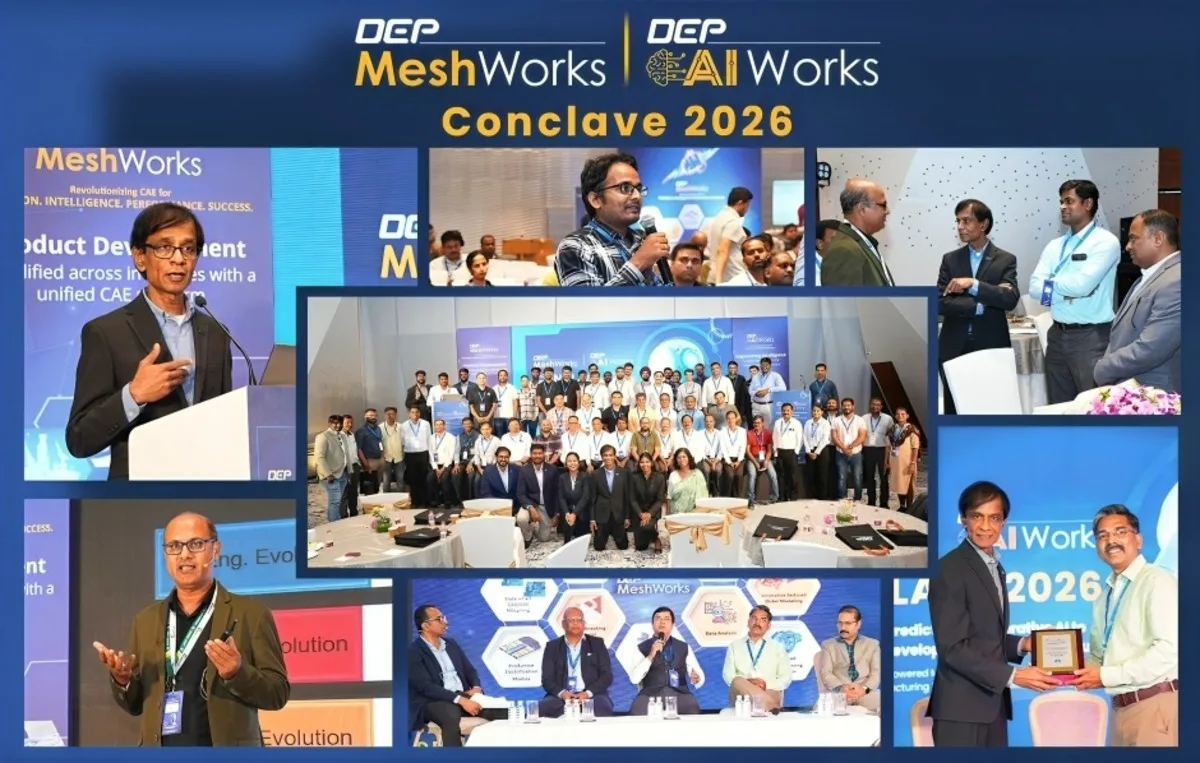
The launch of DEP AIWorks signals a clear shift in how engineering teams are expected to approach product development. Instead of treating AI as a separate tool, the platform brings it directly into the core engineering workflow, combining machine learning with physics-based simulation. This approach reflects a growing need for systems that do more than automate tasks, moving towards environments that can support decision-making across the entire product lifecycle, from early design stages to validation and manufacturing.
Blending AI with physics for practical outcomes
At the heart of DEP AIWorks is its ability to combine predictive AI, generative capabilities, and simulation-driven intelligence within a single environment. Built on the foundation of the MeshWorks platform, it integrates neural networks and physics-informed models with established CAE solvers, ensuring that outputs are not just fast but also aligned with real-world engineering conditions. This balance between speed and accuracy is critical, especially in industries where simulation results directly impact safety, cost, and performance.
Flexibility becomes a key differentiator
One of the defining aspects of DEP AIWorks is its physics-agnostic and tool-agnostic design, allowing organisations to work across different datasets, domains, and stages of development without being locked into a specific system. This flexibility enables engineering teams to move seamlessly from design exploration to validation, while maintaining consistency in data and processes. In a landscape where multiple tools often create silos, this unified approach simplifies workflows and reduces friction across teams.
Speed, scale, and smarter engineering workflows
The platform introduces a modular and scalable architecture that supports adaptive model training, rapid prediction, automated parameterisation, optimisation, and generative design, all within a centralised data environment. This allows engineers to build and deploy models in weeks instead of months, while also reducing simulation turnaround times from hours to minutes. As a result, teams can iterate faster, test more scenarios, and make decisions with greater confidence, ultimately improving productivity without compromising engineering rigour.
Expanding across industries and use cases
DEP AIWorks is designed to support a wide range of sectors, including automotive, aerospace, energy, manufacturing, and telecom, highlighting its role as a cross-industry platform rather than a niche solution. By combining data-driven learning with physics-based validation, it enables organisations to shorten development cycles and respond more quickly to changing requirements, which is becoming increasingly important in competitive and fast-moving markets.
Built on an evolving ecosystem
The platform is not positioned as a standalone offering but as part of the broader DEP ecosystem, working alongside MeshWorks to extend its capabilities into AI-driven workflows. This integration ensures that organisations can adopt new technologies without losing the depth and reliability of existing engineering processes, creating a smoother transition towards intelligent engineering India is gradually moving towards.
Final thoughts
DEP AIWorks reflects a broader shift in how engineering will evolve in the coming years, where AI is no longer an add-on but a core part of product development. By combining generative AI for product development with simulation-driven validation, the platform points towards a future where speed, accuracy, and scalability work together. For engineering teams, the real value lies not just in faster results but in building smarter, more connected workflows that can keep up with rising complexity.
Read More:
Check Point March 2026 report reveals a quieter yet riskier cyber threat shift
HP Latex FS70 W signals a shift in high-speed print workflows
Freshworks names Kuntal Vahalia as SVP global channels to lead upmarket surge
How Statustronics evolves from box-moving to value-addition to partner eco-system