
Check Point March 2026 report reveals a quieter yet riskier cyber threat shift


The Check Point March 2026 report presents an interesting contradiction. On paper, global cyber-attacks dropped slightly, with organisations facing an average of 1,995 attacks per week, marking a 5% decline compared to last year. But this dip does not signal relief.
Instead, it points to a shift in attacker behaviour, where threat actors are recalibrating their strategies, testing new entry points, and adapting to the expanding digital footprint of modern enterprises. The numbers may suggest stability, but the underlying message is clear—attackers are not slowing down, they are evolving.
Sector-wise targeting reveals familiar and new pressure points
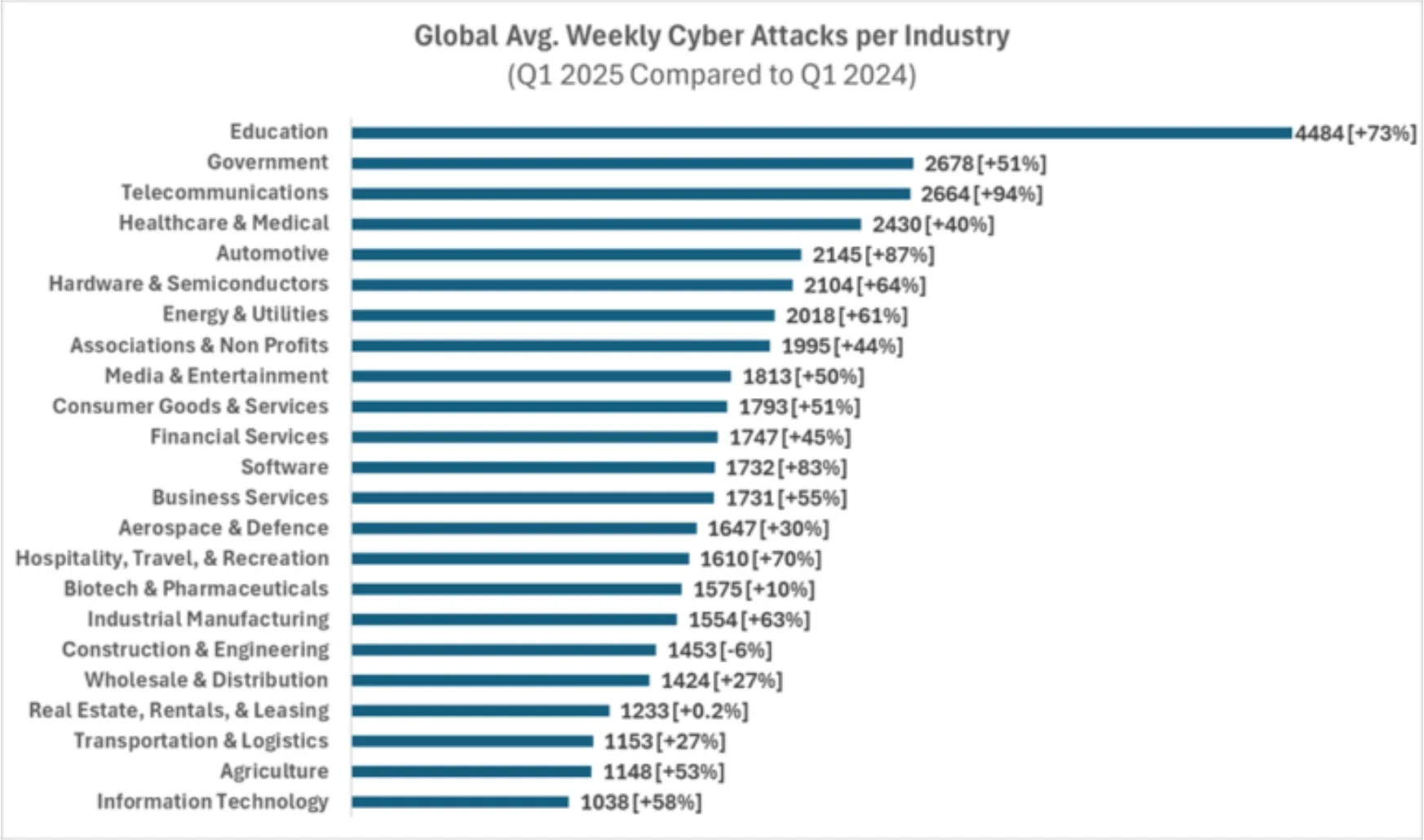
The cyber threat landscape continues to show predictable patterns, with education, government, and telecom sectors remaining the most targeted. Education alone faced over 4,600 weekly attacks per organisation, even after a slight year-on-year drop. Government and telecom followed closely, indicating that critical infrastructure and public-facing systems remain highly exposed. At the same time, a notable shift appeared in the hospitality, travel, and recreation sector, which saw a sharp 30% increase in attacks.
This surge aligns with seasonal demand, where increased transactions and third-party dependencies create more opportunities for exploitation, highlighting how business cycles directly influence threat exposure.
Regional shifts highlight uneven global risk
The geographic spread of attacks adds another layer to the analysis. Latin America emerged as the most targeted region, recording over 3,000 weekly attacks per organisation and showing a year-on-year increase. Meanwhile, regions like APAC, Africa, Europe, and North America reported declines, though the drop does not necessarily indicate reduced risk. Instead, it reflects how attackers redistribute focus based on opportunity, defences, and potential impact. The shifting regional pattern reinforces the idea that cyber threats are fluid and constantly adapting to global conditions.
GenAI cyber risks quietly expand exposure
One of the most critical insights from the report lies in the rise of GenAI cyber risks, which are expanding in ways that are less visible but potentially more damaging. The data shows that one in every 28 GenAI prompts submitted in enterprise environments posed a high risk of sensitive data leakage, impacting 91% of organisations using these tools.
Additionally, 17% of prompts contained potentially sensitive information. With organisations using an average of nine GenAI tools and users generating around 78 prompts per month, the scale of exposure is growing rapidly. This indicates a shift in the cyber threat landscape, where risk is no longer defined only by external attacks but also by internal behaviours that unintentionally expose critical data.
Ransomware rebound March signals persistent disruption
The ransomware rebound March trend adds another layer of concern. While ransomware incidents declined slightly year-on-year, they increased by 7% compared to the previous month, showing renewed momentum.
A total of 672 publicly reported attacks highlights that ransomware remains a key disruption tool for cybercriminals. Business services, consumer goods, and industrial manufacturing were the most affected sectors, together accounting for a majority of incidents. Regionally, North America remained the most impacted, followed by Europe and APAC, with Europe showing a noticeable rise in share compared to the previous month.
A more organised yet fragmented ransomware ecosystem
The report also points to a maturing ransomware ecosystem where power is concentrated among a few dominant groups while a larger number of smaller players continue to operate. Groups like Qilin, Akira, and DragonForce collectively accounted for a significant share of attacks, but nearly 47 different ransomware groups were active during the month. This combination of consolidation and expansion makes the ecosystem more resilient and difficult to disrupt, as new actors continue to emerge even when major groups fluctuate in activity.
Final takeaway: risk is shifting, not shrinking
The Check-Point March 2026 report ultimately highlights a critical shift in how cyber risk should be understood. While overall attack volumes may fluctuate, the nature of risk is becoming more complex, driven by automation, evolving attack strategies, and new exposure points such as GenAI tools.
For organisations, the focus needs to move beyond counting attacks to understanding impact, managing internal risks, and strengthening preventive systems. The threat is no longer just louder, it is quieter, faster, and far more embedded in everyday digital operations.
Read more:
How Statustronics evolves from box-moving to value-addition to partner eco-system
Scalefusion strengthens UEM and Zero Trust strategy through partner ecosystem
QKD performance validation study by QNu Labs shows ARMOS QKD readiness







 2 Min read