/dqc/media/agency_attachments/2026/08/21/2026-08-21t061716244z-dq-channels-logojpg-2026-08-21-11-47-17.jpeg)

/dqc/media/media_files/2026/09/10/dq-channels-whatsapp-2026-09-10-17-07-48.png)

 Follow Us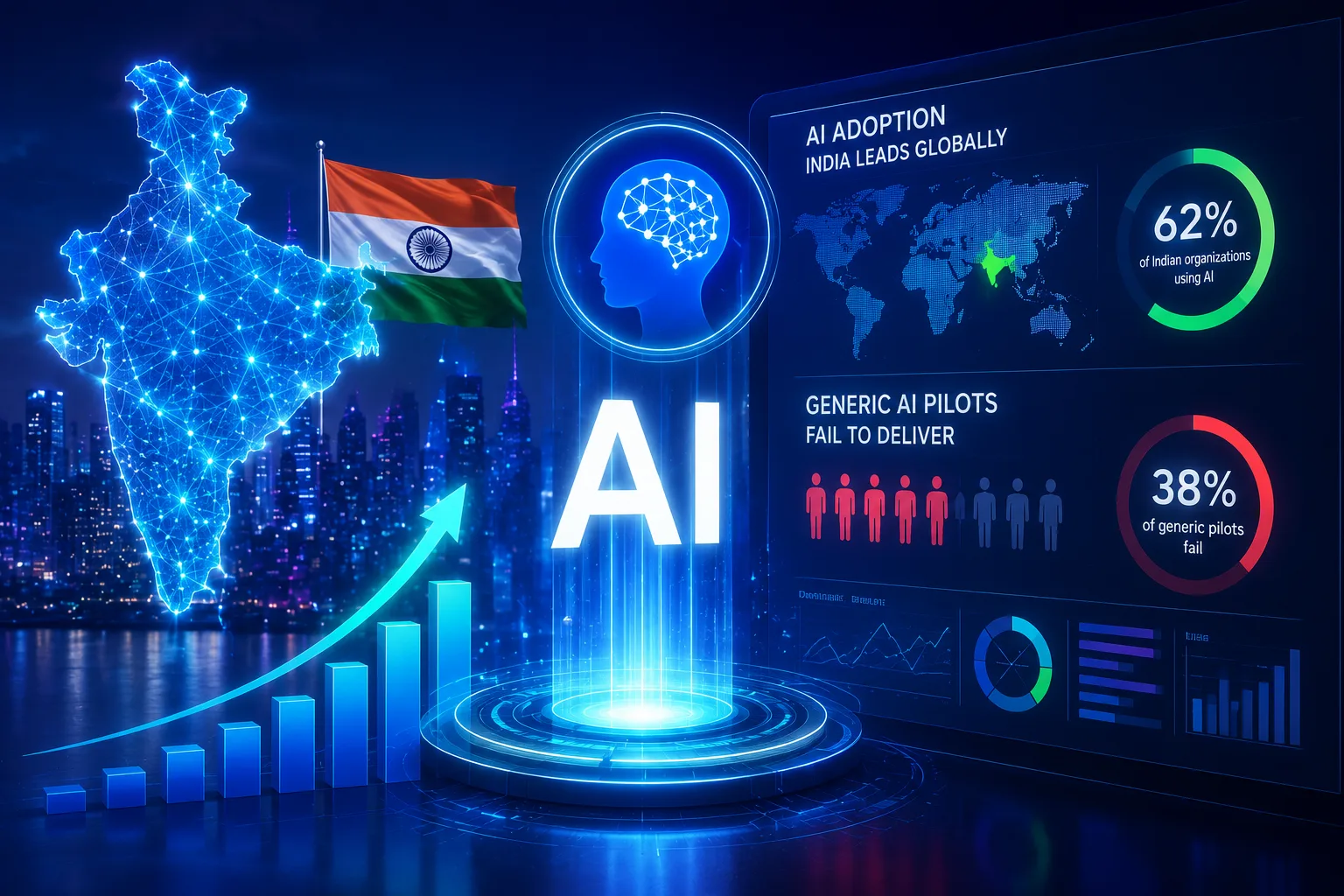
Salesforce has released the India-specific findings of its comprehensive Agentic Workplace Study, a double-blind survey of desk workers conducted in partnership with research firm YouGov.
The report reveals a distinct paradox in India's technology ecosystem: while Indian employees are 45% more likely than the global average to integrate artificial intelligence into their core daily workflows, the country also reports the world's highest rate of failed enterprise AI pilots, the highest adoption share across all surveyed international markets.
According to the study, 38% of workers in India state their organisation experienced an unsuccessful AI pilot within the past year, significantly exceeding the global baseline of 28%.
The data indicates that India's digital workforce is not experiencing AI fatigue or technology rejection; rather, employees are explicitly rejecting generic, out-of-context chatbots. As enterprises transition from initial generative experimentation to deep, operational adoption, employees are demanding intelligent agentic systems that understand domain-specific business data, operate natively within existing software workflows, and deliver role-tailored execution.
Analysing the Pilot Failure Matrix: Why Generic AI Falls Short
The research breaks down the precise operational bottlenecks that cause early-stage AI projects to stall or get abandoned across Indian enterprises.
A primary driver behind this friction is the "Context Deficit." When off-the-shelf AI models are deployed without secure access to underlying customer relationship management (CRM) records, enterprise resource planning (ERP) databases, or operational telemetry, they produce superficial outputs that fail to assist complex decision-making.
The top causes cited by Indian respondents for unsuccessful AI implementations include:
Lack of Business Context (34%): AI outputs failed to account for company-specific operations, customer histories, or industry rules (compared to 22% globally).
Limited Role Personalisation (31%): Systems offered rigid, one-size-fits-all interfaces that could not be adapted to specialised job responsibilities.
Generic, Superficial Outputs (31%): Generated content lacked the depth, accuracy, or formatting required for immediate professional use.
Insufficient Employee Enablement (29%): Organisations deployed software tools without structured training, change management, or prompt engineering frameworks.
Tool Fragmentation & Fatigue (28%): Workers were overwhelmed by disparate, disconnected AI tools operating outside their primary workspace applications.
The Rise of the Informed Sceptic
The study also highlights a counterintuitive trend: 49% of workers in India now classify themselves as AI sceptics, compared to 37% globally.
Rather than signalling an anti-technology bias, this elevated scepticism reflects a maturing, highly sophisticated workforce. Because Indian desk workers use AI tools more frequently than their international peers, they have developed higher benchmarks for accuracy, data privacy, and functional utility. They quickly recognise the limitations of standalone wrapper applications and insist on enterprise-grade reliability.
| Surveyed Metric Category | Global Benchmark Average | India Market Finding | Strategic Industry Implication |
| Core Workflow AI Integration | Baseline Market Standard | 45% Above Global Avg (World Leader) | India represents the primary proving ground for active daily AI usage. |
| Unsuccessful AI Pilot Rate | 28% of Organizations | 38% of Organizations | Generic, prompt-only AI tools are being aggressively phased out. |
| Workplace AI Scepticism | 37% of Desk Workers | 49% of Desk Workers | Greater hands-on exposure drives demand for higher accuracy and trust. |
| Top Pilot Blocker: Lack of Context | 22% of Failed Projects | 34% of Failed Projects | AI agents must be grounded in real-time, unified enterprise data stacks. |
Research Methodology & Scope
Conducted in partnership with YouGov, the double-blind online survey evaluated over1,500 desk workers across 13 major global markets, including Australia, India (120 respondents), Japan, Singapore, France, Germany, Italy, Netherlands, Spain, United Kingdom, Mexico, United States, and Canada.
Desk workers were defined as employees performing primarily mental labour over manual or task-based labour, with required baseline familiarity with AI tools. The sample represents a cross-section of job roles, company sizes, and commercial industries.
Executive Perspectives on Operationalising AI
Deepu Chacko, Vice President of Solution Engineering at Salesforce India, emphasised that success in the next wave of corporate technology depends on execution and operational alignment:
“India's AI story is now about execution. The workforce is experiencing AI in the flow of work, and that experience is creating a more mature expectation from technology, AI that understands their business, supports their role, and helps them make decisions with confidence. Leaders must now focus on operationalising AI, connecting data, redesigning workflows, building trust, and equipping people to work alongside agents. If this is done well, AI will not just lift productivity. It will define how India competes, innovates, and grows.”
By grounding artificial intelligence in real-time enterprise data, eliminating application switching, and providing role-based enablement, Indian enterprises can convert workforce enthusiasm into durable productivity gains, positioning India as a global leader in agentic AI execution.
Read More:
Salesforce Trailblazers unite in Chennai to solve real-world AI challenges
Why AI-ready data centres need more than computing power
Nutanix explains how hybrid multi-cloud services will define channel growth