/dqc/media/agency_attachments/2026/08/21/2026-08-21t061716244z-dq-channels-logojpg-2026-08-21-11-47-17.jpeg)

/dqc/media/media_files/2026/09/10/dq-channels-whatsapp-2026-09-10-17-07-48.png)

 Follow Us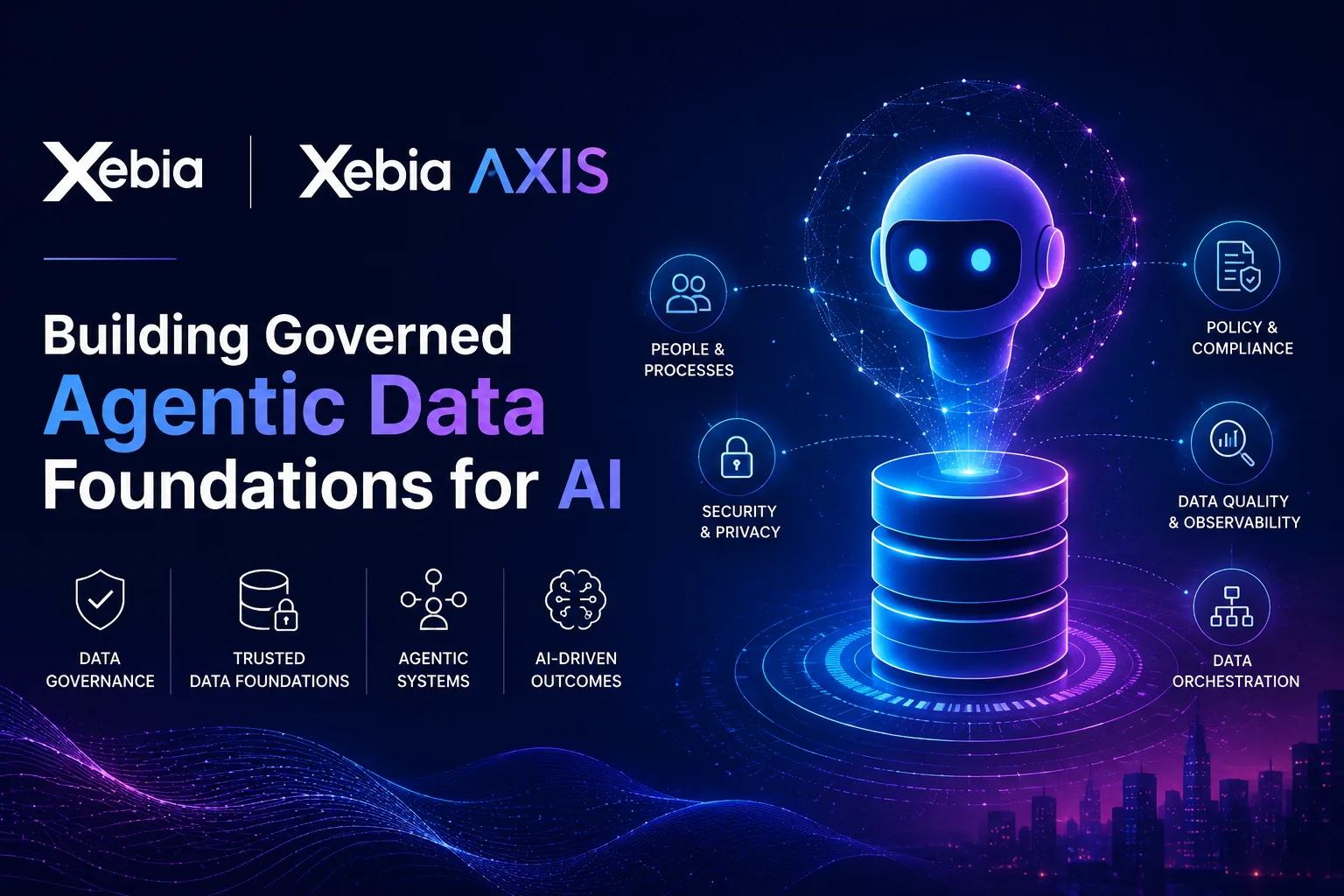
Xebia has announced the general availability of Xebia Axis: Agentic Data Foundation. The comprehensive solution combines proprietary operational AI agents with experienced human data engineering teams to assess, migrate, validate, and manage modern enterprise data platforms. The software framework is engineered to execute end-to-end cloud migrations roughly three times faster than conventional, human-led staff augmentation models without sacrificing data quality, structural compliance, or regulatory governance protocols.
The product rollout addresses a fundamental shift in how enterprise databases are utilised. Traditional cloud data warehouses and data lakes were designed predominantly for human operators, analysts, and business intelligence software, users who can intuitively interpret or work around minor schema inconsistencies, format fragmentation, and incomplete fields.
However, modern autonomous agentic AI systems process information exactly as they find it. If an automated reasoning agent encounters unmapped columns, missing labels, or fragmented data lineages, it will quickly produce execution errors or hallmarked outputs. Xebia Axis resolves this operational failure point by ensuring that the underlying data pipelines, access controls, and compliance boundaries are consistent, auditable, and entirely production-ready.
The Technical Framework: Six Integrated Modular Dimensions
Rather than forcing enterprise technology groups to purchase and integrate separate point products for discovery, validation, and pipeline monitoring, Xebia Axis unifies the full data modernisation cycle inside a single, interoperable solution.
The platform's operations are divided across six specialised, collaborative modules that allow companies to transition from unmanaged data sprawl to structured architectures in a matter of weeks:
Readiness Module: Automatically scans the entire corporate data estate to compile an accurate infrastructure inventory, surfacing hidden hardcodings, cross-system anti-patterns, and complexity risks to build a prioritised migration blueprint.
Platform Module: Generates governed, policy-validated Infrastructure as Code (IaC) templates via conversational interfaces, compiling production-ready Terraform scripts to establish clean, cloud-native landing zones.
Knowledge Module: Parses unstructured corporate assets—including scattered documentation, historical emails, and disconnected text files—to build a persistent, governed vector database layer for local semantic searches.
Migration Module: Automates the transcription and translation of legacy data pipelines while performing deep background parity checks prior to final production cutover to eliminate workload data loss.
Observability Module: Provides real-time telemetry monitoring across service-level agreements (SLAs), operational data health metrics, and active autonomous agent interaction footprints.
Operations Module: Conducts ongoing background root-cause analyses of active data anomalies, automatically writing system adjustments and submitting them as pull requests for human review to ensure continuous, self-healing data operations.
Multi-Cloud Interoperability and Governance Safeguards
Crucially, the platform avoids restrictive single-vendor ecosystem dependency. Xebia Axis features native product compatibility across leading hyperscale cloud data engines, including Amazon Redshift, Google BigQuery, Databricks, Snowflake, and Microsoft Fabric, and integrates seamlessly with leading large language models such as OpenAI, Claude, Gemini, and Mistral AI.
Furthermore, critical enterprise security controls—such as role-based access parameters, detailed audit trails, explicit data residency configurations, and algorithmic bias controls—are engineered directly into the foundational framework layer rather than being added post-deployment. Data remains secure within the customer’s internal cloud perimeter.
| Platform Operational Capability | Traditional Data Engineering | Xebia Axis Agentic Approach |
| Data Migration Velocity | Frictional manual rewrites requiring 12 to 18 months of delivery effort. | 3x Faster Execution: Complete pipeline automation completed in weeks. |
| Workforce Leverage Index | Highly linear output dependent entirely on manual engineering headcount. | 10x Leverage Gain: Human teams dictate strategy; agents scale production execution. |
| Governance Architecture | Fragmented access and audit policies added post-deployment. | Governance by Design: Cryptographic auditing and compliance built into code. |
| System Resiliency & Maintenance | Manual operational patching leading to extended pipeline downtime. | Self-Healing Operations: Agents generate automated pull requests to fix bugs. |
Proven Case Studies Across Core Verticals
Early deployments of the Xebia Axis platform demonstrate measurable infrastructure and cost performance enhancements across complex, global operational environments:
Global Banking Sector: A tier-one banking corporation deployed Axis to collapse and consolidate disparate fraud and credit data streams from siloed batch networks into a single, unified database layer. This enabled their predictive models to access data in real time, projecting a 30% to 50% reduction in underlying data infrastructure costs over a 24-month horizon.
Commercial Aviation: A multinational airline leveraged the system to modernise fragmented operations and historical customer registries. By automating legacy discovery and code conversion workflows, the carrier compressed a traditional 12-to-18-month migration window down to a few months.
Retail Supply Chains: A global retail entity resolved ongoing data-quality failures by combining duplicate pipelines into a single, continuously monitored platform. The automated system isolates and flags structural anomalies before they reach downstream reporting layers.
Complementary Engineering Transformation via Xebia Ace
The launch of the Axis platform expands Xebia's broader AI-native enterprise strategy, arriving alongside Xebia Ace, an advanced, outcome-driven software engineering framework. While Axis hardens and governs the underlying enterprise data layer, Xebia Ace embeds intelligent agents directly across the entire software development lifecycle (SDLC).
By automating manual tasks across requirements analysis, architectural C4 diagram generation, QA scenario modelling, and infrastructure code compilation, Xebia Ace assists software development teams in accelerating delivery speeds by up to 40% while significantly lowering production code defects.
Anand Sahay, Chief Executive Officer at Xebia, highlighted that data readiness stands as the primary bottleneck separating AI experimentation from production success:
“Enterprises have spent years moving data to the cloud, but many still cannot put AI into production because the underlying data and governance are not ready. Xebia Axis closes that gap, so our clients can move to an Agentic Enterprise faster than competitors still wrestling with legacy data platforms.”
Niels Zeilemaker, Xebia’s Global CTO for Data & AI, emphasised that automated tools provide the most efficient pathway to erase technical debt:
“The same agent technology that makes data debt urgent also makes it faster to resolve. Xebia Axis puts purpose-built agents alongside senior engineers to build and run data platforms in production, with governance built into the platform itself.”
Read More:
Why Dell believes AI PCs need consultative selling, not hardware transactions
OVHcloud sees managed services replacing traditional cloud resale in India
How cloud transformation is becoming a business strategy conversation
Lava shares update as 86 employees and partners return safely from Vietnam