/dqc/media/agency_attachments/2026/08/21/2026-08-21t061716244z-dq-channels-logojpg-2026-08-21-11-47-17.jpeg)

/dqc/media/media_files/2026/09/10/dq-channels-whatsapp-2026-09-10-17-07-48.png)

 Follow Us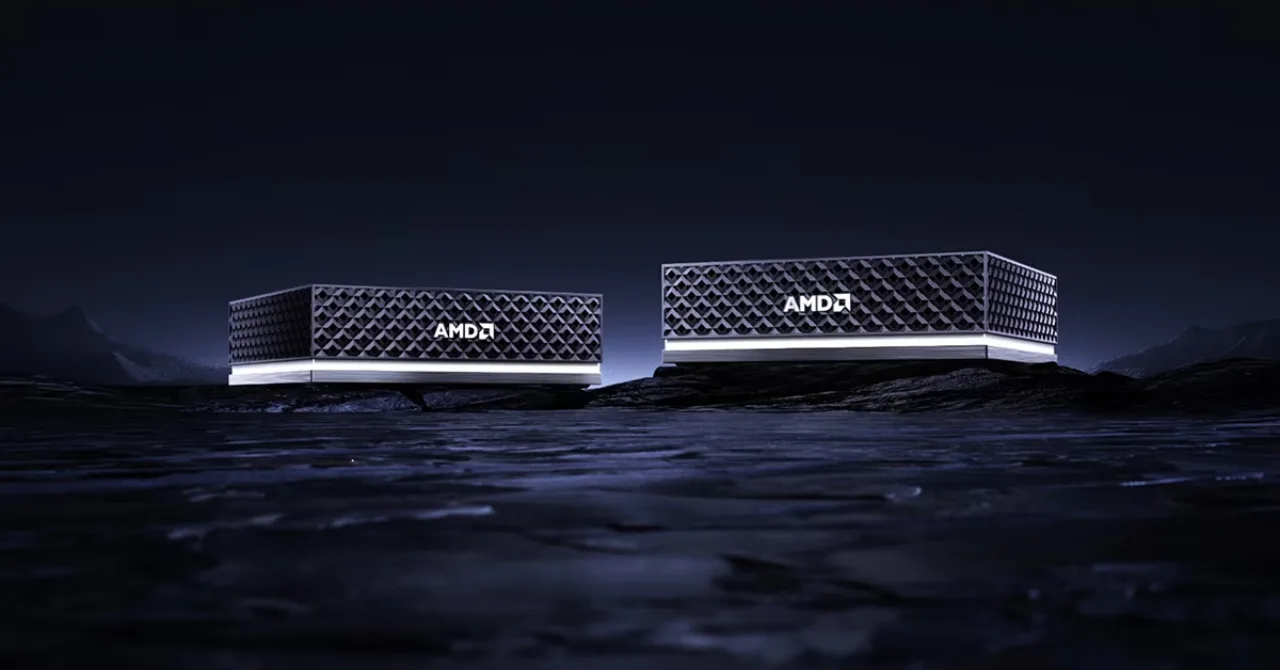
AMD has announced a major expansion of its hardware offerings focused on local artificial intelligence deployment, moving processing workloads away from cloud dependencies directly onto local workstations and enterprise PCs. The company announced that pre-orders for its compact Ryzen AI Halo developer platform will open in June 2026. Concurrently, AMD introduced the Ryzen AI Max PRO 400 Series processors, designed to serve as the hardware foundation for emerging "Agent Computers", systems engineered to interpret prompts, plan multi-step operations, and run workflows locally with minimal human oversight.
Local Execution for Complex Enterprise AI
As organisations attempt to scale agentic frameworks, the operational constraints of centralised cloud systems, specifically data privacy vulnerabilities, high token costs, and communication latency, have driven a demand for powerful edge hardware.
The Ryzen AI Max PRO 400 Series represents the first x86 client processors capable of running 300 billion-parameter large language models (LLMs) entirely within a local user environment. This capacity enables enterprise workstations to manage deep, multi-layered agent processes without trading off processing speed or exposing corporate datasets to external infrastructure layers.
Ryzen AI Halo: Sandbox Environment for Local Development
The initial iteration of the compact Ryzen AI Halo developer platform is engineered to function as a self-contained, on-desk environment for building, fine-tuning, and running heavy generative AI applications.
Technical details of the initial platform include:
Processing Core: Driven by the AMD Ryzen AI Max+ 395 processor featuring up to 12 cores and 32 threads.
Memory & Storage: Equipped with 128GB of unified system memory, creating the operational headroom needed to compute up to 200-billion-parameter localised models.
Cross-OS Compatibility: Supports cross-platform execution, taking developers from Linux prototyping environments straight through to final Windows native deployments.
Software Optimisation: Tuned directly for the open AMD ROCm software stack and compatible with mainstream industry tools, including PyTorch, vLLM, and llama.cpp, Ollama, ComfyUI, and LM Studio.
Retail Channel: The platform will be distributed exclusively through Micro Centre starting in June 2026.
Hardware Escalation: The Ryzen AI Max PRO 400 Architecture
Looking toward the third quarter of 2026, AMD plans to upgrade the Ryzen AI Halo developer environment by deploying the newly unveiled Ryzen AI Max PRO 400 Series silicon. Built using the latest "Zen 5" CPU core architecture, these advanced processors integrate AMD RDNA 3.5 graphics components with an AMD XDNA 2 Neural Processing Unit (NPU).
To handle massive localised datasets and compute-heavy real-time rendering, the top-tier configurations scale system resources significantly, offering up to 192GB of unified system memory and a dedicated 160GB of Video RAM (VRAM) allocation.
| Parameter / Feature | Initial Ryzen AI Halo Platform | Q3 2026 Upgraded Platform Generation |
| Primary Processor Line | AMD Ryzen AI Max+ 395 | AMD Ryzen AI Max PRO 400 Series |
| Maximum Unified Memory | 128GB | 192GB |
| Maximum VRAM Capacity | Standard System Allocation | 160GB |
| Local Model Capacity | Up to 200 Billion Parameters | Up to 300 Billion Parameters |
| Silicon Core Architecture | Previous-Gen Architecture Foundations | AMD "Zen 5" + RDNA 3.5 + XDNA 2 |
OEM Ecosystem Integration
Major original equipment manufacturers (OEMs) are integrating the newly introduced processors into commercial laptops, mobile workstations, and small form-factor enterprise desktops starting later this year.
Ketan Patel, President of Personal Systems atHP Inc., commented on the deployment strategy:
“HP is designing solutions that combine powerful performance, advanced AI capabilities, and the flexibility needed to accelerate from experimentation to production locally... We are excited to expand our portfolio with the AMD Ryzen AI Halo Platform and Ryzen AI Max PRO 400 Series processors.”
Luca Rossi, President of the Intelligent Devices Group atLenovo, highlighted the broader structural pivot:
“AI is moving from the cloud to where work actually happens: on the device, in real time. Beyond adding new features, it’s enabling systems that can execute, adapt and respond instantly, while keeping data local and more secure. With platforms like AMD’s Ryzen AI Max PRO 400 Series, we’re scaling this through an ecosystem approach.”
Read More:
Box Pushers Changing Perspective towards Services
Box-pushers to solution providers: Surat Association charts a new course for south Gujarat
Cybersecurity managed services are reshaping enterprise security models
Wellknown Computers hosted Lenovo India leadership focussing on channel retail strategy