
NEURA Robotics Qualcomm collaboration robotics AI announced

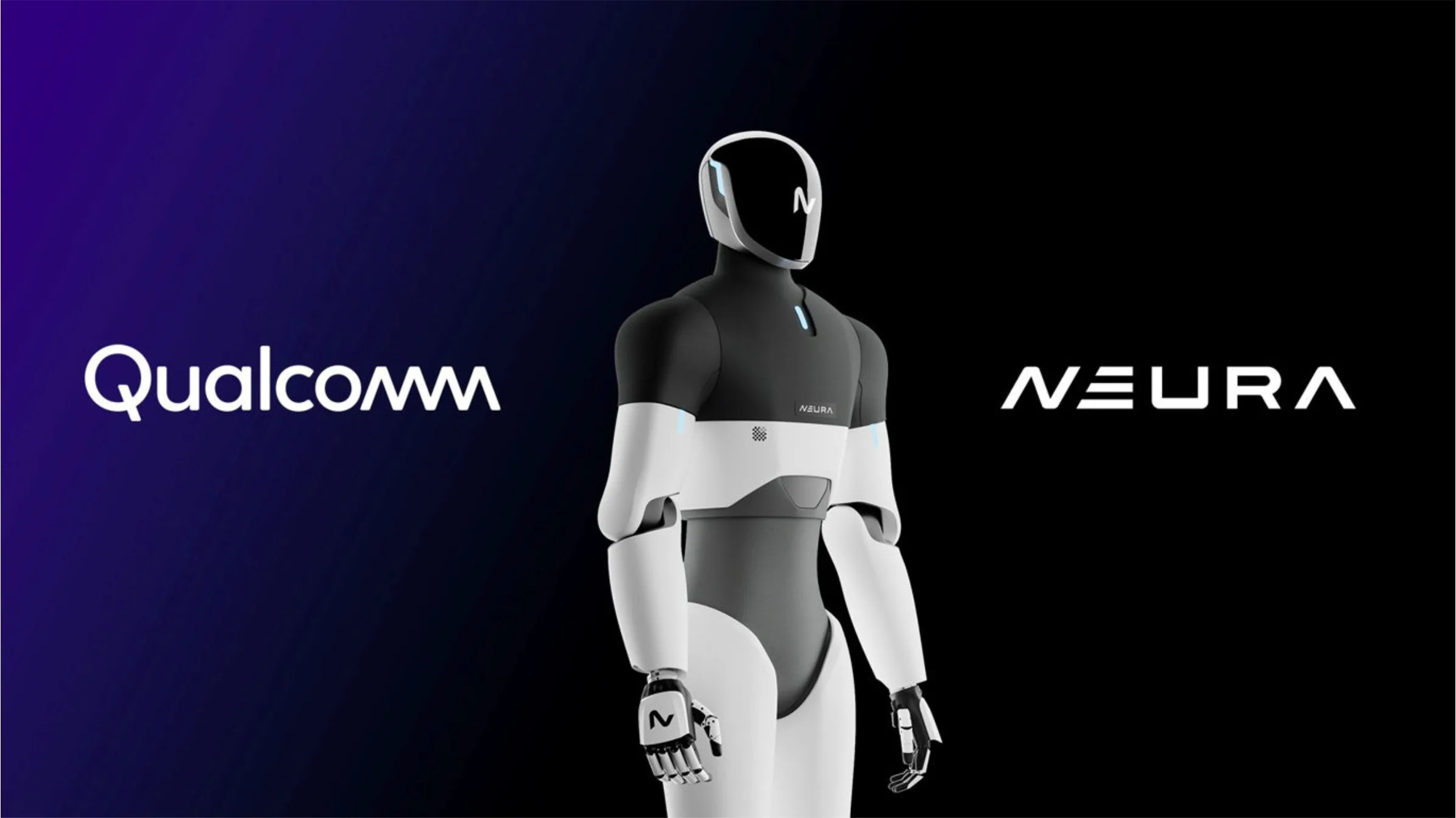
NEURA Robotics and Qualcomm Technologies have announced a strategic collaboration focused on advancing robotics platforms and physical artificial intelligence systems. The NEURA Robotics Qualcomm collaboration robotics AI initiative is intended to combine robotics system expertise with edge computing and connectivity technologies to accelerate the development of intelligent robots designed for real-world environments.
The companies said the collaboration will focus on building scalable robotic intelligence capable of operating safely alongside humans across industrial, service and household environments. The partnership aims to align AI compute, robotics platforms and software systems in order to support production-ready robotics deployments.
Focus on scalable robotic intelligence
At the centre of theNEURA Robotics Qualcomm collaboration robotics AI initiative is a shared goal of enabling intelligent robots capable of performing tasks across multiple environments.
The collaboration brings together Qualcomm Technologies’ expertise in AI computing platforms, connectivity technologies and robotics processors with NEURA Robotics’ robotics hardware systems and embodied AI software stack.
Both companies aim to address one of the key challenges in robotics development: moving from research prototypes to scalable systems that can operate reliably in real-world conditions.
By combining high-performance edge AI capabilities with robotics platforms designed for human interaction, the collaboration seeks to support the development of robots that can function across industrial, service and domestic settings.
Developing “Brain + Nervous System” architectures
A core element of theNEURA Robotics Qualcomm collaboration robotics AI initiative involves the development of reference architectures described as “Brain + Nervous System”.
These architectures aim to combine higher-level cognitive functions such as perception, reasoning and planning with real-time control systems that allow robots to respond instantly to their surroundings.
Qualcomm Technologies’ robotics processors, including the Dragonwing IQ10 Series, will play a central role in the system architecture. These processors will be integrated with NEURA Robotics’ hardware platforms and embodied AI software stack.
The approach is designed to deliver ultra-low-latency control while supporting complex AI processing tasks directly on robotic devices.
Aligning AI infrastructure with robotics platforms
The NEURA Robotics Qualcomm collaboration robotics AI initiative will also focus on integrating Qualcomm Technologies’ robotics architecture with NEURA Robotics’ platform strategy.
This architecture includes components such as:
heterogeneous edge computing systems
edge AI processing
mixed-criticality computing environments
machine learning operations
AI data pipelines
The combined system is intended to support deployment across multiple robotic form factors while maintaining reliability and operational safety.
The companies said the collaboration will also work on creating a standardised runtime and deployment interface. This interface will support the deployment, validation and updating of AI workloads across robotics platforms, helping simplify the transition from development to production.
Enabling developer ecosystems and robotics platforms
Another component of the NEURA Robotics Qualcomm collaboration robotics AI initiative involves building a broader ecosystem for robotics development.
NEURA Robotics’ Neuraverse platform is expected to serve as a central environment for simulation, training and orchestration of physical AI workloads. The cloud-based platform connects cognitive robots into a shared intelligence network.
The concept behind the platform is that improvements made by one robot can be shared across other robotic systems within the network.
Robotic systems developed by NEURA Robotics may also serve as reference platforms for testing and development. These include:
robotic arms
mobile robots
service robots
household robots
humanoid platforms
The collaboration aims to encourage third-party developers to build applications that can operate across different robotic systems using a common platform framework.
Emphasis on safety and real-time performance
The companies said the NEURA Robotics Qualcomm collaboration robotics AI initiative will place emphasis on functional safety, real-time responsiveness and human-centric design.
These elements are considered essential for robotics systems operating in environments where humans and machines interact directly.
The collaboration also plans to use data-driven methods to continuously improve AI performance, system reliability and operational determinism across deployed robots.
Industry perspectives on physical AI
David Reger, CEO and Founder of NEURA Robotics, said the collaboration reflects a broader push to build scalable and open robotics systems.
“This collaboration marks a major step toward making physical AI real: open, scalable and trusted,” Reger said.
He noted that combining robotics platforms with edge AI technologies could accelerate the development of cognitive robots capable of operating across industries and everyday environments.
“By bringing together our cognitive robotics platforms and the Neuraverse ecosystem with Qualcomm Technologies’ leadership in edge AI and connectivity, we’re aiming to accelerate a future where cognitive robots operate safely alongside humans,” Reger said.
Nakul Duggal, Executive Vice President and Group General Manager for Automotive, Industrial and Embedded IoT and Robotics at Qualcomm Technologies, said robotics represents one of the most demanding use cases for edge AI.
“Robotics represents one of the most demanding edge AI use cases, where decisions must happen instantly, reliably and locally, without relying solely on the cloud for safety-critical responses,” Duggal said.
He added that collaboration within the robotics ecosystem can help accelerate the development of intelligent devices capable of performing complex tasks directly on-device.
Toward commercial deployment of physical AI
Through the NEURA Robotics Qualcomm collaboration robotics AI initiative, both companies aim to advance the commercial deployment of cognitive and humanoid robotics systems.
The partnership is intended to help bring physical AI technologies out of experimental environments and into practical applications across industries.
By combining robotics engineering with advanced edge computing and AI platforms, the companies expect the collaboration to support the development of robots capable of operating autonomously while interacting safely with people in real-world settings.







 2 Min read