/dqc/media/agency_attachments/2026/08/21/2026-08-21t061716244z-dq-channels-logojpg-2026-08-21-11-47-17.jpeg)

/dqc/media/media_files/2026/09/10/dq-channels-whatsapp-2026-09-10-17-07-48.png)

 Follow Us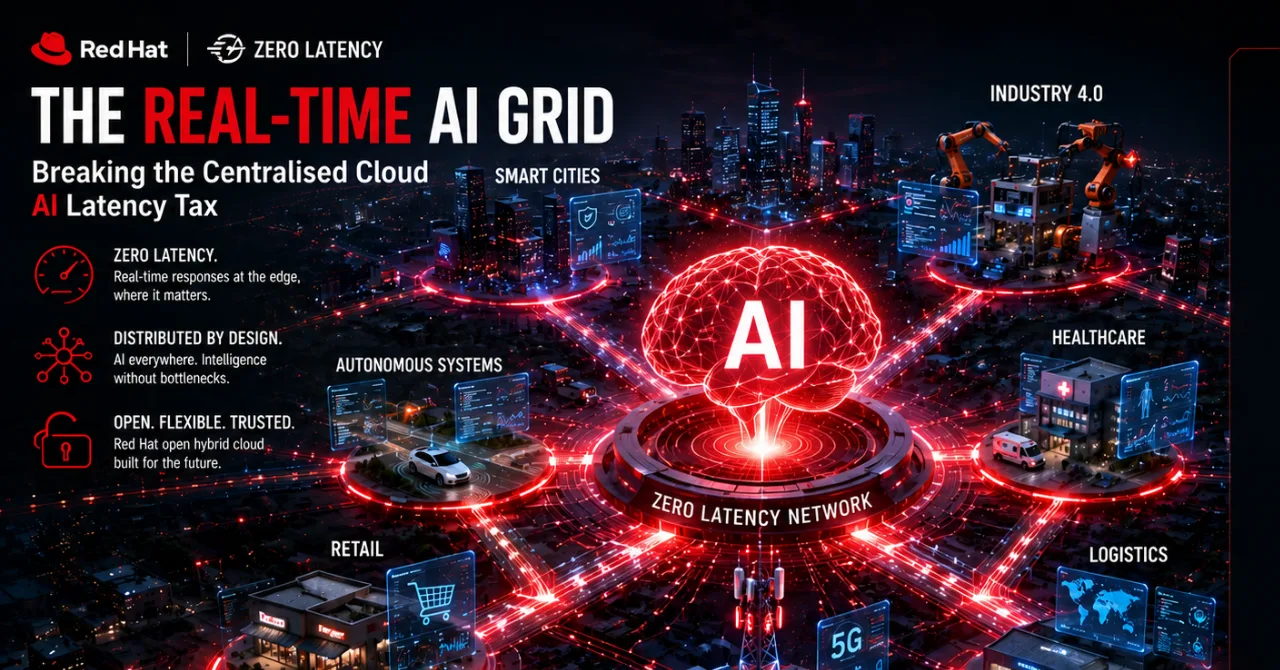
As AI transitions from isolated research labs into mission-critical industrial applications, the industry has hit a wall: the "latency tax." Centralised cloud architectures often struggle to meet the millisecond-scale processing requirements of real-time automation and safety-critical transactions.
To bridge this gap, Zero Latency (0.lat) has announced the adoption of Red Hat AI Factory with NVIDIA as the Kubernetes foundation for its distributed neocloud network, Zerogrid.
What is a Neocloud?
Unlike traditional hyperscale clouds, a neocloud like Zerogrid is a decentralised network of edge datacenters designed to dispatch specialised GPU services exactly where data originates. Zero Latency aggregates these sites into a high-performance fabric powered by NVIDIA Blackwell GPUs and Intel Xeon processors.
The three pillars of Zerogrid
Zero Latency’s backbone, powered by Red Hat AI Enterprise, focuses on solving three enterprise-scale challenges:
Global Scalability: Standardises AI workloads across hundreds of edge sites, allowing for one-click deployment and unified management via Red Hat Advanced Cluster Management for Kubernetes.
On-Demand Performance:It makes specialised hardware accessible on demand by providing on-demand access to NVIDIA Blackwell GPUs, eliminating the need for large private capital expenditures.
Enterprise Resilience: Leverages the stability of Red Hat OpenShift AI to provide a secure, containerised environment that meets rigorous industrial IT standards.
Leadership perspectives on decentralisation
The move signals a major shift in how AI computing reaches the enterprise.
“Zero Latency is changing how AI compute reaches the edge,” said Joe Fernandes, vice president and general manager, AI Business Unit, Red Hat. “We’re working with Zero Latency to help define the architecture for the future of low-latency AI applications.”
Michael Huerta, Cofounder of Zero Latency, believes the centralised model is no longer sufficient for machine-driven workloads:
“AI inference is the next domain... machine-driven, constraint-bound, and poorly served by the centralized cloud. Red Hat AI Enterprise gives us the containerization foundation to bring this architecture to enterprise customers, from the factory floor to the city street.”
Conclusion
The collaboration between Red Hat, NVIDIA, and Zero Latency represents a significant evolution for AI startups and industrial giants alike. By moving inference away from distant data centres and closer to the point of action, Zerogrid is ensuring that the "Future of AI" isn't just intelligent, it's real-time.
Read More:
HP AI PC launch expands beyond traditional computing
National Technology Day 2026: Is India’s B2B AI ecosystem built for long-term trust?
CAIT to host Global investors meet in Moscow to connect Indian MSMEs with Russian buyers