
National Technology Day 2026: Is India’s B2B AI ecosystem built for long-term trust?

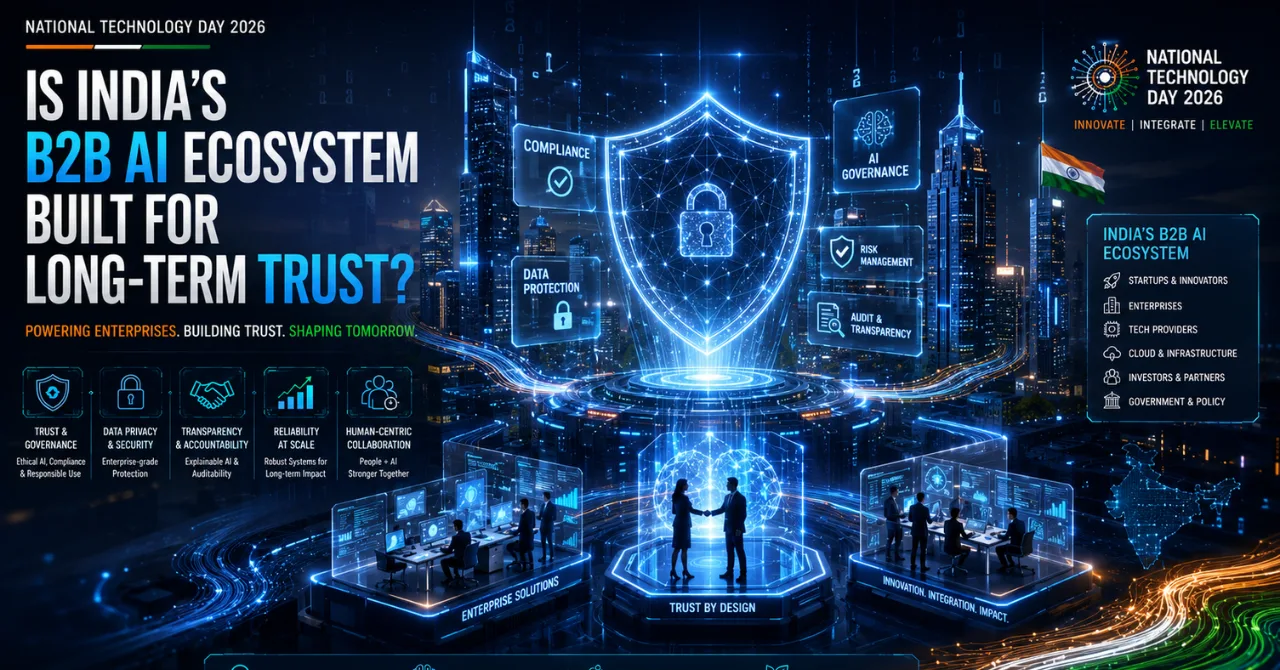
India’s B2B technology ecosystem is entering a defining phase. AI, automation, robotics and intelligent infrastructure are no longer future-facing ambitions discussed only inside boardrooms. They are now deeply embedded in the operational backbone of enterprises.
But alongside the acceleration comes an uncomfortable question. Can businesses sustain the AI boom without compromising security, governance and long-term trust?
That tension sits at the heart of National Technology Day 2026. Industry leaders across sectors believe the next phase of enterprise growth will not simply depend on deploying advanced technologies faster. It will depend on how responsibly organisations build, secure and scale them.
Enterprises are moving from experimentation to AI-led operations
India’s enterprise landscape has rapidly moved beyond basic digital adoption. AI is increasingly shaping customer engagement, operations, infrastructure management and decision-making processes across industries.
Ravi Kaklasaria, CEO & Co-Founder, edForce, said enterprises are now embedding AI, cloud and automation technologies directly into their operational core.
“Enterprises are no longer experimenting with AI, cloud, and automation; they are embedding them into core operations to drive efficiency, scale, and innovation,” Kaklasaria said.
That transition is visible across sectors. From fintech and manufacturing to enterprise services and workplace management, businesses are trying to convert AI from a support tool into a business driver.
Sandipan Mitra, CEO & Co-Founder, HungerBox, believes the next wave of enterprise AI will reward organisations that combine operational intelligence with industry expertise.
“The real winners in the AI boom will not be companies that simply add a generic AI layer on top of existing systems. They will be domain-first companies that combine AI with deep industry context, workflow understanding, and rich operational data,” Mitra said.
He added that many enterprises are chasing AI-led outcomes without first addressing the quality of the systems underneath.
“Clean data, strong process design, and business-contextual intelligence will separate serious adopters from those only racing with the hype,” he said.
Ankit Bhatnagar, Deputy Chief Product Officer, PeopleStrong, said AI is now fundamentally reshaping how organisations hire, train and engage employees.
“AI is transforming how organisations hire, develop, and engage their people, and HR is where that transformation matters most, because every employee experience is personal,” Bhatnagar said.
“With MAAX, our multi-agent architecture, we've built specialised AI agents for each stage of the employee journey: hiring, onboarding, learning, growth, and well-being.”
He described this as part of a broader shift towards AI-led workplaces.
“This is the workplace we're building toward, one where the depth of HR meets the scale of AI, for every employee, in every role,” he added.
The retail sector is witnessing a similar transformation.
Ragini Varma, Chief Business Officer – India, Fynd, said AI is rapidly becoming the operational layer behind modern businesses.
“AI is no longer a distant horizon; it is the operating layer shaping modern business,” Varma said.
“What separates innovation from simple adoption is intent: the commitment to building technology that is responsible, inclusive, and rooted in real-world impact.”
According to Varma, AI is helping businesses become more intelligent, agile and customer-centric, regardless of their scale.
“At Fynd, we believe India’s digital growth story will be defined not only by how boldly we innovate, but by how meaningfully that innovation reaches and benefits people,” she said.
Security is becoming the defining challenge of the AI era
As enterprises scale AI deployments, security and governance concerns are becoming harder to ignore.
Venkatesh Subramaniam, President & Global Head – Infrastructure, Cybersecurity & Privacy, Mindsprint, said enterprises are rapidly moving towards becoming AI-first organisations, but many are underestimating the risks attached to poorly governed systems.
“The AI boom is exhilarating, but at the same time, it brings a growing sense of caution,” Subramaniam said.
“In the rush to deploy AI at scale, critical fundamentals such as security, governance, and identity management are often treated as secondary considerations.”
According to Subramaniam, the growth of machine identities is fundamentally reshaping enterprise security challenges.
“One of our recent reports highlights that machine identities now outnumber human identities by 92 to 1, fundamentally reshaping the enterprise attack surface,” he said.
He warned that vulnerabilities inside interconnected AI ecosystems can spread rapidly across networks before organisations are prepared to respond.
“No system, regardless of how intelligent it becomes, can outgrow a weak foundation,” Subramaniam added.
Heather Dawe, Chief Data Scientist and Head of Responsible AI, UST, echoed similar concerns around balancing innovation with accountability.
“As organisations adopt AI and digital technologies at scale, ensuring the security, resilience, and trustworthiness of the underlying infrastructure must remain a top priority,” Dawe said.
“Innovation must be balanced with accountability, with equal focus on how responsibly technology is deployed and governed.”
Responsible growth is becoming central to enterprise strategy
The AI conversation inside enterprises is also shifting beyond deployment metrics and efficiency gains. Increasingly, business leaders are asking deeper questions around trust, societal value and responsible growth.
Ankit Sarawagi, CFO, Verloop.io, said the long-term winners will be organisations that scale technology and workforce capabilities together.
“The organisations that will endure are those that grow their technology and their people together, ensuring scale does not come at the cost of accountability or trust,” Sarawagi said.
Lakshman Devarajan, Founder & CEO, Mad Monkey AI, argued that the technology industry may need to redefine what growth actually means.
“If growth means more users spending more hours generating more data for more ads, we've seen that movie. It ends with a mental health crisis and a generation that can't focus,” Devarajan said.
He believes the industry should instead focus on measuring real-world outcomes and social impact.
“How many collaborations did your platform enable? How many students found their first co-founder? How many earned their first income through your ecosystem? These are growth metrics that matter, not daily active minutes,” he said.
Devarajan added that India has a unique opportunity to shape a more community-driven technology ecosystem. “Technology should serve the community, not just shareholders,” he said.
“National Technology Day is a good moment to ask ourselves: are we building technology that the next generation will thank us for, or apologise for?” he added.
Infrastructure, energy and sustainability are entering the AI debate
As AI workloads continue expanding, enterprise leaders are increasingly discussing the physical infrastructure needed to sustain growth.
Raahul Hari Nair, Founder, CHI’GRIDS, said the next stage of enterprise transformation will depend heavily on energy intelligence and infrastructure optimisation.
“As AI-driven workloads grow, businesses will need platforms that can continuously balance reliability, efficiency, and sustainability,” Nair said.
“The long-term viability of the AI boom will depend not just on compute capabilities, but on how effectively the underlying energy layer is optimised and controlled.”
That pressure is also extending into data centre cooling and high-performance infrastructure design.
Kulpreet Sahni, Founder & CEO, Chiltier, said advanced processors and AI computing environments are significantly increasing thermal management challenges.
“Future-ready infrastructure will play a defining role in enabling secure and sustainable growth,” Sahni said.
“The next decade of technological leadership will not only depend on advancements in AI and computing, but also on how intelligently organisations build and optimise the ecosystems supporting them.”
India’s innovation ambitions are becoming broader
National Technology Day is also prompting reflection on India’s wider technology evolution.
Dr. Ramya Chatterjee, CEO, Solitaire Brand Business, Director – ProintekGlobal Innovations, said India’s digital public infrastructure has helped create a scalable and inclusive innovation ecosystem.
“Initiatives such as Aadhaar, Unified Payments Interface (UPI), and DigiLocker have enabled seamless access to services, reduced transaction costs, and allowed startups to innovate rapidly without rebuilding core systems,” Chatterjee said.
He added that India is gradually moving beyond its image as a cost-efficient outsourcing destination towards becoming a centre for original innovation and intellectual property creation.
“Technology continues to act as a powerful enabler, helping India transition from a cost-driven economy to a capability-driven one,” he said.
Raja Manickam, Founder & CEO, iVP Semi, believes India must now focus more aggressively on commercialising research and strengthening deep-tech innovation.
“We are a nation of scientists, engineers, thinkers, let’s unleash our strengths,” Manickam said.
Patanjali Somayaji, Chief Technology Officer, axio, said responsible innovation will play a major role in shaping India’s technology-led future.
“As emerging technologies continue to reshape industries, we believe responsible innovation will play a defining role in accelerating India's journey towards Viksit Bharat,” Somayaji said.
Intelligent automation is reshaping manufacturing
India’s industrial and manufacturing ecosystem is also witnessing a major shift towards AI-powered automation.
Prateek Jain, Co-Founder & COO, Addverb, said the sector is moving beyond traditional robotics towards intelligent and autonomous systems.
“The transition is taking place quickly from traditional industrial robots to flexible, AI-powered robots that can autonomously operate in dynamic, real-world environments around warehouses, factories and supply chains,” Jain said.
According to Jain, the long-term success of industrial AI will depend on workforce readiness as much as technological capability.
“Technology advancement without continuous skilling and workforce empowerment becomes a challenge,” he said. “Responsible innovation, deep skilling, and human-machine collaboration will define the leaders in this next phase,” he concluded.
Trust may become the biggest differentiator in enterprise AI
The larger message emerging this National Technology Day is remarkably consistent. The future of enterprise AI may not be decided by which companies deploy technology the fastest.
It may instead depend on which organisations build systems that are resilient, secure, inclusive and trusted over time.
Amit Kumar, CTO & Director, Easebuzz, said the fintech ecosystem is already seeing this shift clearly.
“For fintechs, the next few years will separate companies that built for resilience versus those that built merely for scale and speed,” Kumar said.
As enterprises continue racing towards AI-led transformation, resilience may ultimately become the metric that matters most.
Vinay Sinha, Managing Director, India Sales, AMD, said inclusive AI growth will depend on building flexible and sustainable computing ecosystems rather than relying on a one-size-fits-all approach.
“To make AI more accessible and inclusive, businesses must use the right compute tools for the right workloads while fostering open ecosystems that give developers and enterprises greater flexibility and choice,” Sinha said.
He added that India’s growing digital infrastructure and technology talent base position the country strongly for the next phase of AI-led growth.
Read More:
Association with SI focusing on AV, Dr. Ramya Chatterjee, SOLITAIRE
Why USEReady believes AI orchestration will define the next decade of enterprise transformation
World Password Day 2026: Why AI is making passwords obsolete faster than expected





 2 Min read