
STMicroelectronics Ultralow-Power image sensors targets always-on vision without battery drain

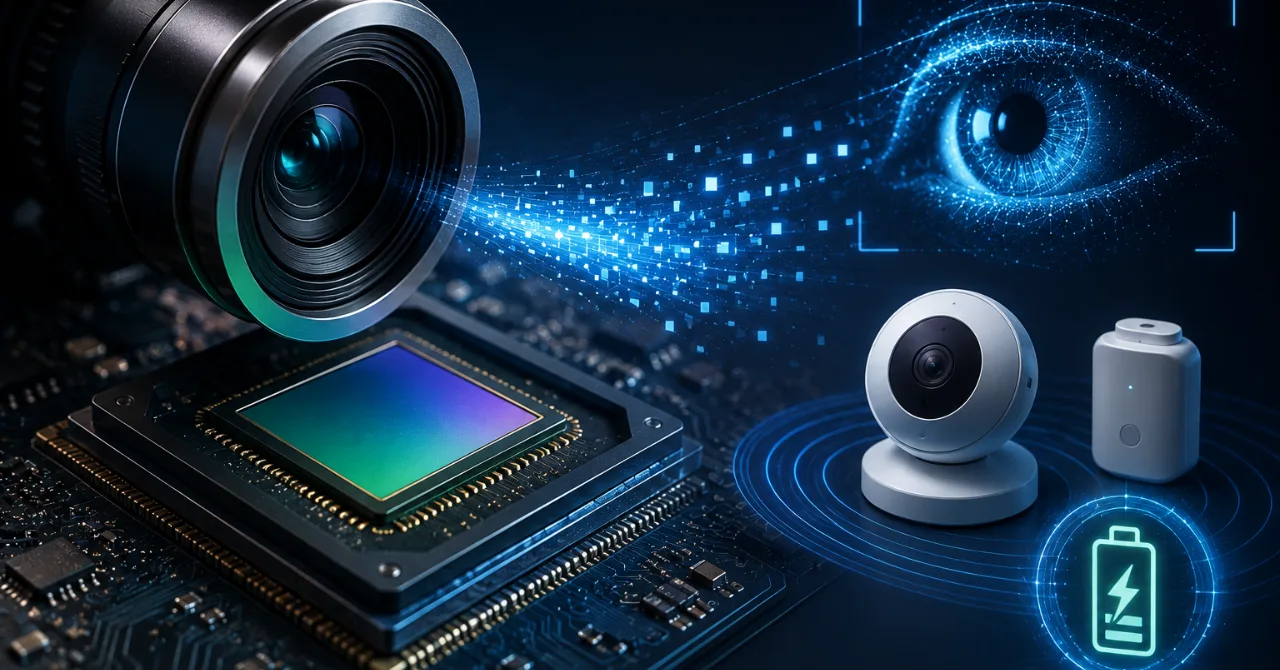
STMicroelectronics is expanding its ST BrightSense portfolio with a new generation of ultralow-power image sensors designed for the next wave of wearable and edge AI devices. The newly introduced VD55G4 and VD65G4 sensors aim to solve one of the biggest challenges in always-on vision systems: delivering continuous visual awareness without draining battery life.
The launch reflects a larger industry shift where compact devices like AR glasses, XR headsets, wearables, and smart appliances increasingly rely on embedded vision and local AI processing instead of cloud-heavy operations. These sensors are designed to operate under strict power, size, and cost limits while still supporting responsive AI-ready imaging.
Always-On Vision Moves Closer to Mainstream Devices
The new STMicroelectronics ultralow-power image sensors introduce both monochrome and RGB global-shutter options, giving developers flexibility for different smart device use cases. Built with detect-and-wake architecture, the sensors can monitor scenes continuously and activate the main processor only when needed.
This shift from continuous streaming to event-driven operation could become important for Always-on vision sensors for wearables and smart glasses, where battery size and heat management remain major design constraints. According to STMicroelectronics, the sensors can consume up to 10 times less power than conventional global-shutter sensors while operating at around 800×700 resolution and 10 frames per second.
The company is also positioning these sensors as enablers for edge AI systems that work locally on devices. In smart home appliances, IoT products, and medical devices, local processing reduces dependence on cloud connectivity while lowering standby power consumption.
Smart Glasses Battery Life Tech Gets New Focus
Battery life has become one of the defining challenges for AR and XR products. The VD55G4 and VD65G4 sensors are being designed specifically for compact systems that need to stay active throughout the day without becoming bulky or uncomfortable.
For smart glasses and AR/VR headsets, the sensors support tracking and spatial awareness while maintaining low energy use. Their compatibility with low-power microcontrollers and compact SoCs also makes integration simpler for device makers working on smaller form factors.
The sensors are produced using STMicroelectronics 3D stacked architecture on 300 mm wafers at the company’s Crolles facility. Alongside the hardware launch, ST is also building a larger development ecosystem with STM32 and Raspberry Pi development boards, camera modules, platform drivers, and software kits aimed at speeding up embedded vision projects.
Conclusion
The latest ST BrightSense expansion highlights how imaging technology is evolving beyond smartphones and traditional cameras. As edge AI devices become smaller and more context-aware, ultralow-power imaging is emerging as a critical layer for future wearables, smart homes, and AI-driven consumer electronics. By focusing on power efficiency, local intelligence, and compact integration, STMicroelectronics is positioning its new sensors around the growing demand for always-on computing experiences.
Read More:
Akamai to acquire LayerX for USD 205 million to master AI usage control
India cloud computing landscape and the big shift for channel partners





 2 Min read