What MATLAB EXPO 2026 revealed about future engineering

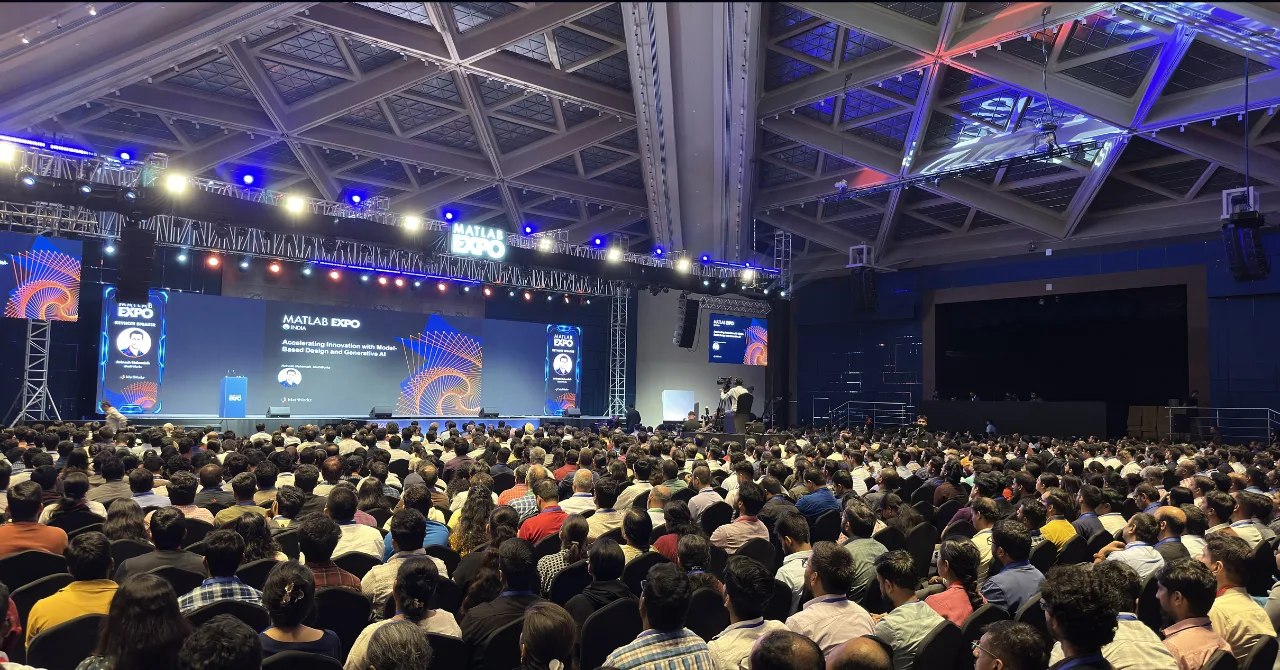
Artificial intelligence in engineering is no longer staying inside research labs or pilot projects. That was one of the clearest messages emerging from MATLAB EXPO 2026 in Bengaluru, where more than 1,300 engineers, researchers and industry leaders gathered to discuss how AI is starting to reshape real-world product development and industrial workflows.
The event focused heavily on practical adoption rather than futuristic promises. Sessions explored how generative AI, engineering copilots and agentic automation are being integrated into existing engineering systems without compromising validation, traceability or safety. Across presentations and demonstrations, the larger message remained consistent — engineering teams are now trying to make AI reliable enough for production environments, not just experimentation.
MATLAB R2026a AI features reflect a shift towards execution
One of the strongest themes across MATLAB EXPO 2026 was the growing role of AI-assisted engineering inside established workflows. Demonstrations involving MATLAB and Simulink highlighted how engineering teams are using AI copilots and agentic systems to accelerate simulations, automate repetitive tasks and improve design decisions.
MathWorks executives Seth Deland and Avinash Nehemiah discussed how generative and agentic AI capabilities are helping teams move faster from early concepts to deployable systems. But unlike consumer AI discussions focused on creativity, the emphasis here was different. Engineering organisations are placing equal importance on verification, governance and oversight.
That distinction matters because engineering sectors such as aerospace, automotive and industrial automation cannot afford unpredictable outputs. Instead, AI systems are being developed as collaborative tools where engineers continue to supervise critical decisions.
Digital Engineering trends in India move beyond automation talk
The discussions also highlighted broader Digital Engineering trends India is witnessing across industries. Companies including Boeing, Tata Consultancy Services, Mercedes-Benz Research and Development India and Collins Aerospace shared how digital twins, embedded AI, and simulation-led workflows are becoming central to modern engineering operations.
Savyasachi Srinivas, Vice President, Collins Aerospace, described how AI-enabled knowledge systems and digital engineering models are helping organisations move products from concept to certification more efficiently. The focus is gradually shifting from isolated automation tools towards connected engineering ecosystems where simulation, AI and operational data work together continuously.
The UAV pavilion and race car showcased that idea further. From drones and eVTOL systems to Formula Racing platforms, engineering teams are increasingly relying on AI-integrated simulation environments to reduce development complexity while maintaining precision.
Trustworthy AI for safety-critical systems becomes essential
Perhaps the most important takeaway from MATLAB EXPO 2026 was the growing industry focus on Trustworthy AI for safety-critical systems. Panel discussions repeatedly returned to themes such as human oversight, governance and validation of AI-assisted outputs.
Rather than replacing engineers, the conversations suggested that AI is becoming an operational layer that supports decision-making while humans remain accountable for final outcomes. As industries move deeper into AI-assisted engineering, that balance between automation and trust may ultimately define how quickly enterprises adopt these technologies at scale.
Read More:
Zoho Cybersecurity Report exposes hidden AI security gaps
UST Taciti acquisition signals a bigger push Into SAP modernisation
AgentSkope Netskope fixes security team burnout
Yotta Shakti Cloud and IBM partnership targets India’s AI control challenge






 2 Min read