
Why Hitachi iQ AI Blueprints Could Change Enterprise AI

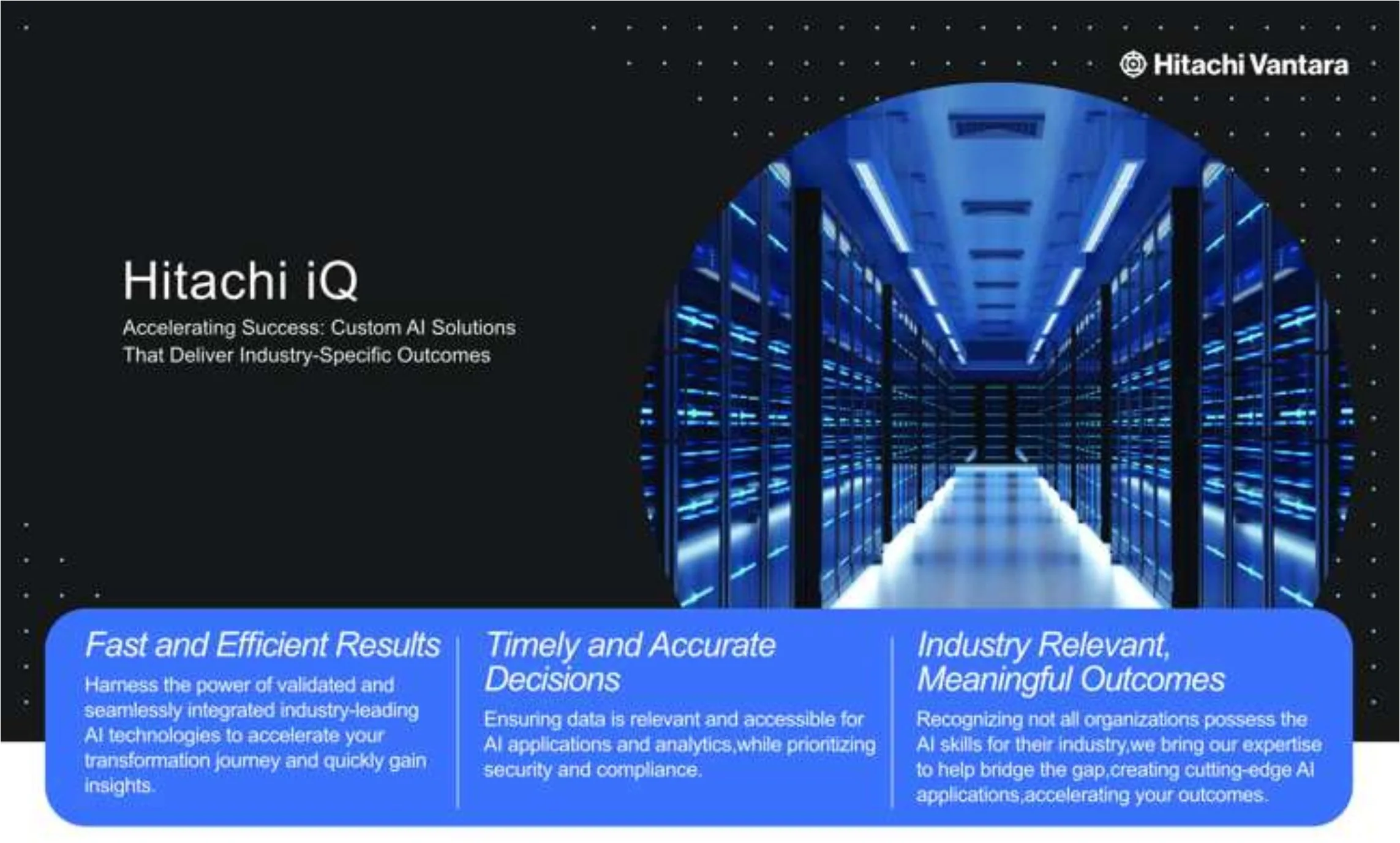
As AI moves from experiments to real deployments, many enterprises are hitting a wall. Data is messy, governance is unclear, and scaling AI safely is harder than expected. This is where Hitachi iQ AI Blueprints step in, not as another AI tool, but as a structured way to make AI usable in production. Hitachi Vantara’s latest update to its iQ portfolio focuses on the simple idea of AI needing strong data, clear workflows, and built-in control to work at scale.
Why AI Is Stuck and What’s Changing
The shift from copilots to autonomous agents is creating new challenges. These agents don’t just assistthey act, decide, and interact with systems directly. That raises the stakes. The update shows a clear pattern of AI success depending heavily on data maturity, governance and security are no longer optional, and infrastructure must support real-time, production workloads
Hitachi iQ AI Blueprints aim to close this gap by combining infrastructure, data, and agent orchestration into one system.
How Hitachi iQ AI Blueprints Bring Order
At the core is Hitachi iQ Studio, where AI agents are designed and managed. The new updates introduce a structured way to handle agents using the Hitachi iQ Studio supervisor worker model. Instead of chaotic automation the worker agents handle tasks and the upervisor agents manage workflows and adapt decisions
This setup brings visibility and control, something most AI deployments lack today. It’s not just about automation, it’s about making AI predictable.
Data Stays Where It Matters
One of the biggest shifts comes from how data is handled. WithModel Context Protocol (MCP) for AI agents, Hitachi iQ allows agents to access distributed data without moving it.
This matters because data stays secure and governed, performance improves by keeping data close to compute, and complexity reduces across hybrid environments. This approach also supports Secure RAG on-premises for regulated industries, where moving data isn’t always an option.
Infrastructure Built for Real Workloads
Hitachi iQ expands support for NVIDIA Blackwell GPUs and integrates compute, storage, and networking into a single stack. The focus is clear, AI infrastructure must be predictable, efficient, and ready for production. It’s less about raw power and more about balance, performance, scalability, and operational simplicity.
What This Means Going Forward
The bigger insight is simple. Enterprises don’t just need better AI, they need better systems around AI. Hitachi iQ AI Blueprints highlight a shift toward structured agent workflows, stronger data foundations, and secure, on-prem AI deployments
In short, AI is growing up. And with Hitachi iQ AI Blueprints, it’s becoming something enterprises can actually trust and scale.
Read More:
Cisco Secure AI Factory with NVIDIA rethink how AI gets built







 2 Min read