/dqc/media/agency_attachments/2026/08/21/2026-08-21t061716244z-dq-channels-logojpg-2026-08-21-11-47-17.jpeg)

/dqc/media/media_files/2026/09/10/dq-channels-whatsapp-2026-09-10-17-07-48.png)

 Follow Us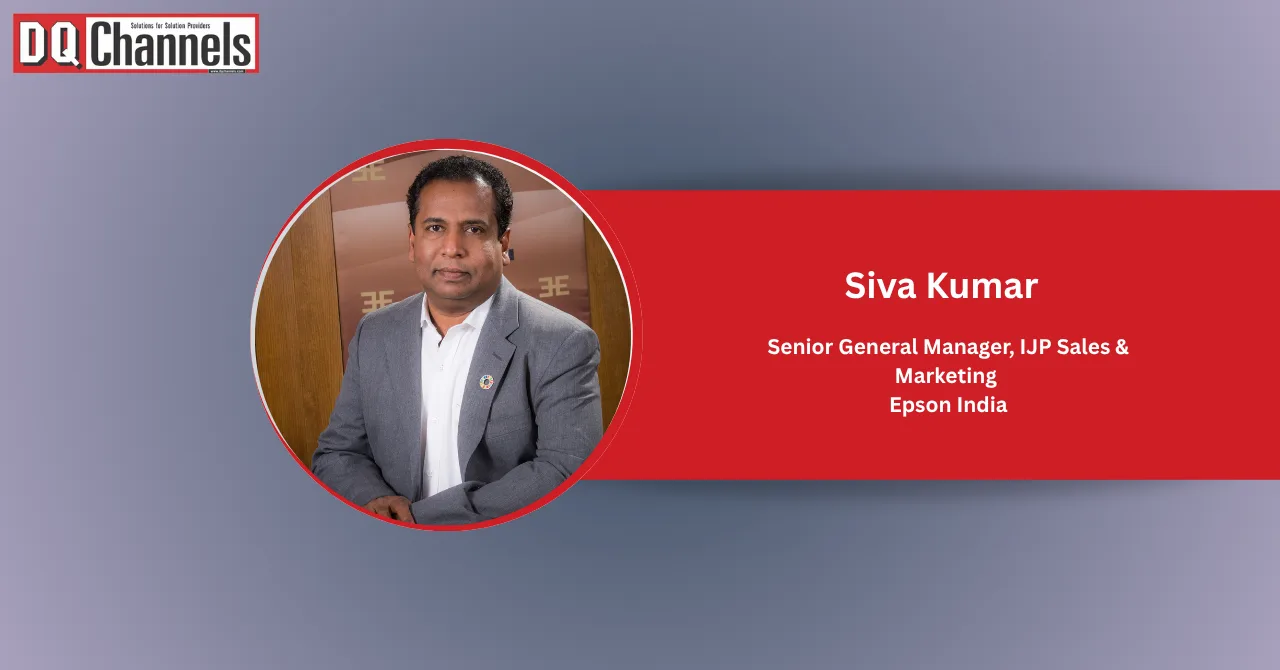
India’s printing market is changing in ways that are creating a wider role for channel partners. While traditional print workloads have been affected by digitisation, ink tank adoption is expanding across homes, offices and businesses. At the same time, customers are looking beyond the printer itself towards managed print services, print security, device management and document workflows.
For channel partners, this is shifting the opportunity from a one-time hardware transaction towards a broader relationship built around inkjet printing, managed print services (MPS), software, consumables and ongoing support. Siva Kumar, Senior General Manager, IJP Sales & Marketing, Epson India, discusses the changing market, the shift from laser to inkjet and how partners can prepare for the next phase of the printing business.
Ink tank technology is changing the market
According to Kumar, India's overall office printing market, combining laser and inkjet, is close to 3.9–4 million units. The composition of that market, however, has changed considerably.
The laser market has moved from around 1.7 million units in 2015 to about 1.5 million today. In contrast, the ink tank market has grown from around 595,000 units in 2015 to about 2.1 million units in 2025. The traditional ink cartridge segment has declined from around 919,000 units to about 206,000 units.
Overall, the market has grown from around 3.2 million units in 2015 to nearly 4 million units in FY25, with ink tank technology driving much of that growth. Importantly, ink tank adoption is no longer confined to home users. It is increasingly moving into offices and businesses.
“So, over the next three to five years, I see the biggest opportunity in the continued shift towards ink tank technology, across homes, offices and businesses.”
For partners, this creates opportunities beyond the initial hardware sale, including consumables, solutions and customer support. Kumar also sees MPS gaining traction among SMEs and mid-sized corporates, extending what can otherwise be a transactional relationship.
The laser-to-inkjet shift is still a perception game
One of the biggest barriers to wider enterprise adoption of inkjet remains perception. Office printing has traditionally been associated with laser, while inkjet has been viewed largely as a home-printing technology.
Kumar says that perception is changing as ink tank technology evolves and adoption expands among large enterprises, government organisations, corporates and banks. He also points to developments in speed and print quality, with inkjet printers now reaching speeds of up to 100 ppm.
Economics is another part of the discussion. Kumar cites an example where printing on an entry-level, sub-20 ppm laser printer using a genuine toner cartridge costs around Rs 1.50 per page, compared with around 15 paise per page on an Epson mono ink tank printer.
He also highlights power consumption and Heat-Free Technology as factors in the comparison. An entry-level 20 ppm ink tank printer, according to Kumar, consumes around 20 watts compared with approximately 300 watts for a comparable laser printer at the same print speed.
Kumar says the shift is organic rather than exponential. For enterprises, the decision increasingly involves performance, total cost of ownership, power consumption, heat, consumables and environmental considerations.
MPS creates a wider revenue pool for partners
The channel opportunity is also moving beyond hardware.
“I think the opportunity will be a combination of hardware, consumables, software and services. It is not going to be limited to hardware alone.”
Epson Print Admin can help control and monitor usage at user level and is offered on a licence-fee basis. Epson Device Admin helps monitor individual devices and printer usage. The Epson Remote Monitoring System allows connected printers to be monitored remotely, including print volumes, ink levels and meter readings.
This gives partners an opportunity to move from simply selling a printer to managing the customer's printing environment.
Under an MPS model, hardware, software, consumables and services can be brought together under one contract. Kumar says such arrangements can run for a couple of years, giving partners an opportunity to build longer-term customer relationships.
Epson wants smaller partners in the MPS opportunity
MPS has traditionally been driven by large system integrators with their own applications, monitoring systems and field teams. But Kumar says smaller system integrators and channel partners are showing interest.
The challenge is infrastructure. Smaller partners may not have the applications, resources or systems needed to run an MPS engagement efficiently.
Epson is developing an application specifically to help smaller partners manage MPS engagements. The planned application will provide access to meter readings and a dashboard for better visibility of managed devices. Kumar clarifies that the application is still under development and has not yet been launched.
“So, our focus is to make the MPS model more accessible, not just to large national partners, but also to mid-sized and smaller value-added resellers and system integrators.”
The approach also recognises that the channel will not consist of one type of partner. Epson sees different roles for IT retail partners, office automation partners, system integrators and value-added partners.
Print is becoming part of a broader IT workflow
Printing itself remains important, but the surrounding technology is expanding.
For large enterprises, Kumar identifies print security, print management, device management and document management as growing areas. Large organisations with many users and devices need greater control over usage and secure printing environments.
The requirements are different for mid-sized businesses. Here, managed services are increasingly being considered as an alternative to outright purchases, driven by cost reduction, simpler IT operations and a move from CAPEX to OPEX.
For channel partners, this means the printer can become the starting point for a wider conversation around the customer's printing environment.
Local manufacturing could influence the channel
Epson is also moving towards local manufacturing. Kumar says the company has started a manufacturing facility in Chennai in collaboration with a local manufacturer and is currently manufacturing one SKU.
The choice of an entry-level model is linked to domestic demand across home and office markets. Epson's approach is to evaluate additional SKUs and production lines as market potential and demand grow.
For the channel, Kumar says the focus is also on maintaining appropriate inventory levels and planning stock across the supply chain. If local production provides a cost advantage, he says that benefit will be passed on to channel partners.
Three capabilities will matter for partners
Kumar identifies three areas partners should develop as the market becomes more service-oriented: people and customer support, technology and monitoring, and financial readiness.
A dedicated resource can coordinate customer requirements and ongoing service. Monitoring capabilities can help partners proactively manage printer usage, ink levels and consumables. Financial readiness is important because service-led models generate revenue over the duration of an engagement rather than entirely upfront.
The message is therefore broader than simply moving from laser to inkjet.
“The key will be to stay close to the changing needs of customers, understand the technology shift and build capabilities accordingly.”
For Epson's channel, the printing opportunity is evolving from a product sale into a combination of technology, services and customer management. Ink tank adoption may be driving the hardware shift, but MPS, monitoring, software, security and document management could determine how much value partners can build around that installed base.
Read More:
National Engineers’ Day 2026: How AI is reshaping engineering and B2B technology
Beyond the SLA: Who owns the business outcome?
Why RST expects RFID to add new mileage to its TSC Auto ID business