Why Business Continuity Services Are Becoming the Next Growth Engine for MSPs

For years, cloud adoption was positioned as the natural progression of enterprise IT. Organisations moved workloads to the cloud in pursuit of flexibility, scalability and operational efficiency. However, as businesses mature in their digital transformation journeys, a different conversation is beginning to emerge around complexity, control and long-term resilience.
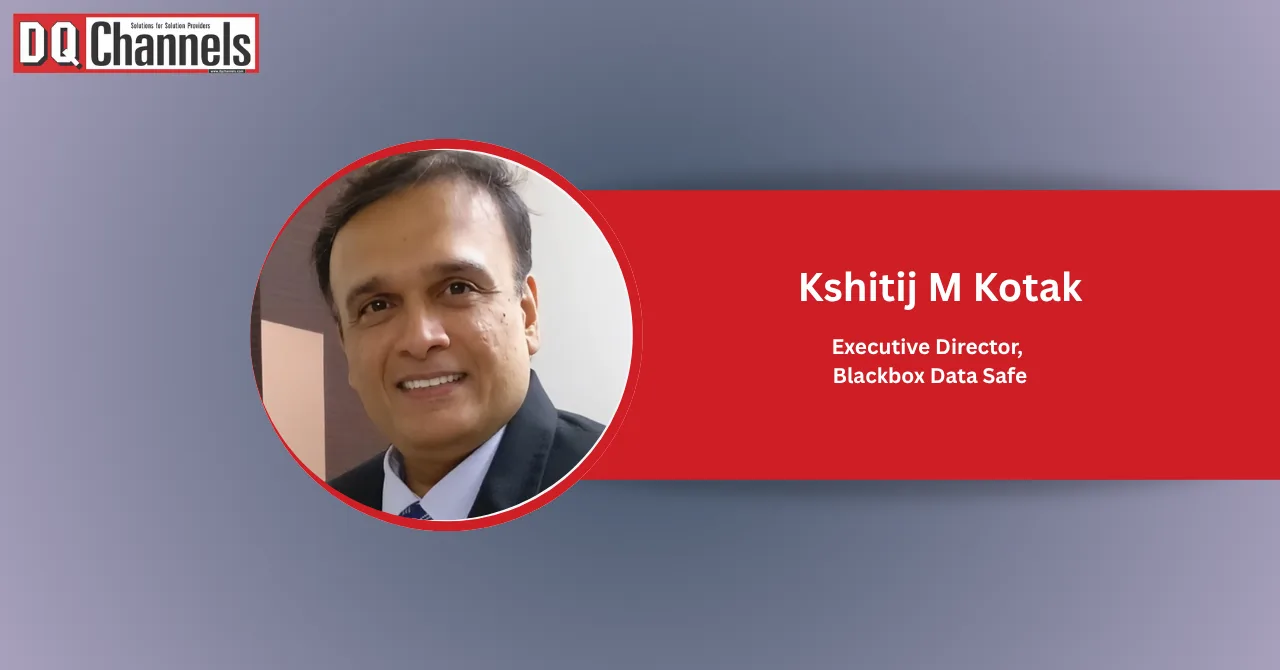
According to Kshitij M Kotak, Executive Director, Blackbox Data Safe and former CIO, many organisations are now confronting the realities of managing increasingly fragmented technology environments.
Reflecting on the rise of hybrid and cloud-centric IT architectures, Kotak offered a candid assessment.
"I have been there done that. Since 2018. It is a technical nightmare: complex to administer and expensive to maintain."
His comments highlight a challenge that many mid-market enterprises and SMBs are experiencing today. As businesses spread workloads across on-premises infrastructure, cloud platforms and multiple service providers, operational management becomes increasingly difficult. This complexity is also driving greater reliance on managed service providers for day-to-day IT operations and business continuity planning.
Customers want outcomes, not infrastructure
Kotak believes the market has already moved beyond conversations centred purely on infrastructure deployment.
Businesses are increasingly seeking partners that can help develop strategy, execute transformation projects, manage operations and provide long-term support. The expectation is no longer about deploying technology. It is about ensuring business outcomes.
"Customers are not looking for infra deployment; they actually want comprehensive strategy, execution, administration and support."
Interestingly, Kotak also points to a growing trend that is receiving increasing attention among enterprise decision-makers. According to his experience working with mid-market organisations over the past sixteen months, many customers are actively evaluating reverse migration strategies from cloud environments.
He argues that business continuity, operational resilience and availability have become fragmented across multiple platforms, causing organisations to reassess the value proposition of cloud-first approaches.
From concerns around costs and governance to questions around sovereignty and geopolitical risks, enterprises are becoming more focused on measurable business benefits rather than technology adoption for its own sake.
"Customers now are increasingly looking for tangible and measurable business advantages; cloud has moved away from that space."
The reality of multi-cloud complexity
Multi-cloud strategies are often promoted as a path towards flexibility and resilience. However, Kotak challenges the assumption that multiple cloud environments automatically simplify operations.
Using a simple analogy, he argues that organisations often underestimate the complexity that accompanies multi-cloud deployments.
"You cannot ride two bicycles with different wheel diameters without falling off and breaking both. Plus yourself."
In his view, true simplicity, visibility and operational resilience remain difficult to achieve in highly fragmented multi-cloud environments. While hybrid cloud models can provide practical flexibility, he believes the idea of achieving simplicity through multiple cloud environments remains unrealistic.
This perspective reflects a broader concern around workload visibility, recovery readiness and operational accountability. As organisations continue to distribute workloads across different platforms, maintaining consistent governance and continuity becomes increasingly challenging.
Compliance pressures are reshaping resilience strategies
India's evolving regulatory landscape is also forcing enterprises to reassess how they approach resilience, backup and disaster recovery.
Kotak identifies data protection requirements as a significant challenge, particularly for businesses operating with limited technology budgets.
"DPDP is biggest spanner, especially for businesses that cannot allot 7-12% towards technology depending upon industry vertical."
At the same time, he argues that organisations often overlook a fundamental reality. Every system designed to improve availability and resilience can also introduce new vulnerabilities.
Backup environments, disaster recovery systems and continuity frameworks are essential. However, they also expand the overall technology footprint that organisations must protect.
Ultimately, Kotak believes customer expectations have become remarkably simple.
"Customers have only one expectation: Keep business running - no matter what."
That expectation is pushing channel partners and service providers towards greater operational accountability. Organisations are increasingly looking for partners capable of delivering continuity rather than simply supplying technology.
Why guarantees deserve scrutiny
One of Kotak's strongest observations centres on the growing tendency among technology providers to make absolute claims around security and availability.
He cautions against vendors that promise complete protection without acknowledging the inherent trade-offs involved.
"Anyone who guarantees 100% uptime with 100% security against targeted attack without disconnected protection is a snake-oil trader."
His perspective reflects a pragmatic understanding of modern cybersecurity. Security, availability and connectivity often exist in tension with one another. As organisations pursue greater accessibility and operational efficiency, they must also recognise that risk can never be completely eliminated.
According to Kotak, resilience should not be measured by marketing claims but by an organisation's ability to continue operating despite disruptions.
The future of MSPs lies in resilience, not resale
Looking ahead, Kotak believes the traditional infrastructure resale model has already lost its strategic relevance.
"Era of infrastructure resale and deployment was over in 2014."
While hardware and deployment projects continue to generate revenue, he argues they increasingly serve as entry points rather than long-term business opportunities.
The larger opportunity lies in helping organisations maintain continuity, resilience and operational stability. However, Kotak also challenges conventional thinking around managed services.
Rather than advocating for endless layers of operational support, he argues that technology solutions should ultimately minimise the need for intervention.
"If anything needs support, it is not well done."
This philosophy reflects a growing demand for systems that are designed for simplicity, reliability and autonomy. Businesses want technology that works consistently in the background without requiring constant management and oversight.
Business continuity is becoming the ultimate value metric
The responses from Kshitij M Kotak reveal an increasingly important shift in enterprise technology conversations. Organisations are becoming less focused on infrastructure choices and more focused on operational outcomes.
Cloud adoption, hybrid architectures, disaster recovery frameworks and compliance initiatives are all being evaluated through a single lens: can the business continue operating without disruption?
The growing complexity of modern IT environments is creating new opportunities for managed service providers, but only for those capable of delivering measurable resilience rather than transactional services.
As enterprises confront rising operational complexity, evolving regulations and increasing cyber risk, the most valuable partners may not be those selling the latest technology. Instead, they will be those helping organisations ensure continuity, maintain control and reduce uncertainty in an increasingly fragmented digital landscape.
Read More:
Synology Computex 2026: How Enterprise Storage and AI Readiness Are Reshaping Channel Opportunities
Backup as a service: Synology shifts towards outcome-led cyber resilience
Why AceCloud sees managed services as the future of cloud partnerships




 2 Min read