/dqc/media/agency_attachments/2026/08/21/2026-08-21t061716244z-dq-channels-logojpg-2026-08-21-11-47-17.jpeg)

/dqc/media/media_files/2026/09/10/dq-channels-whatsapp-2026-09-10-17-07-48.png)

 Follow Us
There is a simple problem hiding inside modern IT operations: everything can look fine on the dashboard while something important is already going wrong for the customer.
A server may be up, the database may be responding, and no major threshold may have been breached. Yet a payment is taking too long, checkout is failing, or an employee cannot complete a critical task. Technically, the infrastructure is available. From the user’s point of view, the service is not working as expected.
That gap between system health and business experience is beginning to reshape managed services. For years, channel partners were judged on familiar measures such as uptime, response time, resolution time and SLA compliance. Those metrics still matter, but customers increasingly want to know what the service actually delivered.
Did transactions continue? Was disruption prevented? Did productivity improve? Was the customer journey protected?
That is where outcome-based IT begins to change the conversation.
The idea is attractive because it moves the relationship beyond technology delivery. At the same time, it creates a harder question for channel partners, system integrators and MSPs: how much of the final business outcome can they realistically own?
The SLA is moving closer to the business
Traditional SLAs are comfortable because they measure things that are fairly clear. Availability can be tracked. Response time can be recorded. Resolution time can be reviewed.
The difficulty is that these measures do not always reflect what the customer actually experiences.
An application may remain available while transaction latency rises enough to frustrate users. A server can meet its uptime target even when a business process depending on it is failing.
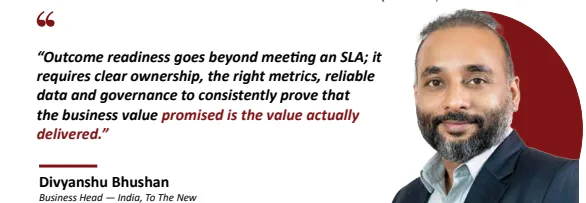
Outcome-based services therefore need a different starting point. Instead of beginning with the technology, both sides need to agree on the business problem and what success will look like.
For productivity, the useful measure may be cycle time, throughput, capacity released or cost per transaction rather than the number of processes automated.
For customer experience, success might mean faster resolution, higher conversion, better retention or another clearly defined improvement.
The same applies to reliability. Generic infrastructure uptime tells only part of the story. Measuring whether an important customer journey completed successfully within an agreed time says much more.
This does not mean traditional SLAs disappear. They become the operational foundation beneath a smaller number of business outcomes.
Define success before discussing price
Outcome-based contracts become weak very quickly if commercial terms are discussed before measurement is agreed.
Both sides need a baseline, a limited set of relevant metrics, agreed data sources and a clear measurement period. Without those, almost every later claim of improvement can become debatable.
ROI creates another challenge because not every transformation benefit appears directly as money saved.
Some improvements are easy to quantify, such as lower processing cost or reduced downtime. Others need credible operational measures.
Productivity can be reflected in shorter cycle time or more work handled with the same resources. Resilience can be measured through faster recovery and avoided disruption. Risk reduction can be demonstrated through fewer incidents or stronger controls.
The point is not to convert every benefit into a financial number. It is to make sure every promised benefit has a credible way to be measured.
That also helps partners answer an important question before signing: is this an outcome they can genuinely influence?
Control matters as much as commitment
Business results rarely depend on one technology provider.
Customer behaviour, internal processes, management decisions, data quality, adoption, Cloud platforms, telecom networks and third-party applications can all affect the final result. A partner may deliver its technical responsibilities well and still see the wider business outcome fall short.
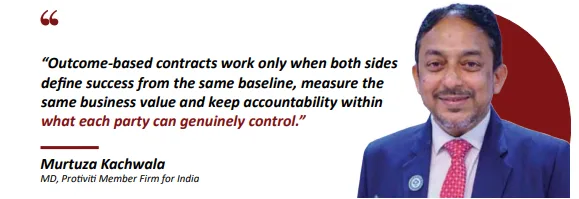
This is why an outcome contract needs to separate what the partner controls, what it can influence and what remains outside its authority.
A partner may be expected to guarantee application availability while a critical third-party dependency sits outside its control. Or it may be held responsible for performance even though the customer can make unreviewed production changes.
The SLA may sound ambitious, but the operating model underneath it is fragile.
Service boundaries, customer dependencies, data definitions, decision rights and exceptions for major changes need to be agreed before accountability is transferred. These are not legal details added at the end. They define whether the service can be delivered at all.
Risk management becomes part of the service
Once a partner starts accepting responsibility for business outcomes, commercial risk becomes part of service design.
Putting all outcome risk on the service provider may look attractive from the customer side, but it becomes difficult to sustain when important variables remain outside the provider’s control.
A more balanced model can combine a predictable base component with a variable component linked to agreed outcomes.
That still creates accountability, but it avoids pretending that one party controls everything.
For channel partners, this is an important shift. The question is no longer only whether they can deploy, manage or support the technology. They also need to ask whether they can responsibly own the result.
Better contracts, therefore, are not just about stronger wording. They depend on a more realistic view of operational control.
Visibility has to come before accountability
A partner cannot sensibly guarantee an outcome in an environment it cannot properly see.
Customer estates are rarely clean. There may be legacy infrastructure, fragmented monitoring, undocumented dependencies, old applications, capacity constraints and third-party systems that become visible only when they fail.
Before taking responsibility, partners need to understand the infrastructure, applications, network, Cloud dependencies, endpoints, cybersecurity controls and operating processes involved.
Historical incidents can reveal recurring weaknesses. Existing performance data can expose capacity constraints. Recovery procedures should be tested instead of simply accepted as documented.
The partner also needs to know where the blind spots are.
A useful readiness test is straightforward:
Can the partner measure the outcome?
Can it understand the dependencies behind it?
Can it intervene when required?
Can it recover predictably?
Can it produce evidence of what happened?
If not, responsibility needs to stop at the boundary of actual control.
A partner could, for example, accept responsibility for monitoring and incident coordination while excluding end-to-end availability until it has accurate service mapping, visibility into dependencies and authority over the changes required for recovery.
That is not weak contracting. It is disciplined contracting.
Outcome readiness is also a margin test
There is another practical issue that cannot be ignored: cost.
Observability platforms, telemetry storage, automation, security controls and skilled people all cost money. Poorly defined outcome commitments can increase incident costs, create disputes and reduce managed services margins.
Partners therefore need to track cost-to-serve alongside customer value.
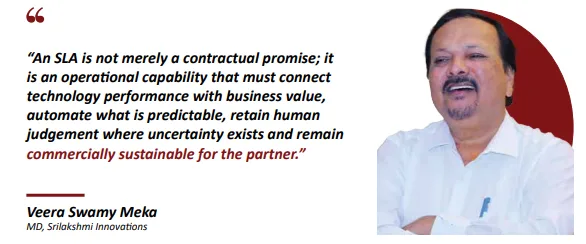
The goal should not be to promise the widest possible outcome. It should be to own outcomes that can be delivered consistently and profitably.
This matters especially for smaller and mid-sized partners.
A technically impressive service that destroys its own margin is not a mature outcome model. Nor is an agreement sustainable when one side carries risks it cannot control.
Procurement will need to adjust too
Traditional IT procurement is comfortable comparing licences, infrastructure, project costs and service hours.
Outcomes are harder because the buyer and provider first need to agree on the baseline, measurement method and the factors that influence the result.
That makes business involvement more important. When the discussion moves towards productivity, resilience, customer experience or transaction performance, it can no longer remain only between IT and procurement teams.
Partners will also need broader skills.
Technical capability remains essential, but outcome-based services demand stronger consulting, analytics, business-process understanding, commercial judgement and risk management.
The partner is no longer simply operating technology. It is helping the customer connect technology performance with business performance.
The real test is knowing what to own
Outcome-based managed services create a strong opportunity for channel partners because they bring them closer to the customer’s business. But the opportunity comes with a warning.
Outcome accountability cannot be created by simply rewriting an SLA.
Partners first need a clear definition of success, a credible baseline, measurable outcomes, enough control over the operating environment and commercial terms that reflect shared risk.
If those pieces are missing, the promised outcome should become narrower until the capability catches up.
The strongest partner may therefore not be the one willing to guarantee the most. It may be the one that knows exactly what it can responsibly own.
And once that responsibility is accepted, the next question becomes even more important: how does the partner actually deliver the outcome?
That is where observability, AIOps, service mapping, automation, security controls and service-level engineering come into play.
Read More:
12 years of Make in India: Why electronics and Semicon could define the next phase
Tier 2 and Tier 3 Markets: What UBON sees in India's next growth phase
ADCTA and AU Small Finance Bank support taxpayer registration camps in Nehru Place
Enterprise AI partners: Why domain expertise and integration now matter