/dqc/media/agency_attachments/2026/08/21/2026-08-21t061716244z-dq-channels-logojpg-2026-08-21-11-47-17.jpeg)

/dqc/media/media_files/2026/09/10/dq-channels-whatsapp-2026-09-10-17-07-48.png)

 Follow Us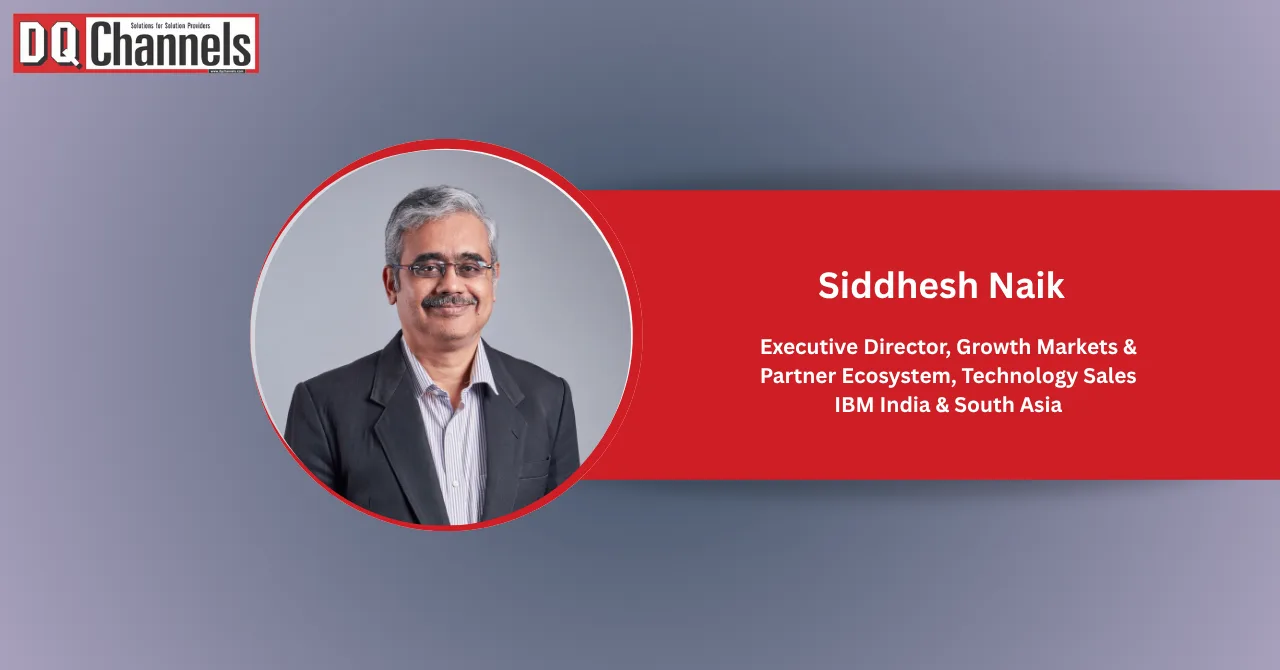
Enterprise AI is moving into a different phase. The early stage was largely about pilots, often running in isolation. Production is different. AI has to work with existing applications, workflows, automation, infrastructure, data and security controls.
That shift is changing the role of technology partners. They are no longer simply implementing technology. They increasingly need to understand the customer’s environment, industry and business processes and help integrate AI into day-to-day operations.
Siddhesh Naik, Executive Director, Growth Markets & Partner Ecosystem, Technology Sales, IBM India & South Asia, says the move from pilots to production is creating a much broader role for partners, spanning AI governance, data foundations, security, hybrid infrastructure, industry expertise and change management.
“The partner paradigm is completely changing in terms of partners who bring in deep customer relationships, who bring in the domain knowledge, and the implementation skills as well on our platforms are the ones who are able to thrive.”
AI production is creating a more complex partner opportunity
Moving an AI use case into production brings several layers together. Agentic AI, for example, has to integrate with existing automation and tooling while operating within defined governance and security guardrails.
Naik points to the need for audit trails that can show whether an agent is behaving according to its defined objective. The architecture itself can span cloud, multi-cloud and on-premises environments, alongside data, models, security and existing applications.
There is also a less technical but equally important requirement: change management.
“You bring in a beautiful change, but if the operations team doesn't embrace it, it means nothing.”
For partners, this creates opportunities across the AI lifecycle. These include agentic workflows, AI governance, AI-ready data foundations and security.
Naik says customers are recognising that AI cannot scale without the right data foundation. That means addressing data quality, governance, access policies, personally identifiable information and the risk of model hallucination.
AI governance and security are becoming core partner skills
As AI enters regulated environments, governance becomes more than a compliance exercise.
Naik points to scenarios such as a bank using a credit risk model or an AI system involved in a home-loan decision. The organisation needs to understand why a decision was made. Models can also drift as datasets change, while partners need to consider issues such as hallucination, hate profiles and profanity.
“While AI brings in a significant value, you got to have all the right guardrails in place to ensure you are able to deliver that value in the right way.”
Security is another major opportunity. Naik highlights database activity monitoring, data security, identity and access and access governance. The rise of agentic AI also introduces machine identities that need to be secured and tracked.
This creates a need for partners with both deep technology skills and industry knowledge.
“A marriage of the tech platform and the domain skills, I think, is the name of the game with the partners.”
Real-world examples show where partners are building AI solutions
IBM’s partner ecosystem already provides examples of this convergence between technology and domain expertise.
For responsible AI, Naik cites Infosys, which uses IBM watsonx.governance for AI governance across risk, compliance and process governance for BFSI deployments.
In lending, Lending Labs has created Ontoz, a platform for loan-related processes including home loans, auto loans, loans for MSMEs and KYC and customer onboarding. The platform is built on IBM Cloud and uses agentic capabilities.
Another example is NeuroGaint Systems, which has developed NeuroLC, an agentic platform for trade finance automation. The solution is designed to support workflows around Letter of Credit processing for banks.
In security, SkySecure Technologies has built an AI SOC platform. Its agentic capabilities can help with alert triage, investigation, root-cause analysis and response preparation, while consequential actions remain subject to human approval.
These examples illustrate the shift Naik describes: the technology platform is only one part of the solution. Domain understanding determines how that technology is applied.
Reusable IP can turn projects into recurring opportunities
One of the challenges for partners is moving beyond one-off AI projects. IBM’s Build and co-creation approach is focused on helping partners create reusable assets, solution patterns and industry skills that can be taken to multiple customers.
Naik gives the example of pharma, where partners need to address requirements such as CAPA and FDA regulations. An asset created for one customer can potentially be adapted across the industry.
The same approach is being developed across BFSI, pharma, discrete manufacturing, process manufacturing and government.
Sandbox environments can allow partners to build and demonstrate solutions before deploying and replicating them.
This creates a path from individual implementation work towards repeatable AI solutions and industry-specific IP.
Sovereign AI is expanding the conversation
AI adoption is also bringing sovereignty into the partner discussion.
Naik says the conversation is moving beyond data sovereignty towards technology sovereignty and operational control-plane sovereignty. For regulated or government environments, questions can include where the cloud control plane is located and where AI inference takes place.
IBM is bringing this into its sovereign platform discussions through IBM Sovereign Core, according to Naik.
For partners, sovereignty therefore becomes another dimension of designing AI environments for regulated sectors rather than simply addressing where data is stored.
Open ecosystems will matter as AI enters existing IT
Enterprise AI will not replace existing applications and automation overnight. Partners need to integrate agentic platforms with the systems customers already operate.
That makes interoperability increasingly important.
“Nobody is going to change their core applications or RPAs or tooling or automation they have put up over the years, but the agentic platform that I'm talking about has to go and integrate with all of that.”
Naik also highlights the role of open-source foundations in IBM’s platform approach. For partners operating in multi-vendor environments, the ability to integrate across a diverse technology landscape becomes a core capability.
SMB and MSME opportunities need a different approach
The AI opportunity is not limited to large enterprises. Naik says MSMEs are increasingly moving directly towards agentic AI rather than following the traditional path from machine learning to more advanced AI.
But cost and fit remain important.
For banks and fintechs, one opportunity is automating MSME onboarding, including KYC and corporate KYC. At the same time, Naik says enterprise solutions cannot simply be forced into the MSME market.
“You can't force fit an enterprise solution into an MSME piece.”
Instead, partners need lightweight solutions at an appropriate price point.
The next differentiator is the ability to integrate
As AI moves from pilot to production, scale alone may no longer distinguish partners.
Naik says partners need to combine scale with specialised domain skills, industry knowledge and ecosystem collaboration. They also need to integrate AI with existing enterprise applications and platforms.
“So, it's not just about scale anymore. It is also about your ability to combine scale with specialized domain skills, industry knowledge, and the ability to collaborate across ecosystems.”
There is another factor: fungibility. The technology landscape changes quickly, and what is relevant today may be replaced by something new within months.
For partners, the ability to absorb new technology and build on it becomes critical.
“How do I have a platform and a partner who's able to absorb the new and build on it is what has become the name of the game.”
The broader message is that enterprise AI is becoming an integration and transformation challenge as much as a technology one. Partners that can combine domain expertise, AI governance, security, data, integration and ecosystem collaboration will have a wider role as customers move AI into production.
And that role extends beyond technology implementation. Naik says partners that can engage at the CXO level and help organisations drive change are becoming increasingly important as enterprises scale their AI journeys.
Read More:
AI-powered managed services: Where the next channel opportunity lies
When green dashboards hide red flags: Building outcome-ready IT operations
Epson inkjet printers: Why the bigger channel opportunity is beyond hardware
Sennheiser wireless audio solutions go on show in at InfoComm India