
Can India Build Its Own AI Stack Without Relying on Global Tech Giants?

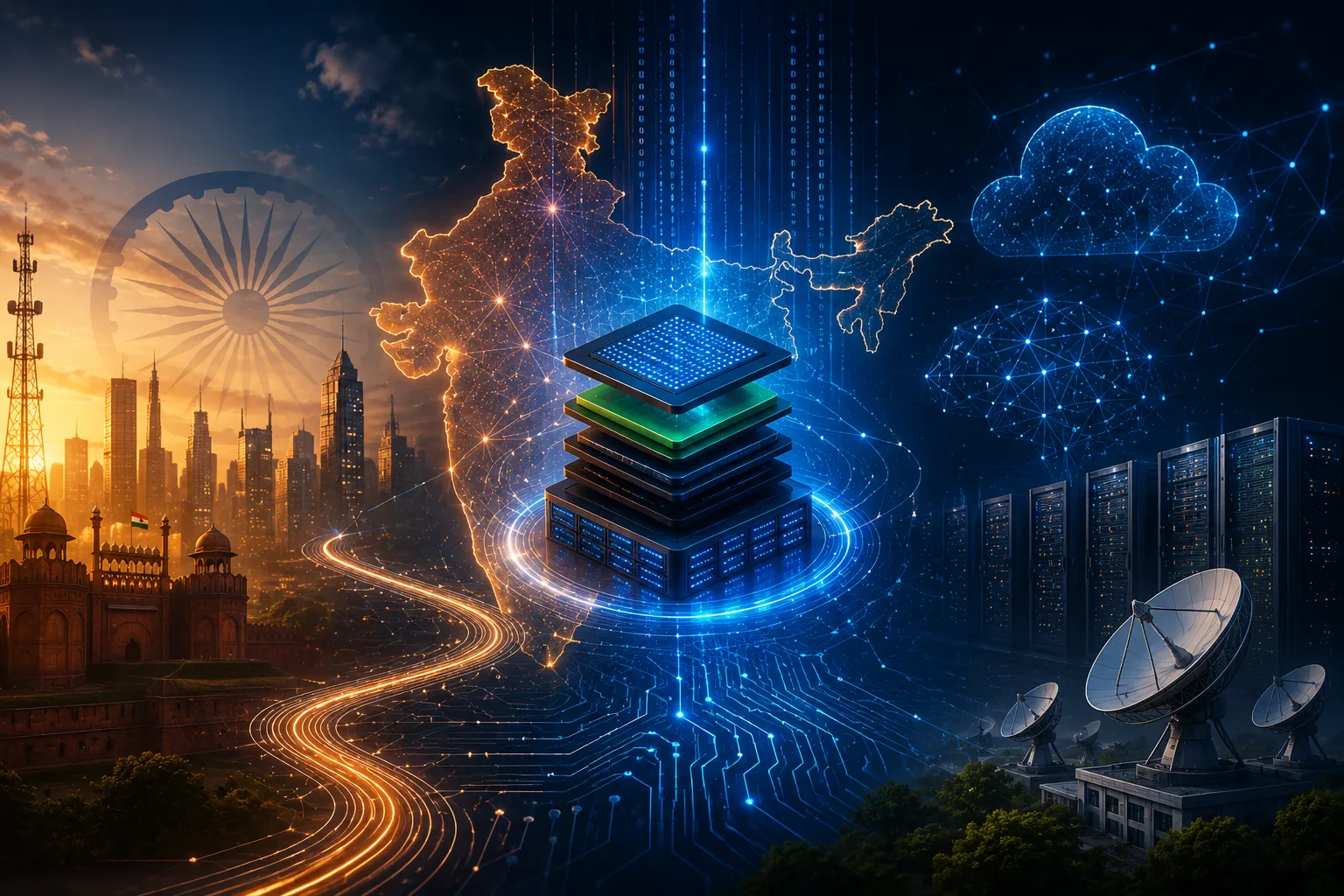
How artificial intelligence is developing at a fast pace is unanticipated by most governments. Just as energy grids and railways once ranked economies, artificial intelligence seems destined to be a new growth factor.
For India, the debate has now moved on. No one has really argued whether AI will change how the country works, governs, and competes. The more challenging question is whether the country's AI ecosystem will be built to reflect its own values and preferences.
The last two years have brought real movement: the IndiaAI Mission, fresh investment in cloud infrastructure, and early multilingual model development. None of this is trivial. But a large language model alone doesn't add up to an AI ecosystem. Genuine capability requires progress across several layers at once — compute, data governance, cloud platforms, foundation models, applications, and the policy scaffolding that connects them. Getting all of that to function together demands sustained investment and coordination that goes well beyond any single ministry or company.
Why AI Sovereignty Matters
India's digital economy has been greatly enabled by the presence of global technology platforms, which have fast-tracked innovation and digitally transformed industries. However, with AI comes a different concern.
Modern AIs require advanced computing resources, data, and decision-making authority in everything from healthcare and finance to governance and public services. Having a tiny handful of providers that control most of that stack rings serious alarm bells for data sovereignty, affordability, cloud audits and staying in control over the decades that follow.
AI sovereignty isn't merely ownership over data. It also comes with control over infrastructure, the marketplaces and the entire ecosystems on which these systems operate. The capacity to develop and deploy AI within a nation is a real strategic strength, not solely for security, but for data sovereignty over the long game.
The Building Blocks
India is already equipped with a significant portion of the infrastructure required for establishing its own AI ecosystem.
Over the last few years, India has proven its strength in building digital systems at scale, Aadhaar, UPI and ONDC being just a few examples. These are platforms that hundreds of millions of people use daily, and have inclusivity at their core level of innovation.
The natural next step should then be to transmute that same energy into AI.
The government has been investing heavily in India's computing power and GPU availability, so researchers, startups and large companies have access to it. The idea is to weaken the reliance on foreign AI infrastructures and empower Indian creators.
And that work is actually underway. BharatGen is training an AI that will be proficient in Indian languages, and BHASHINI is taking on one of India's most intriguing yet unacknowledged problems: creating a multilingual language AI that spans the country's massive linguistic spectrum. These are not merely research initiatives. They are preparing an Indian-centric AI infrastructure.
These puzzles are falling into place. India has created a digital public infrastructure. It has the opportunity to copy that in artificial intelligence and maybe even do better.
The Reality Check
India is on the move. The AI value chain is inherently interconnected. India needs semiconductors, high-performance GPUs and open source research that is coming from all over the world. Even the leading AI programs, from the US, China, and Europe, take advantage of international hardware supply chains and international research collaborations.
So it shouldn't be total technological dependence that we want. The aim should be strategic control.
India doesn't have to develop every part of an AI system here in order to be relevant. But it has to develop the capabilities here that will ensure that it remains autonomous, keeping AI workloads partially on local private cloud hosting, developing AI models suited to Indian consumers, and managing its own data.
Three priorities should be: maintaining ownership of AI research within India, focusing on data sovereignty and creating robust domestic capabilities that minimise exposure and build an ecosystem.
Leading step in the future
If India really wants to lead in AI in the future, we need to keep building regional AI infrastructure. Otherwise, all sorts of researchers, startups, and large institutions find it difficult to develop.
It is vital that we invest in AI models that truly understand Indian languages and the local context. Given the diversity in Indian languages, an English-centric model cannot suffice.
Nonetheless, no single aspect will be able to develop an AI ecosystem that closes these digital gaps. For this scenario to become a reality, real efforts by government, academia, startups, and infrastructure providers will be required.
The opportunity goes beyond India. There are many countries that face similar challenges, for example: growing linguistic diversity, multi-layered regulatory systems, data sovereignty requirements and limited access to AI infrastructure. If India manages to create an institutionalised, credible, autonomous AI ecosystem at scale, it could become a benchmark for other economies facing the same challenge.
Written By - Padma Reddy Sama, Co-Founder, BharathCloud
Read More:
From ERP to ERX: How AI Is Turning Planning into Intelligent Execution
Red Hat explains why hybrid cloud and open source is a channel opportunity
Why AI security is becoming the biggest growth opportunity for channel partners
Why Dell believes AI PCs need consultative selling, not hardware transactions








 2 Min read