
From Perimeter Security to Identity-Aware Access: The Evolution of Enterprise Security Architectures

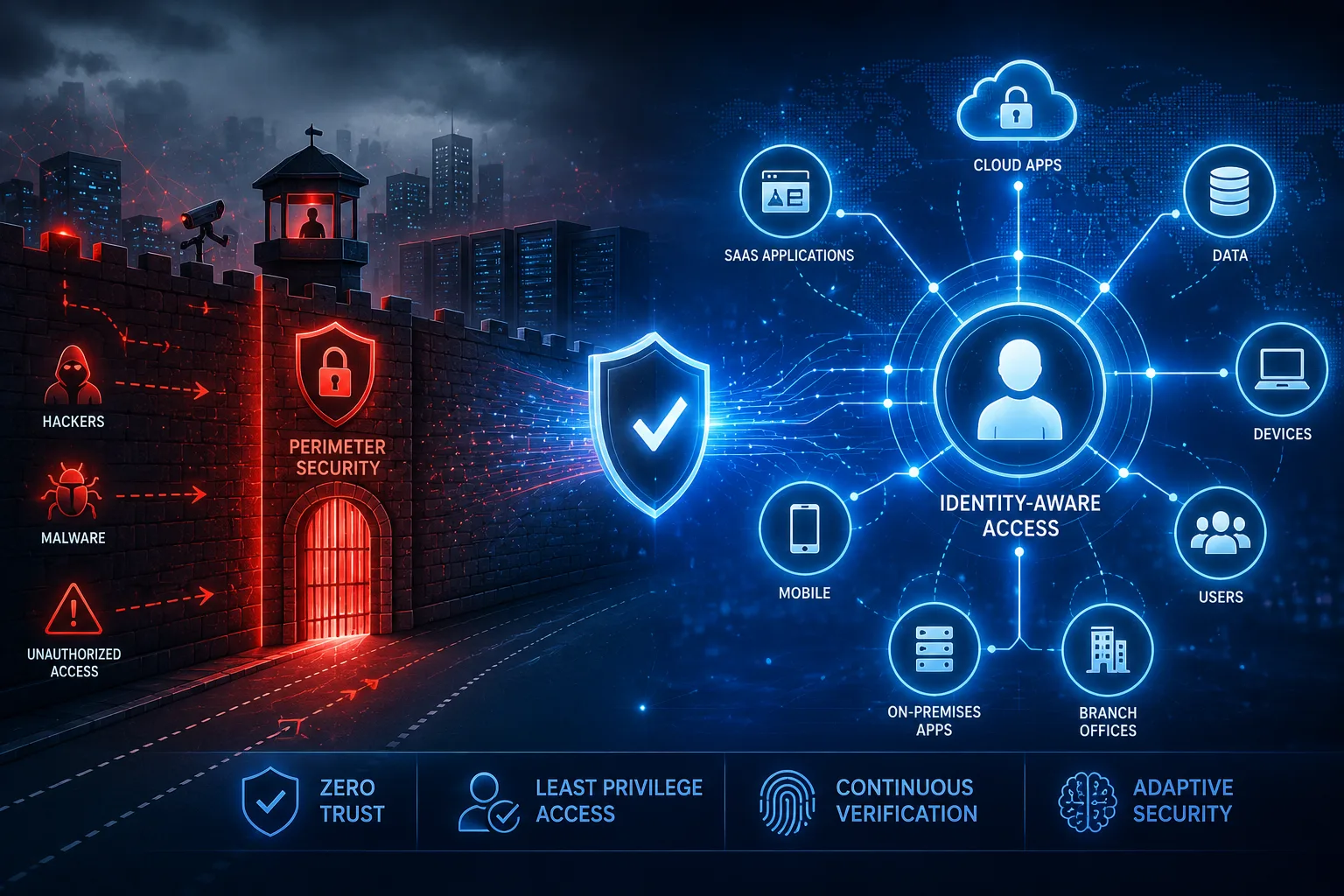
For many years, enterprise security was focused on the simple concept of preventing outside threats and trusting those inside the network. Once users were inside the security perimeter formed by firewalls, VPNs and secure gateways, they were widely trusted. This approach was effective when users, applications and data were all confined within a specific space.
That boundary no longer exists.
The traditional perimeter has disappeared as organisations transformed to cloud environments, adopted SaaS applications and made hybrid work possible. Critical systems have become accessible from anywhere, often using unregulated or personal devices. Perimeter-based security also creates blind spots. It introduces security gaps, limits visibility, and increases the risk of unauthorised access, making it ill-suited to today's dynamic enterprise landscape.
The Collapse of the Traditional Perimeter
The manner in which security must operate has completely transformed as a result of the move toward distributed IT environments. Network traffic no longer flows through a single regulated path, and applications are no longer limited to data centres. Instead, users access resources virtually from anywhere using a wide range of devices and networks.
According to Gartner, over 80% of organisations are expected to adopt a cloud-first method by 2025, which will significantly reduce reliance on traditional on-premises infrastructure. This evolution has grown the attack surface and made it more challenging to apply perimeter-based controls alone to enforce consistent security policies.
In this new strategy, virtual private networks (VPNs) - once a vital part of remote access - also show their limitations. Rather than offering application-level control, they provide network-level access, often enabling additional access than is necessary. This increases the risk, especially in the instance that user credentials are compromised.
Identity Becomes the New Control Point
Identity has developed into the most reliable way of enforcing security in environments where there is no apparent perimeter.
Identity-aware access shifts the focus from the exact location of a user's connection to the user's identity and the context behind their request for access. This includes factors like user identification, location, posture and behaviour of the device.
This approach is in accordance with Zero Trust principles, which operate on the concept of "never trust, always verify." Instead of automatically offering access, every request is continuously authenticated and constantly evaluated based on risk.
The benefits of identity-aware access are significant. Instead of limiting access to whole networks, access could be limited to specific applications. Real-time blocking or flagging of risky login attempts is enabled. Additionally, compromised credentials can be prevented before they can affect more serious breaches.
Beyond Authentication: Context Matters
Identity-aware security extends beyond authentication - it is driven by context.
For example, it can be simple for a user to log in from a known location and device. But the same user could be exposed to additional authentication or restrictions if they attempt to log in from an unusual location or device. Without unnecessarily compromising the user experience, this dynamic approach improves security.
According to Microsoft’s security research, more than 99.9% of account compromise attacks can be blocked using multi-factor authentication (MFA). This underlines how important it is to strengthen identity as the initial line of defence.
However, identification is inadequate in itself. To build a complete comprehensive security architecture, it must be integrated with network constraints, device posture assessment, and continuous monitoring. Together, these capabilities provide a layered approach that enables organisations to verify every access request and respond effectively.
Integrating Security with Application Access
Infrastructure's position is evolving as organisations adopt identity-aware access. Security is now integrated into the delivery of applications rather than existing as a separate layer.
Identity-based rules are increasingly being implemented through the adoption of technologies like application delivery controllers (ADCs) and secure access gateways. Without increasing unnecessary delays, these systems can manage to evaluate user context, efficiently route traffic and implement security measures.
In hybrid environments, where applications are distributed across on-premises and cloud platforms, this integration is particularly important. Implementing regulations continuously throughout different environments ensures that security remains independent of the spot of the application.
Balancing Security and User Experience
Ensuring the right balance between security and a smooth user experience is one of the major challenges when implementing identity-aware access. Users can get dissatisfied by extremely restrictive security measures, while inadequate controls could result in vulnerabilities.
The objective is to apply security effectively based on the levels of risk. Technologies such as Single sign-on (SSO), adaptive authentication solutions, and continuous session monitoring enable maintaining this balance and provide seamless access under low-risk conditions while enforcing stronger verification for users when risk is high.
This risk-based approach enhances security and usability to improve productivity in hybrid work environments without compromising the protection of critical resources.
Conclusion: A Necessary Shift
The shift from perimeter security to identity-aware access reflects a fundamental change in how organisations approach security and protect their digital environment. It is more a strategic change in architecture and risk management instead of just a technological advancement.
Identity provides a stable and reliable control system in a world where users, devices and applications are constantly evolving. Organisations that still rely only on perimeter defences face a risk of lagging behind in terms of operational efficiency and being unable to tackle security threats effectively.
Integrating identity, context and intelligent infrastructure is essential to the future of enterprise security. By continuously verifying every access request based on identity and context, organisations can adopt a Zero Trust security model that strengthens resilience while enabling secure access from anywhere. Because in today's digital world, trust must always be continuously verified and is no longer defined by network location.
Written By - Shibu Paul, Vice President – International Sales at Array Networks
Read More:
OVHcloud sees managed services replacing traditional cloud resale in India
How Ziroh Labs sees the next phase of enterprise AI beyond GPU infrastructure
How AI transformation is replacing traditional IT services for enterprises
Why managed detection and response will define the future of cybersecurity partners








 2 Min read