
The Compliance Tax Has Eaten the Tariff

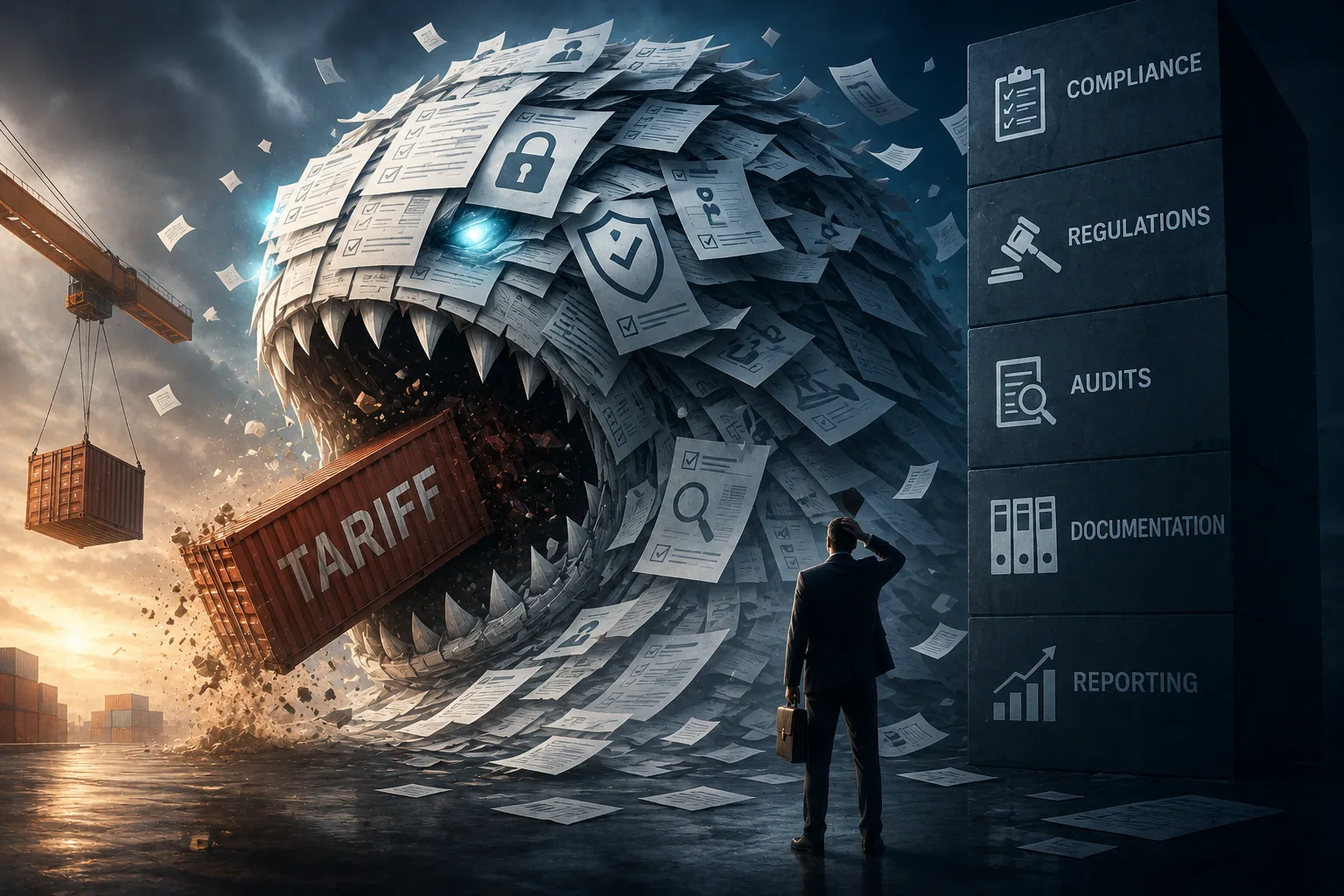
Compliance has become the bigger invoice. A senior procurement head at a European auto components buyer told me earlier this year that his team now spends more on the people who classify, document, and audit a shipment than on the freight that moves it. He said it as a complaint. It reads like a diagnosis of where supply chain economics have quietly moved to.
Most resilience playbooks in 2026 still read like tariff playbooks. They model the duty. They model the reroute. What they almost never model is the compliance overhead that rerouting creates: the duplicate testing, the dual origin documentation, the rule-of-origin proofs that auditors now demand for every preferential claim. The number quietly blowing up procurement budgets across Asia is not the headline tariff. It is the second invoice, arriving thirty days later, in the form of denied preferences, reclassification penalties and storage fees at bonded warehouses while lawyers argue.
Three forces rerouting the trade map right now
The “deglobalisation” narrative represents a fundamental oversimplification of the complex structural shifts reshaping global trade. Trade is not retreating, it is being rewritten at a level of granularity that most enterprise systems simply cannot see.
First, the corridor map has hardened into something durable. The Red Sea reroute that began in late 2023 is still adding 10 to 14 days on Asia-Europe lanes and Drewry’s composite World Container Index in April 2026 was running 38 percent above the pre-disruption baseline. The Panama Canal’s Gatun Lake constraints have eased from their 2023 lows but haven’t normalised and the US Gulf remains structurally short on Asia-bound reefer capacity. These are no longer “disruptions” to recover from. They are lane characteristics, baked in.
Second, the commodity complex has split into two species that behave nothing like each other. There are the policy commodities (copper, steel, aluminium, semiconductors, lithium precursors) where prices are now driven as much by Section 232 actions, EU CBAM phase-in adjustments, and export licensing as by fundamentals. And then there are the weather commodities, where the FAO Food Price Index still moves on harvests and El Niño transitions. Procurement teams treating both with the same hedging playbook are losing on both fronts. The IEA’s April 2026 monthly oil report showed Brent trading in a 14-dollar band over the quarter, the tightest range in eighteen months, while copper moved 22 percent in the same window on policy news alone. That is not one market. That is two markets pretending to be one.
Third, trade is reorganising into corridors, not blocs. The US-India bilateral framework negotiated through 2025 has already shifted electronics and pharmaceutical intermediates meaningfully. The EU-India FTA, concluded in principle in February, opens a long negotiating runway that Indian exporters are already pricing into capacity decisions. Mercosur deals, the AfCFTA protocol stack, the IPEF supply chain agreement: none of these are slogans anymore. They are lanes with their own rulebooks, and a shipment that qualifies under one can be inadmissible under another.
Why “China plus one” is not the resilience it claims to be
The most overused phrase in 2025 boardrooms was “China plus one.” The least examined was whether the plus one actually works.
Capacity is not capability. A factory floor in Vietnam, Mexico, or Tamil Nadu does not become a substitute simply because the contract is signed. The bottleneck has shifted from assembly to qualification. Tier 2 and Tier 3 suppliers rarely exist at the new geography, and rebuilding them takes three to five years, not three to five quarters. UNCTAD’s 2025 World Investment Report noted that greenfield announcement values hit a record $1.4 trillion, yet the ratio of announcements to operational capacity actually coming online is the worst it has been in two decades. There is far more paper resilience than real resilience.
For Indian enterprises, this should be welcome news, but not comforting news. The country has genuine depth in chemicals, auto components, electronics manufacturing services, and pharmaceutical formulations. PLI-linked capacity in electronics crossed ₹1.6 lakh crore in cumulative production value by early 2026. But the buyers rerouting their supply chains are not asking whether Indian suppliers exist. They are asking whether those suppliers can survive a CBAM audit, an IPEF data protocol check, a RoDTEP claim dispute, and a sudden BIS classification change, all in the same quarter, without missing a shipment. The firms that can answer yes, with documentation rather than just confidence, are the ones converting interest into orders.
What actually beats stockpiling
Optionality is the only form of resilience that compounds. The question is no longer “Do we have a second supplier approved?” It is: “Can our landed-cost system quote me three alternative routings by tomorrow morning, and does our contract architecture let us switch on Tuesday without a penalty?” That is a different operating model entirely. It rewards companies that have invested in continuous commodity and regulatory monitoring, not those that bought the most impressive annual forecast report.
The IMF’s October 2025 World Economic Outlook estimated that global trade growth will settle into a 2.8 to 3.2 percent corridor through 2027, well below the pre-2010 average, but deeply uneven across corridors. Static planning cannot navigate uneven. Dynamic decision infrastructure can.
Stop measuring your supply chain by what it can absorb. Start measuring it by what it can reconfigure before your competitor does.
Written By - Vishal Ranjan, Founder & CEO of Claight
Read More:
The missing layer in enterprise AI: Why data trust is becoming the new priority
AI Channel Partners: Why Advisory Services Will Define the Next Growth Phase
Beyond Passive Data: Transforming EPC and Manufacturing through AI‑Enabled Digital Twins







 2 Min read