
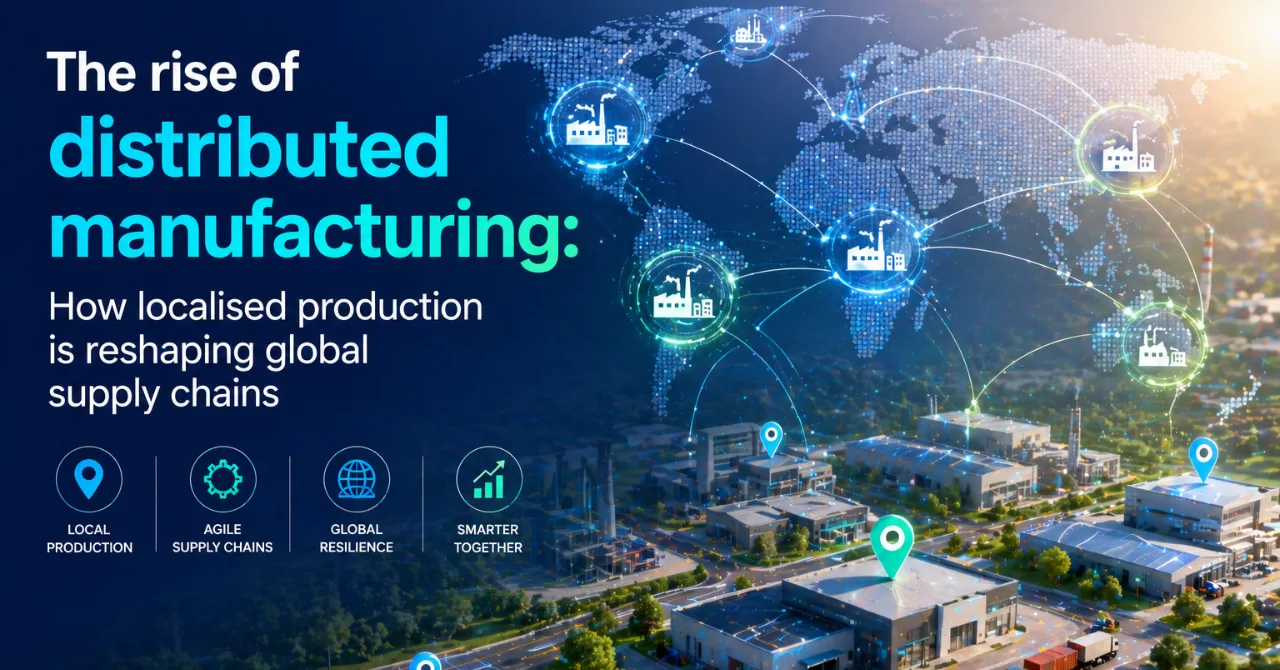
The rise of distributed manufacturing: How localised production is reshaping global supply chains

For decades, the logic of global manufacturing was built on a simple and powerful premise: produce where it is cheapest, then ship to where it is needed. This model delivered genuine efficiency gains and made a wide range of goods accessible at price points that would have been impossible with purely local production. It also, as the world discovered with considerable discomfort across the pandemic years and the supply chain disruptions that followed, created a fragility that nobody had fully priced. When a single factory cluster in one geography was disrupted, or a port was congested, or a shipping route became unavailable, the ripple effects ran through supply chains that had been optimised for efficiency at the cost of resilience. The lesson was both expensive and clarifying.
Distributed manufacturing is the response that is taking shape. Rather than concentrating production in large, low-cost facilities serving global demand from a single geography, the distributed model spreads production capacity across multiple locations -- closer to the markets being served, with less dependency on any single node in the supply chain. This is not simply a risk-management adjustment. It is a fundamental rethinking of where value is created in the production process, and who captures it.
The drivers of this shift are converging from multiple directions simultaneously. Geopolitical fragmentation has made long-distance supply chains politically exposed in ways they were not a decade ago -- tariffs, sanctions, export controls and the weaponisation of trade relationships have all increased the risk cost of dependency on distant production. Consumer expectations around lead times have compressed in markets where two-day delivery has become the baseline reference point, making the economics of local or regional production more competitive than proximity-based models would have been justified by cost alone. And technology -- particularly in the form of advanced manufacturing equipment, automation and digital production management tools has reduced the minimum efficient scale of production, making it economically viable to run smaller, localised facilities that would previously have been uncompetitive against larger centralised operations.
For manufacturers with export operations across multiple geographies, this shift creates both opportunity and pressure. The opportunity is in being closer to key markets in ways that improve responsiveness, reduce working capital tied up in transit inventory and build the direct customer relationships that distant production makes difficult. The pressure is in the investment required to build and maintain distributed production capability, manage quality consistency across multiple facilities and develop the local supplier relationships that regional production depends on. Neither dimension can be ignored.
India sits at an interesting inflexion point in this story. Years of investment in manufacturing capability, a large and skilled engineering workforce, improving logistics infrastructure, and a government policy environment that has been actively encouraging domestic production and export orientation have positioned the country to participate in distributed manufacturing networks in ways that were harder to realise a decade ago. For Indian manufacturers who have historically been primarily domestic-market-focused, the distributed manufacturing trend creates a genuine pathway to deeper integration with global supply chains, not by competing on pure cost, but by offering a combination of quality, flexibility, and geographic positioning that the new supply chain architecture is looking for.
The shift toward distributed manufacturing is not going to resolve the tension between efficiency and resilience -- it is going to rebalance it. Some degree of efficiency will be traded for supply chain security, for speed to market and for the political and operational durability that distributed production provides. For manufacturers who understand that trade-off and invest accordingly, the structural changes underway in global supply chains represent one of the more significant competitive repositioning opportunities in recent memory. The companies that move with this shift rather than against it are the ones that will find themselves better placed on the other side of it.
Written By - Aayaan Bery, Sales and Marketing Director | RAI at KSP Inc.
Read More:
Managed security services: How Acronis Is transforming partner ecosystems
Managed security services: How partners are becoming cyber risk owners








 2 Min read