
Arduino VENTUNO Q targets edge AI systems

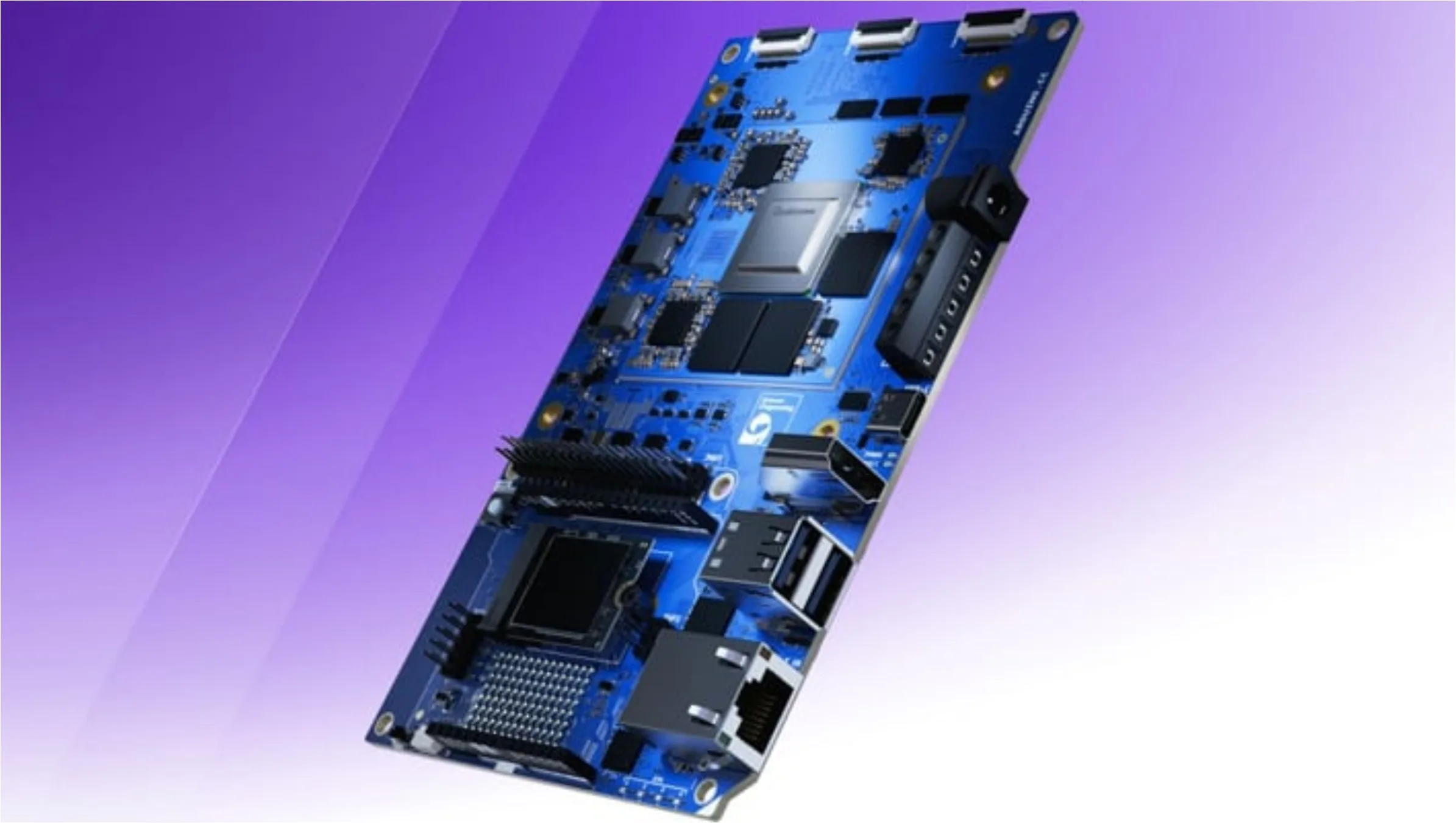
Arduino has announced the upcoming launch of Arduino VENTUNO Q, a new platform designed to support the development of edge AI applications. The board expands the capabilities of the long-running Arduino UNO family and arrives as the organisation approaches its 21st anniversary.
VENTUNO Q is intended to simplify the creation of intelligent machines that operate locally. The platform combines AI computing capabilities with deterministic real-time control, allowing systems to analyse their environment and respond immediately without relying on cloud infrastructure.
The board is designed for developers, educators and researchers working on robotics, automation, and intelligent sensing systems.
Architecture designed for AI and real-time control
At the core of Arduino VENTUNO Q is a dual-processor architecture. The platform integrates a Qualcomm Dragonwing IQ-8 Series processor to handle AI workloads alongside an STM32H5 microcontroller responsible for real-time control tasks.
The processor supports both traditional and generative AI workloads. According to the company, the integrated neural processing unit provides up to 40 dense TOPS of AI acceleration.
The platform also includes:
16 GB RAM for handling simultaneous AI inference tasks
Expandable storage up to 64 GB
A dedicated microcontroller for deterministic low-latency control
This separation of compute and control allows the system to process data while managing precise physical actions such as motor control.
Fabio Violante, VP and GM, Arduino, Qualcomm Technologies, Inc., said the platform is designed to bring AI into physical systems rather than keeping it in the cloud.
“With VENTUNO Q, AI can finally move from the cloud into the physical world. This platform makes it possible to build machines that perceive, decide, and act — all on a single board.”
Expanding access to edge AI
The platform is intended to make advanced AI capabilities more accessible to developers. By integrating high-performance processing with Arduino’s hardware ecosystem, the company aims to support experimentation and rapid prototyping.
Nakul Duggal, EVP and Group GM, Automotive, Industrial and Embedded IoT, Qualcomm Technologies, Inc., said the collaboration focuses on bringing AI development tools to a wider developer base.
“By uniting Arduino's developer ecosystem with the power of Dragonwing processors, we are making advanced edge AI available to millions of developers worldwide.”
He added that the platform allows devices to understand their environment and respond directly at the edge.
Applications across robotics, automation and AI systems
Arduino positions VENTUNO Q as a development platform for multiple edge AI use cases. The board can support autonomous systems that operate entirely offline.
Potential applications include:
AI-powered systems
Local voice assistants running large language models
Smart mirrors responding to gestures
Interactive information kiosks in public spaces
These systems can run speech recognition and text-to-speech processing locally without sending data to external servers.
Robotics and motion control
The platform is designed to support robotic systems requiring visual recognition and movement control. Example scenarios include:
Vision-guided pick-and-place robotic arms
Service robots capable of recognising and following individuals
Autonomous robots navigating complex environments using Visual SLAM
The integration of AI inference with real-time actuation allows machines to respond immediately to environmental changes.
Edge vision and sensing systems
VENTUNO Q can also support intelligent monitoring and inspection systems. Potential use cases include:
Safety monitoring systems that detect hazardous behaviour
Traffic monitoring devices processing data locally
Manufacturing inspection systems that identify defects in components
These applications rely on computer vision models operating directly on the device.
Education and research
The platform is also positioned as a learning tool for developers exploring AI and robotics. It can be used to demonstrate topics such as computer vision, AI inference and generative models in a single environment.
Unified development environment
A key element of Arduino VENTUNO Q is its integrated development environment. The platform supports a combination of operating systems and development frameworks.
The main processor runs Ubuntu or Debian Linux, while the microcontroller operates on the Arduino Core running on Zephyr OS. This architecture allows developers to run complex applications while maintaining predictable timing for hardware operations.
Development workflows are integrated into the Arduino App Lab, which supports:
Arduino sketches
Python scripts
Pre-built AI models
These models include tools for speech recognition, gesture detection, pose estimation and object tracking. According to the company, the platform allows these capabilities to run entirely offline.
The development environment also integrates with Edge Impulse Studio for projects requiring custom machine-learning models. Additional AI frameworks are expected to be supported in the future.
Hardware designed for robotics and AI workloads
VENTUNO Q can function as either a connected development board or a standalone single-board computer.
The platform includes several hardware features intended for robotics and industrial systems:
Industrial I/O interfaces including CAN-FD and PWM
High-speed GPIO for hardware control
Support for multiple MIPI-CSI camera inputs
Advanced audio interfaces and display connectivity
2.5 Gb Ethernet networking
The board also supports ROS 2 workflows, which are widely used in robotics development.
Compatibility with existing ecosystems
Another design goal is compatibility with existing development hardware.
VENTUNO Q supports:
Arduino UNO shields
Arduino Modulino nodes
Qwiic sensors
Raspberry Pi HATs
This compatibility allows developers to reuse existing hardware components when building prototypes or experimental systems.
Looking ahead
With the introduction of Arduino VENTUNO Q, the company is extending its platform from microcontroller-based prototyping to more complex AI-driven systems.
The combination of AI processing, real-time control and integrated development tools aims to reduce the complexity of building intelligent machines that operate at the edge.
For developers exploring robotics, automation and embedded AI systems, the platform represents an attempt to bring multiple capabilities into a single development board.
Read More:
Check Point launches secure AI advisory service to govern and scale enterprise AI
NEURA Robotics Qualcomm collaboration robotics AI announced
Sandisk Extreme Fit USB-C flash drive launches
AMD Ryzen AI 400 Series processors Expands the future of AI PCs






 2 Min read