Freshworks and Sonata Software: How AI is driving predictable partner revenue

The enterprise software market is moving through a clear transition. Partners are no longer rewarded just for transactions. They are being measured on outcomes, recurring revenue, and their ability to deliver real business value from AI-led platforms.
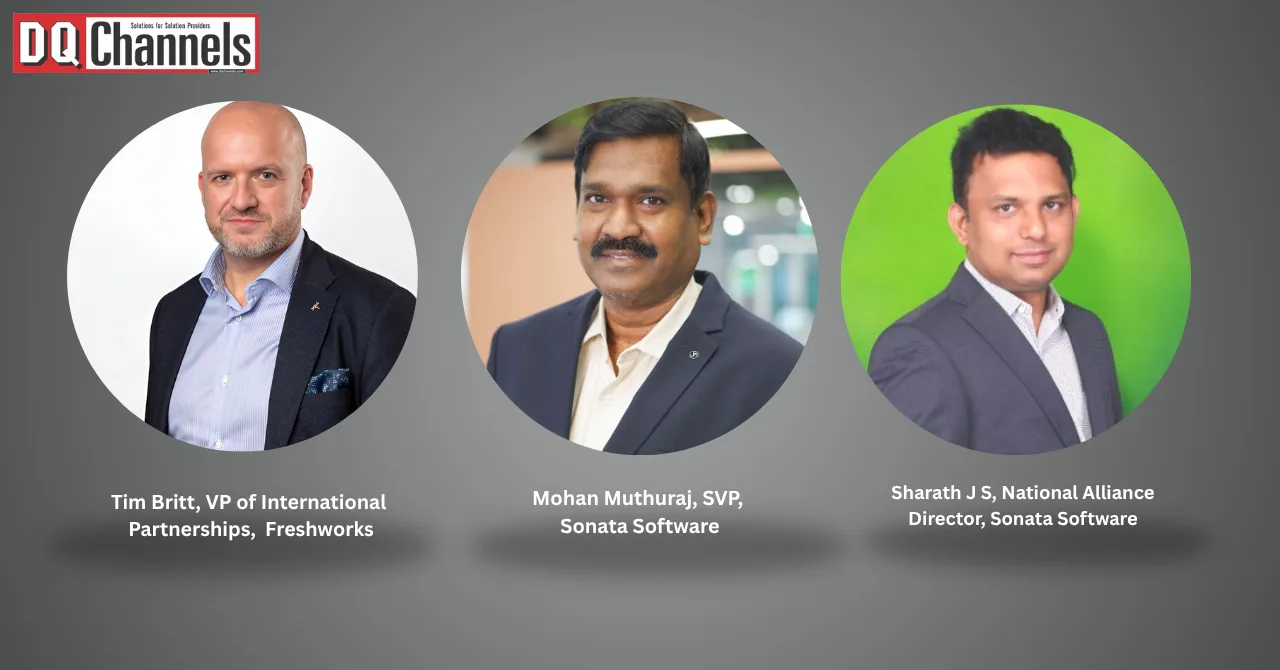
In a recent interaction, Tim Britt, VP of International Partnership at Freshworks, along with Mohan Muthuraj, SVP at Sonata Software, and Sharath J S, National Alliance Director at Sonata Software,outlined how this shift is playing out through their partnership.
Partner revenue models are shifting toward predictable margins and lifecycle ownership
The biggest structural shift is visible in how partner economics are evolving. The move from commission-led models to resale-driven engagement is creating more predictable revenue streams.
As Tim Britt explained, “when you move to a true resale model, you have upfront discounts, but you also have the partner owning the lifecycle of the customer. That includes services, management, and expansion opportunities beyond the initial deal.”
This model ensures partners are not limited to deal closures. They benefit from long-term customer relationships and recurring service layers.
AI-led services are driving deeper partner engagement beyond product sales
AI is no longer a feature that sits on top of enterprise platforms. It is becoming central to how services are delivered, optimised, and monetised.
From Sonata’s perspective, the focus is not just on selling tools but demonstrating measurable outcomes. “The real outcome… is how AI actually brings business benefit to the customer. Customers can see how it works live, not just hear about it,” noted Sharath J S.
This shift is forcing partners to invest in pre-sales capability, proof-of-concept environments, and technical expertise that can translate AI into real operational value.
Migration and adoption remain the biggest barriers in mid-market segments
While demand for modern platforms is rising, adoption is rarely straightforward. Most customers already operate on legacy systems, making migration a critical challenge.
Mohan Muthuraj highlighted this clearly: “customers will always be using some tools already. The challenge is how to migrate that data and ensure they can use the new system seamlessly.”
This is where partners play a decisive role. Beyond implementation, they must manage data migration, ensure continuity, and drive user adoption.
Vertical-specific solutions are becoming essential for enterprise deals
Generic platform positioning is no longer enough. Enterprises are demanding solutions tailored to their industry-specific workflows and challenges.
Sonata is addressing this by building use cases across industries and replicating them across similar customers. “We bring in that expertise… and make a proposal like a verticalized offering to the customers,” said Mohan Muthuraj.
This approach is particularly visible in sectors such as IT services and BFSI, where early success stories are shaping future deployments.
AI adoption is moving from experimentation to measurable ROI
One of the most important shifts highlighted in the discussion is how customer expectations around AI have matured.
Earlier, enterprises were experimenting. Now they are demanding measurable returns. “Last year, customers were trying AI…
now they want to see what value they are getting from it,” Mohan added.
This is changing how solutions are evaluated. AI is no longer optional. It is a core requirement, but only if it delivers tangible efficiency gains and cost savings.
Co-selling and joint execution are accelerating partner capability building
Traditional enablement methods, such as training sessions and documentation, are no longer sufficient to build partner capability.
Freshworks is focusing on co-selling as a primary mechanism for learning and growth. “Working together on real customer opportunities helps partners learn much faster than traditional training,” Tim Britt explained.
This approach allows partners to understand customer needs, build joint solutions, and accelerate their own service maturity.
Final takeaway: partnerships are becoming execution engines, not just sales channels
The Freshworks–Sonata partnership reflects a broader transformation in the channel ecosystem. Partners are no longer intermediaries. They are execution engines responsible for delivering outcomes.
They must combine technical capability, industry knowledge, and lifecycle ownership to stay relevant. At the same time, vendors must build programs that reward long-term value creation, not just transactions.
The direction is clear. The future of partnerships will be defined by who can translate technology into measurable business impact.
Read More:
Lenovo India Partner Program reshapes channel growth
AI data centre infrastructure India: Why storage is now critical for scaling AI






 2 Min read