/dqc/media/agency_attachments/2026/08/21/2026-08-21t061716244z-dq-channels-logojpg-2026-08-21-11-47-17.jpeg)

/dqc/media/media_files/2026/09/10/dq-channels-whatsapp-2026-09-10-17-07-48.png)

 Follow Us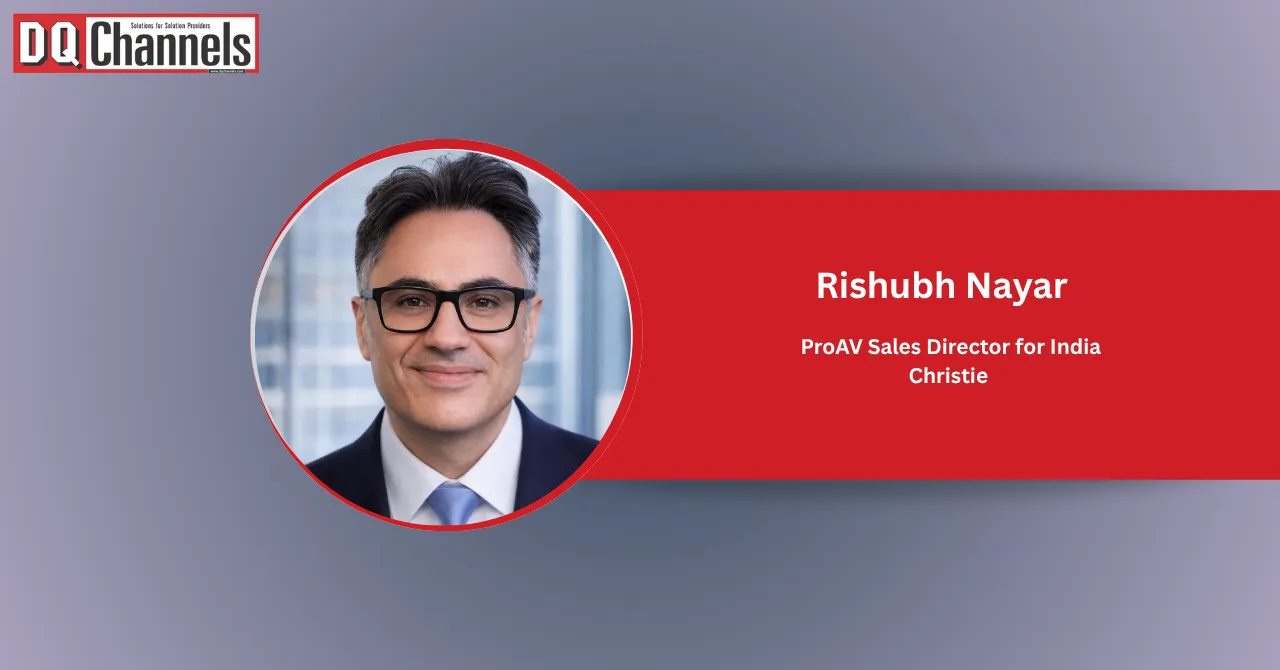
India’s ProAV market is opening up across government, enterprise, museums, experience centres and emerging applications. For Christie, the opportunity is not simply about selling projectors or LED displays. It is about helping customers solve a larger visual and installation challenge, while giving partners the technical capability to execute and support those projects.
That is the central message from Rishubh Nayar, ProAV Sales Director for India, Christie, who describes a market where solution selling, partner capability and service support are becoming increasingly important.
Nayar says Christie has historically avoided a product-only approach.
“We were never a box pusher, we were never a projector seller, we were never an LED seller, we always believed in selling problem-solving for a client.”
That approach continues through products such as the Spider processing system, Mystique automatic calibration, and Terra AV over IP. The objective, he explains, is to address not just the visible display but also what sits behind it.
India’s ProAV opportunity is spread across different markets
Nayar describes India as several distinct markets rather than one uniform geography. Government demand is concentrated strongly in the North, with Delhi playing an important role because of the presence of the central government.
Enterprise demand, meanwhile, is concentrated more heavily in the South, with Bengaluru, Pune, Chennai and Hyderabad among the locations where Christie sees business.
Regional governments create another layer of demand across the country.
When asked about growth opportunities, Nayar points to Gujarat and Karnataka as particularly important markets, alongside Delhi.
The same regional diversity can be seen across Asia Pacific. Nayar says China is Christie’s largest ProAV market in the region, with India the second largest. He also identifies South Korea and Vietnam among the significant markets.
For India, however, the opportunity goes beyond the established metropolitan centres.
Premium ProAV needs a demonstration-led sales approach
Christie operates in a premium segment, and that creates a practical challenge for both the company and its partners: customers want to understand what they are buying before making a significant investment.
Nayar compares the process with buying a premium automobile.
“You would never buy a Mercedes or a BMW without testing the product.”
Christie has an experience centre in Bengaluru where customers can see products in operation. The company also sends projectors to customer locations for demonstrations so they can evaluate performance within their own applications.
Nayar says this is particularly relevant for new customers who have not previously used Christie products.
The demonstration model therefore becomes part of the solution-selling process. It allows customers to see how the technology performs in the environment where it is expected to work rather than evaluating specifications alone.
Partner capability is central to the Christie model
Christie’s India ProAV business works with a group of value-added resellers, supported by distributors but not built around a distribution-centric model.
These partners receive technical training through Christie’s technical service organisation. The focus is on first-level support, installation and commissioning.
For premium ProAV equipment, Nayar argues that installation quality is as important as the product itself.
“To make our products, which are already the most premium-priced products, look good, it's extremely important for them to be installed and commissioned well.”
This is where Christie University also comes into the picture. Nayar describes it as the company’s online training portal, giving partners access to its courses around the clock at no charge.
The broader partner programme combines online learning with hands-on product training.
Before a product launch, resellers receive physical training on installation and commissioning. The objective is to ensure that customers receive consistent execution whether an installation is handled directly or through a partner.
Service is a trust factor, not just a revenue stream
For Christie, service is not being positioned simply as another revenue opportunity for the channel.
Nayar says the company has not consciously worked towards making services a revenue model. Instead, the emphasis is on giving customers confidence in their investment.
“Whenever anyone buys a Christie product in India, he knows that there is a sense of belief and comfort when it comes to services and the support structure.”
That service capability also supports the partner proposition. Certified technical partners and service capabilities can give resellers a larger role in the lifecycle of ProAV installations.
For Nayar, the real measure is whether the equipment is properly installed, commissioned and supported after the sale.
Partners are expected to take solution expertise into new verticals
Christie does not position itself as a large opportunity-generation engine. Nayar is unusually direct about that.
He says the company’s small sales team cannot create all the opportunities in the market. Instead, partners often create opportunities themselves or develop use cases for customers.
This makes the reseller’s understanding of applications particularly important.
Christie sees opportunities across areas such as tourism, museums and theme parks, where installations can create new use cases and then be replicated elsewhere.
Partners entering a new vertical can receive guidance and training from Christie around the applications and practices relevant to that market.
The model therefore works in both directions: Christie provides technology and technical expertise, while partners bring market relationships, application knowledge and opportunities.
India’s emerging installations are changing the ProAV opportunity
One of Nayar’s strongest observations is about the spread of sophisticated AV installations beyond the largest cities.
He points to museums being developed even in Tier-3 locations as an example of how the market is expanding.
“A tier 3 city, which would possibly not even be accessible by train, leave aside by air, would have a museum which is going to house 200 projectors.”
For Christie, such projects underline the breadth of the Indian ProAV opportunity.
Corporate investment is another major area. Nayar points to the growth of global capability centres and the investment by Indian IT companies in experience centres for their clients.
In all these environments, AV becomes part of the overall customer and employee experience rather than simply a display requirement.
Christie is expanding its India commitment
Nayar says Christie’s India presence has grown from a team of two people in 2007 to more than 50. He also points to investment in localisation, including a Make in India programme for government clients when the company launched its direct-view LED offering.
He is clear, however, that Christie does not have a manufacturing unit in India. The company has a light-engine clean room but does not manufacture products locally.
The broader message is one of continued investment in the Indian market and in the partner ecosystem supporting it.
For Christie, India’s ProAV opportunity is therefore not confined to projectors or LED walls. It spans the complete solution — from processing and AV over IP to installation, calibration, commissioning and service.
And that is where Nayar sees the real partner opportunity.
The market is growing across government, enterprise, museums, theme parks and experience centres. But technology alone does not complete the project. Technical capability, application knowledge and dependable post-sales support remain central to delivering the kind of installations Christie wants its customers to experience.
Read More:
Outcome-based managed services: The high stakes of owning business outcomes
12 years of Make in India: Why electronics and Semicon could define the next phase
Tier 2 and Tier 3 Markets: What UBON sees in India's next growth phase
Enterprise AI partners: Why domain expertise and integration now matter