
From AI hype to AI responsibility: The next phase of assessment innovation

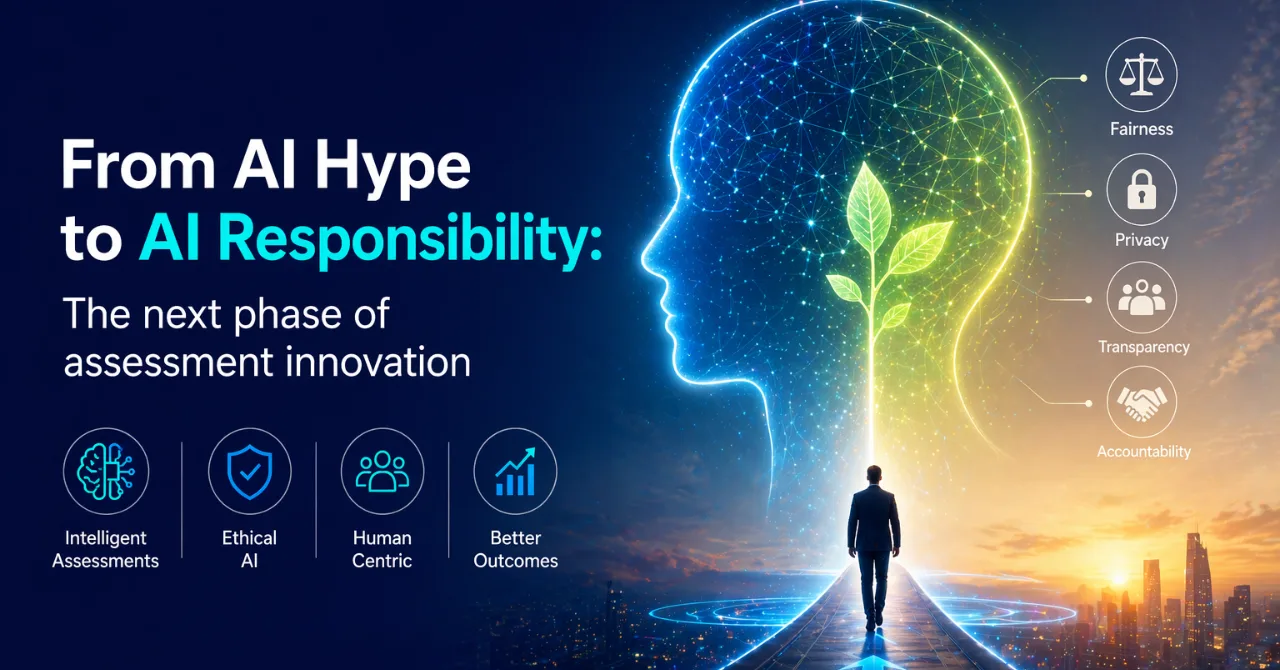
For the last few years, artificial intelligence in assessment has been surrounded by a familiar cycle of excitement. The early conversation was dominated by possibility: AI could generate questions, accelerate grading, strengthen remote proctoring, detect anomalies, and offer faster feedback. That phase mattered because it expanded the horizon of what assessment systems could do. But the sector is now entering a more consequential phase. The central question is no longer whether AI can be used in assessment. It is whether AI can be used responsibly in environments where trust, fairness, and credibility are non-negotiable.
This shift is important because assessment is not just another digital workflow. It is a high-stakes system of judgment. It influences progression, certification, recruitment, compliance, and learner confidence. In such a context, AI cannot be treated as a novelty layer or a convenience feature. It has to be treated as infrastructure. That means reliability, explainability, security, privacy, human oversight, and governance are not optional add-ons. They are design requirements from the beginning. In my own recent work, it has become increasingly clear: long-term value in assessment will come not from building faster, but from building responsibly.
The market itself is beginning to reflect this maturity. Publicly available assessment technologies already span AI-assisted item authoring, automated essay scoring, AI-supported grading, and AI-driven proctoring. Questionmark promotes AI-assisted item writing for faster test creation; ETS’s e-rater engine scores essays and provides writing feedback; Turnitin’s Gradescope supports AI-assisted answer grouping for grading; and platforms such as Proctorio, Honorlock, Mercer | Mettl, and Talview use AI within online proctoring and exam integrity workflows. These examples show that AI is no longer peripheral to assessment operations. It is becoming embedded across the lifecycle.
Yet maturity in usage does not automatically mean maturity in design. That is the real fault line. The next phase of assessment innovation will belong to organisations that can move from “AI-enabled” to “AI-accountable.” In practical terms, that means asking harder questions. Can an AI-supported scoring or proctoring decision be explained to an educator, institution, regulator, or learner? Can anomalous outputs be reviewed and challenged? Are models being used with clear boundaries around what they should and should not decide? Is there a documented human-in-the-loop process for exceptions, appeals, and edge cases? These are not technical details. They are the foundations of trust.
Responsible AI in assessment also requires a deeper respect for domain context. Generic AI can be impressive, but assessment demands contextual intelligence. A system must understand constructs, rubrics, evidence, accommodations, test design, and the difference between efficiency and validity. If AI simply makes an assessment process faster without strengthening its integrity, it may create new forms of risk rather than new forms of value. This is why domain-specific adaptation matters so much. One of the strongest lessons from my own AI journey has been that meaningful assessment innovation comes from integrating AI deeply into workflows, not bolting it on at the surface.
A responsible AI-led assessment framework, in my view, rests on five principles.
First, purpose alignment: AI should support the educational or evaluative intent of the assessment, not distort it for convenience. Second, human accountability: final responsibility must remain with institutions, educators, certifiers, or assessment owners, not with opaque automation. Third, explainability and auditability: systems should generate defensible evidence trails, not black-box outcomes. Fourth, security and data discipline: the assessment chain must protect learner data, preserve integrity, and operate within clear governance controls. Fifth, scalability with fairness: the framework must work not just in pilots, but in real operating environments without compromising accessibility, consistency, or trust. These are the kinds of controls that internal AI governance efforts at Excelsoft are increasingly focused on through model selection, validation, risk controls, human oversight, and responsible deployment practices.
This is also why the industry should be careful about confusing automation with progress. In assessment, more AI is not always better AI. The best systems will be those that know where automation adds value, where human judgment must remain central, and where transparency matters more than speed. An AI-generated question may save time, but only if it is psychometrically sound. An AI-flagged exam session may improve vigilance, but only if review processes are fair and proportionate. An AI-supported essay score may accelerate turnaround, but only if the scoring logic is aligned to the construct being measured and is subject to quality controls.
The encouraging sign is that the assessment ecosystem is moving in this direction. Even vendors are increasingly framing AI in terms of integrity, reviewability, and human-centred use rather than pure automation. Inspera, for example, explicitly positions academic judgment as remaining in human hands, while its platform integrates secure delivery, grading, and integrity workflows. That is a useful signal for the sector: the future of assessment AI will not be defined by how invisible humans become, but by how intelligently humans and AI work together.
The next phase of assessment innovation, then, is not about chasing the next demo. It is about building systems that can be trusted at scale. Hype may open the door, but responsibility is what will determine who earns the right to shape the future of assessment.
Illustrative reference list: AI tools used in the assessment sector
- Questionmark Author Aide - AI-assisted item writing for assessment authoring.
- Excelsoft AI-levate - AI-assisted item writing, rewriting and similarity check.
- ETS e-rater - AI-based essay scoring and writing feedback.
- Turnitin Gradescope - AI-assisted answer grouping and grading workflows.
- Proctorio - AI-based automated online proctoring.
- Honorlock - AI monitoring combined with live proctoring.
- Mercer | Mettl SecureProctor - AI-assisted proctoring, identity verification, and fraud detection.
- Talview AI Proctoring - AI proctoring for multiple assessment formats.
- Inspera Assessment - a digital assessment platform with integrated integrity and grading workflows.
Written By - Adarsh Sudhindra, Chief Innovation Officer, Excelsoft Technologies
Read More:
Managed security services: How partners are becoming cyber risk owners
Managed security services driving cybersecurity transformation and business resilience
AI channel transformation: why partners are moving from resale to managed services
AI redefining distribution strategy toward platform-led partner ecosystem








 2 Min read