From Assembly to Innovation: India’s Shift Towards Indigenous LED Display Manufacturing

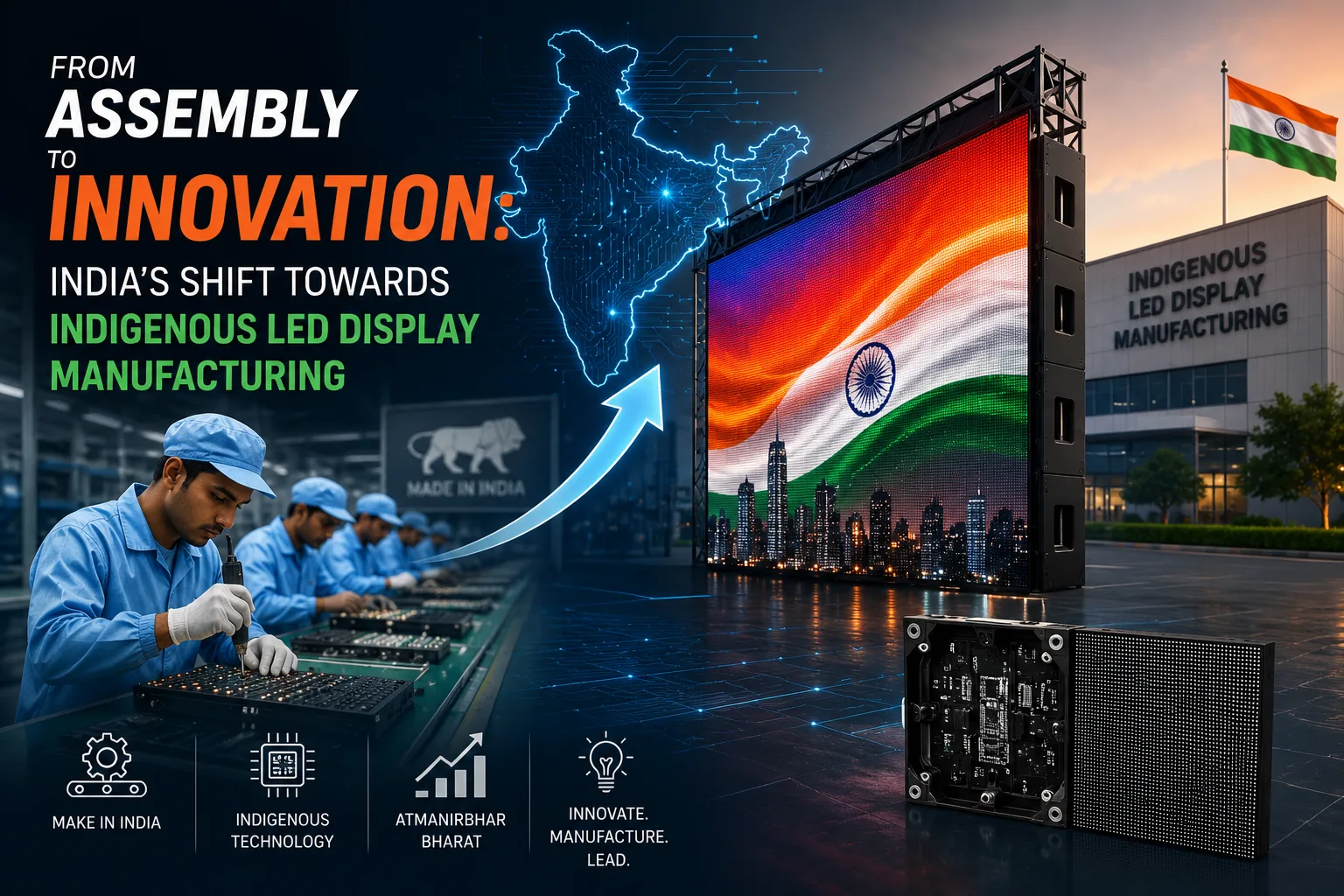
India’s LED display story has changed fast. For a long time, the country mainly assembled products built around imported parts. That model helped the market grow, but it did not build much depth. The next stage is different. India is now moving toward real manufacturing strength, where parts, design, software, testing, and product thinking all matter. This shift is visible in factories, policy, and in the way buyers now look at displays. They want better quality, lower power use, longer life, and more value from local makers. That is pushing the industry beyond simple assembly and toward a more confident, homegrown base. That is why the shift feels practical, urgent, and finally aligned with where the market is heading now.
Market Growth
The market itself is creating strong pressure for change. The Indian LED display market touched USD 848.1 million in 2025, and it is expected to rise to USD 1.315 billion by 2034. That kind of growth is not driven by one sector alone. Retail chains want sharper screens. Entertainment venues want larger and brighter formats. Public spaces want digital signage. Smart city projects want displays that can work outdoors and keep running in tough conditions. Commercial buyers are also asking for high-resolution screens that use less energy and deliver better visibility. In such a market, the country cannot depend only on imports forever. Demand is too broad, and the expectations are too high. Manufacturers that can serve this demand locally will have a clear edge.
Policy Support
Policy has become a major reason this shift now feels possible. Over the past decade, India’s electronics and semiconductor space has expanded sharply under Aatma Nirbhar Bharat, Make in India, and a range of production-linked incentive schemes. The scale of manufacturing in the electronics sector has grown from Rs. 1.9 lakh crore in 2014 to Rs. 11.32 lakh crore in 2025. That is a striking jump, and it shows how incentives can shape industrial behaviour when they are backed by ecosystem work. Customs reform, tax reform, and support for local manufacturing have all helped. Mobile manufacturing showed that India can scale quickly when the policy environment is supportive. LED displays can follow a similar path, provided the industry keeps investing in people, process, and quality.
Local Supply
The real test lies in the supply chain. A display may be assembled in India, but many of its critical parts still come from abroad. LED chips, driver ICs, control systems, and special materials often travel long distances before they reach the factory floor. That creates risk. It also keeps a large share of value outside the country. Indigenous manufacturing can change that, but only if local sourcing becomes stronger. More suppliers, more component makers, and more backward integration will be needed. This will not happen overnight. Still, the direction matters. A stronger domestic supply chain means fewer delays, better control over costs, and less exposure to global shocks. It also gives manufacturers more room to customise products for Indian conditions, which are often harsher than many imported products are built for.
Design Edge
Innovation will decide who leads. Assembly can fill orders, but it cannot build long-term strength. That comes from design, testing, and technical improvement. LED displays are moving into a phase where energy efficiency, heat management, brightness control, pixel precision, and software-driven content delivery all matter more than before. India has an advantage here. It has a large pool of engineers, developers, and manufacturing talent. It also has a market with very specific needs. A display used in a metro station, a highway sign, a stadium, or a control room cannot all be built the same way. Local manufacturers who understand these use cases can build better products. They can also respond faster when buyers need changes in size, format, or performance. That is where real competitiveness starts.
Global Future
India’s opportunity is bigger than domestic demand. Global companies are looking for new manufacturing bases, and supply chains are being redrawn. That opens a door for India to move from a service-heavy role into a stronger product role. The LED display sector can become one of the clearest examples of that shift. It already has market demand. It now has policy support. What it needs most is patience, investment, and a stronger belief in local capability. The future will not belong to companies that merely assemble faster. It will belong to those that build smarter. If India keeps adding depth to its manufacturing base, the LED display industry can become a true example of industrial maturity. It can move from being a buyer of technology to a maker of it, and that change will matter far beyond this one sector.
Written by - Kummarraju Rudraraju, Managing Director at Titan Intech Ltd, presenting UltraLED Displays
Read More:
How Ziroh Labs sees the next phase of enterprise AI beyond GPU infrastructure
How AI transformation is replacing traditional IT services for enterprises
Why managed detection and response will define the future of cybersecurity partners
Why cybersecurity in India needs stronger AI, threat intelligence and partner collaboration








 2 Min read