
From cloud-first to cloud-smart: Driving real outcomes for Indian SMEs

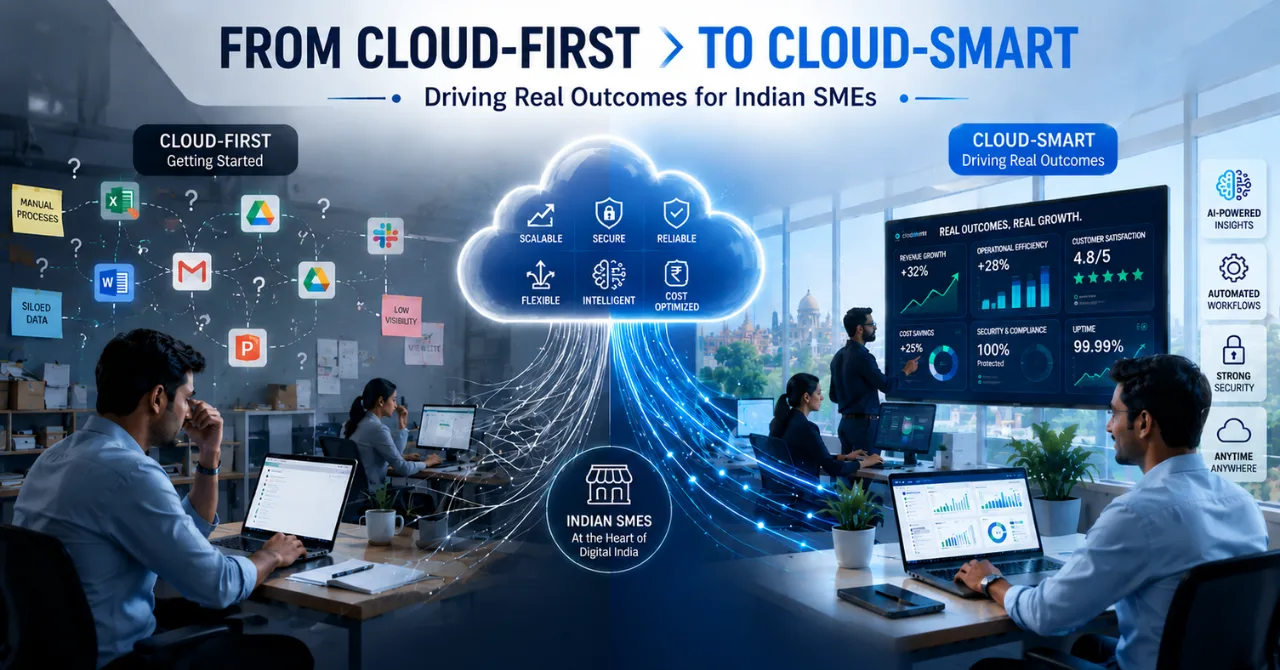
India’s SMEs are entering a new phase of digital transformation, one that goes beyond technology adoption to focus on outcomes. The shift from a cloud-first to a cloud-smart approach reflects a deeper maturity, where technology decisions are driven not by access, but by performance, cost efficiency, security, and business impact.
In the early stages, moving to the cloud was a milestone in itself. It enabled SMEs to move away from legacy systems and heavy upfront IT investments to gain flexibility in operations. Today, however, cloud adoption is no longer a differentiator; it is a necessity. In today’s evolving digital landscape, what matters now is how effectively businesses use the cloud to drive measurable outcomes.
From adoption to intent: Rethinking workload strategy
The initial “cloud-first” approach often meant migrating workloads without fully evaluating cost, performance, or compliance implications. This led to inefficiencies such as higher costs, latency challenges, and operational complexity.
Today, SMEs are taking a more strategic approach. Workloads that require low latency or regulatory control are increasingly retained on-premises or at the network edge, while scalable and compute-intensive workloads continue to leverage the cloud. This shift reflects a move toward ‘intent-driven’ architecture, where infrastructure decisions are aligned with business needs.
For instance, a mid-sized logistics firm redesigned its IT environment by moving real-time fleet tracking systems closer to the edge for faster response times, while retaining analytics and reporting on the cloud, which resulted in improved operational efficiency and reduced latency.
Similarly, a retail SME adopted a hybrid approach by running its inventory management system locally while using cloud platforms for demand forecasting and customer analytics that enabled faster decision-making and better stock utilisation.
Cloud as a platform for intelligence
Cloud is no longer just a storage or computing layer; it is evolving as a platform for intelligence. At the heart of this transformation lies the growing influence of AI, analytics and automation. Cloud platforms provide valuable insights into customer behaviour, improve operations processes through intelligent automation and prediction models.
Automation is streamlining repetitive processes from customer support workflows to supply chain management, allowing teams to focus on higher-value tasks. At the same time, analytics is enabling faster, data-driven decision-making, reducing reliance on intuition. A services-based SME, for example, leveraged AI-driven chatbots integrated with its cloud platform to automate customer queries, significantly improving response times while reducing operational costs.
As cloud environments become more intelligent, the role of reliable and high-performance connectivity becomes critical. Distributed business models require seamless, uninterrupted access to applications and data. This has led to increased adoption of technologies such as SD-WAN and managed connectivity solutions that provide greater control, visibility, and performance optimisation across networks.
Balancing the equation: Cost, performance and security
Balancing cost efficiency with performance and security still stands out as a bigger challenge for SMEs as they optimise their cloud workloads. While the cloud offers flexibility, its unoptimized usage can lead to escalating costs. At the same time, performance without adequate security exposes businesses to significant cyber risks.
The cloud-smart approach addresses this by integrating cost optimisation, performance management, and security into a unified strategy. SMEs are increasingly adopting practices such as workload right-sizing, continuous cost monitoring, and built-in security frameworks, including identity management, encryption, and threat detection. For example, a growing fintech SME implemented automated cost-monitoring tools and optimised its cloud workloads, reducing infrastructure costs while maintaining performance and compliance standards
The role of strategic partnerships
As digital ecosystems become more complex, SMEs are increasingly relying on trusted service partners who can go beyond products to offer strategic guidance. From assessing current infrastructure to designing future-ready architectures, the role of an advisory partner is becoming critical.
In our interaction with many SMEs, we are seeing this shift firsthand. Businesses are looking for integrated solutions that combine connectivity, cloud, AI and security that can be delivered over a robust and resilient network foundation. A managed services partner can simplify this transition, enabling SMEs to move from fragmented adoption to a more cohesive, outcome-driven digital strategy.
A defining shift for the next phase of growth
The move from cloud-first to cloud-smart is not just a technological evolution; it is a strategic shift in how SMEs approach growth. In the AI era, competitive advantage will not come from early adoption, but from intelligent integration. Businesses that can effectively align cloud, AI, and connectivity with their core objectives will be better positioned to drive efficiency, innovation, and resilience. Looking ahead, success will not belong to those who moved to the cloud first, but to those who learned to use it best.
Written By - Aditya Kinra ,Vice- President, Tata Teleservices
Read More:
Why USEReady believes AI orchestration will define the next decade of enterprise transformation
Backup as a service: Synology shifts towards outcome-led cyber resilience
World Password Day 2026: Why AI is making passwords obsolete faster than expected








 2 Min read