
ICEA supports DPIIT issuing QCO amendment for the electronics industry

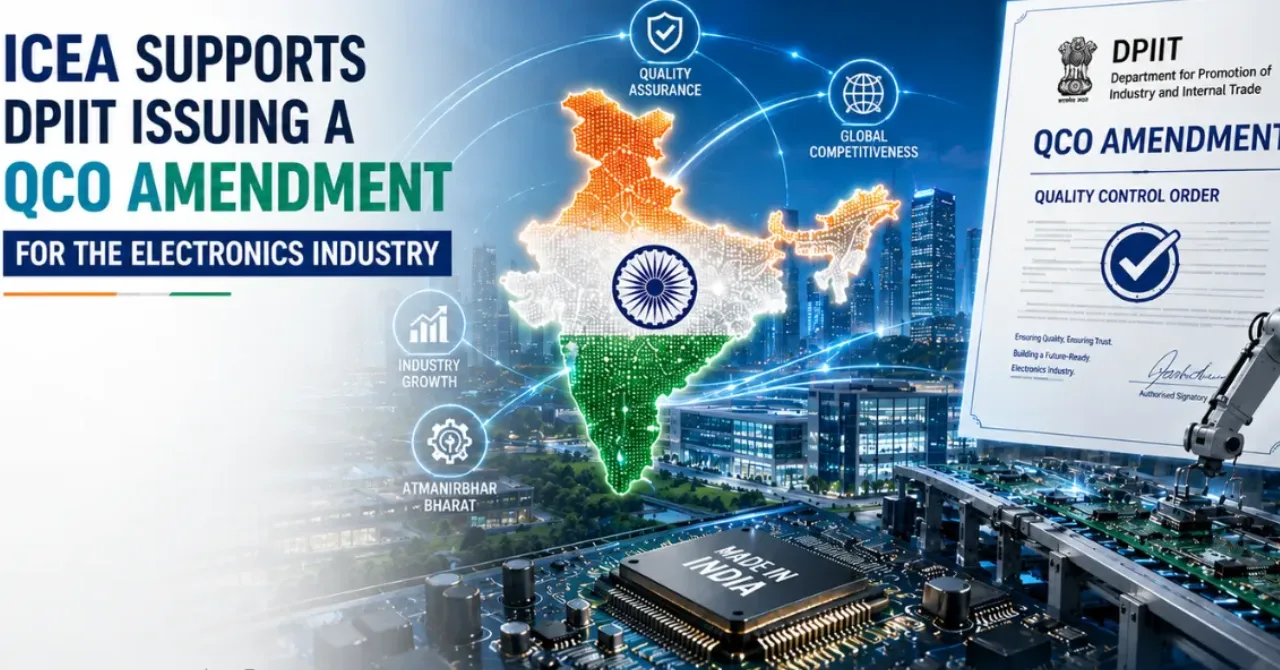
In a significant move to protect India’s electronics manufacturing competitiveness, the India Cellular and Electronics Association (ICEA) has expressed its strong support for the Government’s latest Quality Control Amendment Order, 2026. Issued by the Department for Promotion of Industry and Internal Trade (DPIIT), the notification provides a calibrated relaxation for specific compressor categories until March 31, 2027.
This intervention addresses a critical "supply chain paradox" where immediate domestic manufacturing for certain components is either currently limited or commercially unviable.
The strategic transition window
The ICEA had specifically requested relief for segments where the market is in rapid flux. For instance, fixed-speed air conditioners now account for only 15% of the market as consumers shift toward inverter technology. Consequently, most new industrial investments are being funnelled into inverter compressor plants, leaving a gap in domestic capacity for older fixed-speed models and high-capacity commercial units (above 2 TR).
Key categories receiving relief include:
Fixed-speed compressors for ACs below 7000W.
Commercial compressors above 7000W (2 TR) are used in large-scale applications.
Balancing sovereignty with reality: ICEA comments
The decision is the result of months of rigorous industry consultations. By providing this "transition window," the Government allows manufacturers to avoid operational disruptions while progressively strengthening the domestic supply chain. It moves away from a "one-size-fits-all" mandate toward a calibrated localisation roadmap.
“Government’s decision reflects a pragmatic and industry-aligned approach toward balancing manufacturing continuity with long-term localisation objectives,” said Pankaj Mohindroo, Chairman, ICEA. “This intervention provides the necessary transition period for the industry to build capacities... and progressively strengthen domestic manufacturing capabilities.”
Strengthening "Atmanirbhar Bharat"
This policy shift is viewed as a commitment to nation-building. By ensuring that critical components can still be sourced from relevant geographies while domestic plants scale up, the DPIIT is enabling supply chain resilience. This ensures that the larger vision of a self-reliant India is achieved through industry-aligned milestones rather than abrupt disruptions.
Conclusion
The ICEA’s support for the DPIIT’s consultative approach marks a new era of industry-government synergy. By recognising the nuances of technology transitions, like the shift from fixed-speed to inverter ACs, the Government is ensuring that India remains a globally competitive manufacturing hub while it builds its own advanced technology foundations.
Read More:
Why USEReady believes AI orchestration will define the next decade of enterprise transformation
Freshworks and Sonata Software: How AI is driving predictable partner revenue
World Password Day 2026: Why AI is making passwords obsolete faster than expected







 2 Min read