
Salesforce Headless 360 Changes How AI Agents Work

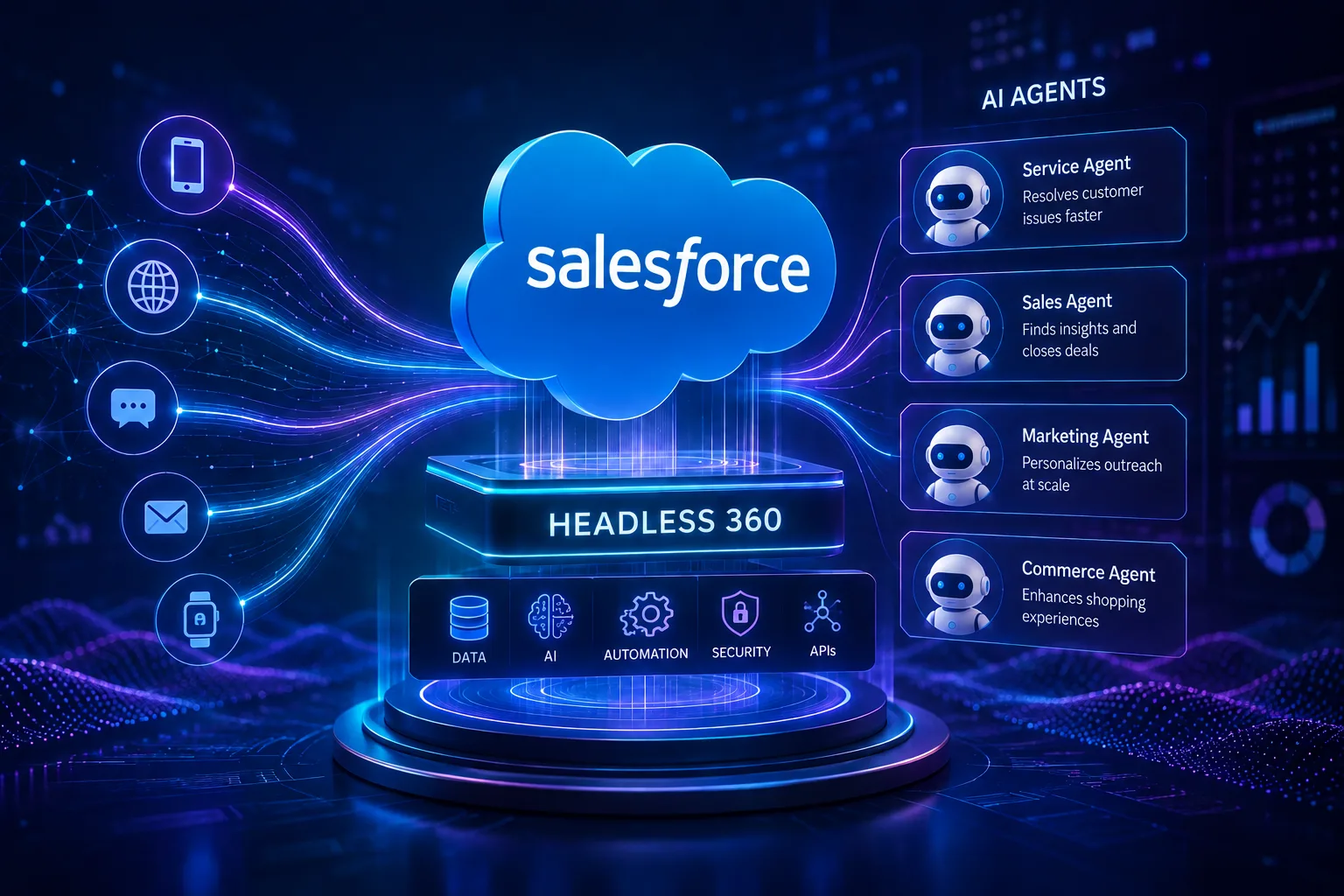
AI agents are quickly becoming a new way to interact with enterprise software, but putting them to work across business systems remains difficult. Salesforce is now taking a different route with Salesforce Headless 360, expanding its platform so that authorised AI agents can discover and use existing business capabilities without organisations having to rebuild integrations and logic for every new experience.
Salesforce Headless 360 moves beyond applications
The central idea behind Headless 360 is simple: instead of treating Salesforce as a collection of applications, its business capabilities can be reused wherever AI agents, applications or digital experiences need them. Existing identity, permissions, metadata, workflows, governance and business logic remain part of that process.
The shift matters because enterprises are increasingly working with multiple AI agents and platforms. Salesforce is positioning Headless 360 as an architectural layer that can connect those agents to trusted enterprise capabilities rather than creating another set of isolated integrations.
Its new Model Context Protocol (MCP) servers are a key part of this approach. The Headless 360 MCP Server allows agents running across Agentforce, Claude, ChatGPT, Cursor and other AI platforms to discover and invoke Salesforce capabilities in real time.
MCP becomes more than an API connection
Salesforce’s approach goes beyond simply exposing APIs. The Headless 360 MCP Server is metadata-aware, allowing agents to understand relationships, permissions, workflows, validation rules and governance around business capabilities.
That means organisations do not have to recreate the same enterprise rules inside prompts or custom code for each agent. The existing context can travel with the action, creating what Salesforce describes as a more governed foundation for the Agentic Enterprise.
This is also where Salesforce Data 360 and Customer 360 become important. The new Data 360 MCP Server exposes nearly 200 Data 360 APIs and allows authorised agents to work with customer context through natural language. Tasks can include building semantic models, transforming data, generating insights, mapping fields, inspecting identity graphs and activating campaigns.
Slack brings enterprise actions into conversations
The strategy extends beyond Salesforce interfaces. Slackbot’s MCP Client can connect with Salesforce MCP servers and more than 20 partner applications, allowing employees to take actions from conversations.
Users can update Salesforce opportunities, retrieve contracts and launch workflows without moving between multiple applications. The same identity, permissions and governance policies remain attached to those actions.
This reflects the broader agent-first enterprise architecture behind Headless 360. Instead of forcing employees or agents to work around application boundaries, Salesforce is making business capabilities available across the surfaces where work happens.
Developers get a reusable foundation
Salesforce is also expanding the developer layer supporting this model. More than 100 Agent Skills and Plugins package business logic into reusable capabilities, while Salesforce Multi-framework supports React applications with native Salesforce authentication, security and data access.
The Headless Experience Layer further extends this approach to web, mobile, embedded and conversational experiences. Headless capabilities are also being expanded across Marketing, Sales, Service, Commerce, MuleSoft, Informatica and Tableau.
Read More:
Coforge and Pega partnership targets AI scaling barriers
Cybeart India and KBC Computech partnership Expands Gaming Reach
HMD India and PhonePe collaboration opens UPI access for feature phone users
Why AI-Driven Testing Will Create a New Opportunity for IT Service Providers and Channel Partners







 2 Min read