
Samsung AMD AI memory partnership signals deeper shift

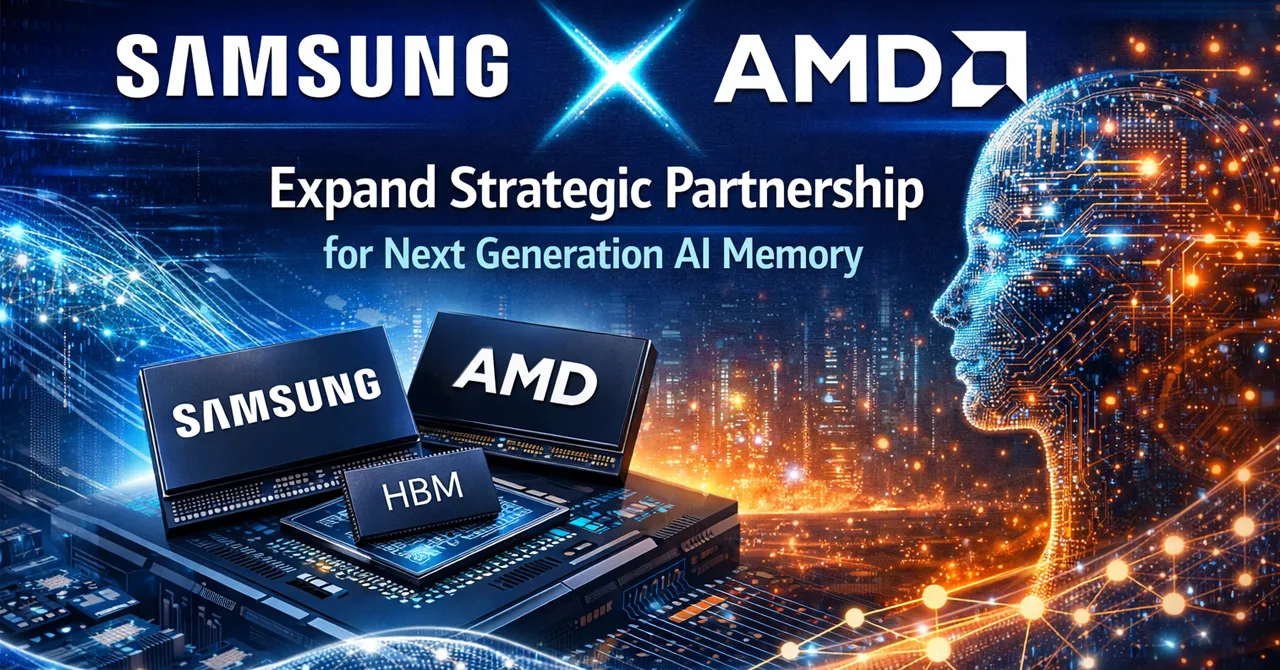
The Samsung AMD AI memory partnership marks a clear shift in how AI infrastructure is being designed. What appears to be a collaboration around memory supply is actually a broader move toward aligning memory, compute, and system architecture into a tightly integrated stack. As AI workloads grow more complex, the focus is moving beyond individual components. The real challenge now lies in how these components work together, efficiently and at scale.
Why the Samsung AMD AI memory partnership is moving deeper into the stack
The Samsung AMD AI memory partnership is expanding across multiple layers of the AI ecosystem. It includes alignment on HBM4 supply for the upcoming AMD Instinct MI455X GPU, along with advanced DRAM solutions for next-generation EPYC processors.
This is not just about faster memory. It reflects a deeper effort to connect silicon, system design, and rack-level architecture into a unified approach. Samsung’s role extends beyond memory into advanced packaging and potential foundry services, while AMD continues to build out its compute and platform roadmap.
The result is a more coordinated system where performance gains come from integration rather than isolated improvements.
Memory becomes the centre of performance
At the core of this collaboration is Samsung’s HBM4, built on a 10nm-class DRAM process and supported by a Samsung 4nm logic base die. With speeds reaching 13 Gbps and bandwidth up to 3.3 TB/s, the focus is clearly on handling large-scale AI workloads efficiently.
These improvements directly support AI model training and inference, where memory bandwidth and energy efficiency play a critical role. In this setup, memory is no longer just a supporting layer. It becomes central to how AI systems perform.
Building systems, not just components
The AMD Instinct MI455X GPU is expected to play a key role within the AMD Helios rack-scale architecture, which is designed to deliver scalable performance for next-generation AI systems. This highlights a broader shift toward building complete systems rather than optimising individual parts. By combining GPUs, CPUs, and high-performance memory into a unified architecture, the collaboration supports more predictable and scalable AI deployments.
The addition of DDR5 memory for EPYC processors further strengthens this approach, ensuring alignment across different layers of the infrastructure.
A long partnership, now evolving
Samsung and AMD have worked together for nearly two decades across graphics, mobile, and computing technologies. Samsung has also supported earlier AMD AI accelerators with memory solutions.
What is changing now is the depth of collaboration. The partnership is moving toward closer integration across the full stack, including discussions around future foundry opportunities.
Samsung AMD AI memory partnership points to integrated AI future
The Samsung AMD AI memory partnership reflects a larger shift in the industry. AI infrastructure is no longer being built in silos. Instead, it is evolving into a connected stack where memory, compute, and architecture are tightly aligned.
As demands for performance, bandwidth, and efficiency continue to rise, this kind of integration becomes essential. The partnership shows how future AI systems will be designed—not as separate components, but as unified, optimised platforms built for scale.
Read More:
Infraon Academy gives channel partners a structured path to tier advancement
The real story behind HPE AI factories and NVIDIA grid
Inside Zscaler partner programme: how zero trust is driving channel growth





 2 Min read