Blackbox Data Safe's Kshitij Kotak on cloud, SMEs and the AI challenge

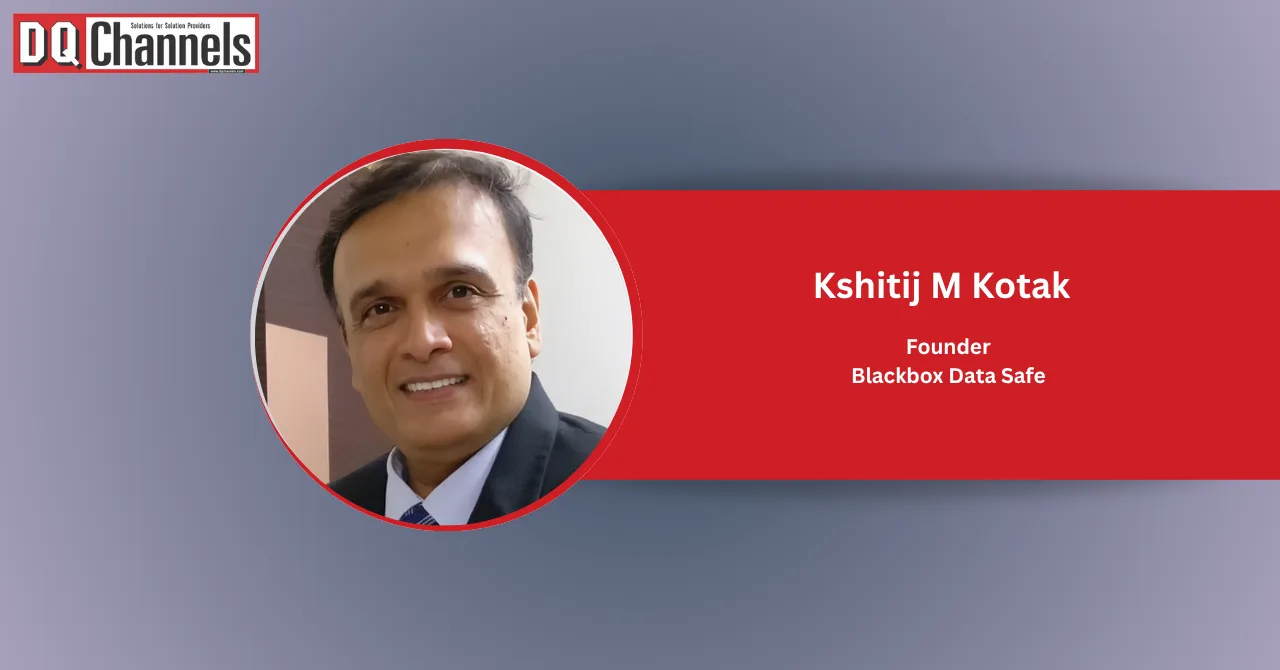
At the ASIRT Synergy Biz Conclave 2026 in Karjat, Maharashtra, Kshitij M Kotak, Founder, Blackbox Data Safe, reflected on more than three decades in IT, the shift from on-premises systems to the cloud, the challenge of building for SMEs and why he believes AI could change far more than the technology industry.
Kshitij M Kotak has seen several technology cycles unfold since entering the industry in 1991. His career has moved between software, hardware, entrepreneurship and technology leadership roles. He says he spent around 12+ years as an IT head, CTO, CIO and CITO, alongside more than two decades as an entrepreneur.
His perspective on today's market is shaped by that long journey, and by a willingness to question where technology is heading next.
Three decades of change
Kotak recalls a very different technology landscape when he began his career.
“I have been associated with the industry since 1991.”
He shared that he wrote artificial intelligence software in 1990-91 and ran on hardware that would seem extremely limited by today's standards. The program used natural language processing and was designed to help people who did not know how to use computers.
For Kotak, that early experience provides an unusual lens through which to view today's AI developments. His professional journey later moved from software into hardware and entrepreneurship.
ASIRT's role in his journey
Kotak also spoke about his association with ASIRT, describing the organisation as an important way of contributing back to the community.
He said ASIRT has continued to grow and improve over the years, including its Synergy conference.
The organisation's willingness to take risks is something he particularly values. Kotak described how the team, advisors, mentors and senior members have supported larger initiatives even when there was a possibility that an event might not work as planned.
“If you have said it, we will do it.”
He also believes ASIRT's approach to member funds is different from organisations that accumulate larger financial reserves.
“We believe as a board of association that the money is from members, the money should go for well-being of members.”
For Kotak, that philosophy is an important part of why he remains proud of having helped found the association.
2020 changed the Blackbox business
The pandemic and lockdown brought a much more immediate change to Kotak's own business.
He describes Blackbox Data Safe as an essentially on-premises, server-based product before 2020. When organisations moved rapidly to cloud environments, the company's existing business effectively disappeared.
“All of a sudden we saw all our business completely evaporated. People went to cloud, we had to reinvent ourselves.”
That forced Blackbox to rethink its proposition.
Kotak says customers that moved to the cloud are now increasingly questioning recurring costs and looking again at where their data and systems reside.
He describes this as a shift towards greater interest in keeping data private and accessible while retaining some of the convenience associated with cloud computing.
That led to a different proposition: a private cloud approach for customers that want cloud-like convenience without moving everything outside their own environment.
The SME challenge remains
Kotak sees a particular challenge in building such systems for small and medium enterprises.
For large enterprises, he says, building such infrastructure is not necessarily the biggest issue. For SMEs, creating a system at a price they can afford remains difficult.
“For SMEs, building such a system at a price which SMEs can afford was a big challenge and trust me, it still remains.”
He describes the product journey as one of continuous improvement.
Every month, the company evaluates what has been done, what needs to change and what new technologies can be explored.
“It's a continuous improvement process. It's a continuous learning process.”
Kotak also acknowledges the difficulty of building a commercially successful Make in India product. In his view, creating the product is one challenge; making it commercially successful is another.
He believes partners can play an important role in that journey.
AI is no longer just another technology
Kotak's views on AI are perhaps the strongest part of the conversation.
Having worked on an AI program decades ago, he believes the technology has entered a fundamentally different phase.
He says that after years of relatively slow movement, developments accelerated sharply around 2023.
“AI is not your usual computerisation.”
And his next statement is even stronger:
“AI is not game changing. It is going to be life changing.”
Kotak believes AI has the ability to affect how people live, work and interact with technology. But his concern is not AI alone. It is how humans choose to use it.
He distinguishes between AI as a technology and the applications and objectives built around it.
“AI by itself is not a problem. AI applications and what humans want out of it is a genuine problem.”
He argues that AI is increasingly being used for corporate interests rather than human improvement and points to job losses as one of the consequences he is worried about.
The uncomfortable side of AI
Kotak does not present AI as an entirely positive development. He believes the technology has enormous potential but also carries serious risks when misused.
“AI is capable not only of improving human lives but of destroying the world.”
His position is deliberately provocative. He says he is concerned about the way AI is being deployed and believes the social consequences could become significant.
For technology leaders and consultants, he argues, understanding what AI can do is now essential.
There is enormous potential, but Kotak's central warning is that technological capability and responsible use are not the same thing.
“There is so much that can be done with it. I can tell you, we are not using it for the good of the world.”
A career shaped by reinvention
Kotak's account brings together several technology shifts, from early AI and software to hardware, on-premise systems, cloud and today's AI wave.
His experience at Blackbox Data Safe has also reinforced a lesson that runs through the conversation: technology businesses have to keep adapting when customer needs change.
For SMEs, he sees affordability as a continuing challenge. For partners, he sees an important role in helping new technology propositions reach the market. And for AI, he sees something much larger than another technology cycle.
His conclusion is stark.
“AI is not game changing. It is going to be life changing.”
For someone who began working with artificial intelligence more than three decades ago, that is a warning worth considering.
Read More:
Online Vs. Offline: Nehru Place comments on E-commerce business model
Warranty under pressure: Nehru Place channel raises questions


 2 Min read