
Why managed AI services are replacing one-time AI projects

Artificial intelligence is reshaping enterprise technology services at a pace few organisations anticipated. While AI is creating new opportunities across industries, it is also challenging long-established business models built around project-based delivery and implementation services. As enterprises move beyond experimentation, customers are placing greater emphasis on measurable business outcomes, long-term optimisation and continuous AI management, creating new expectations for technology partners.
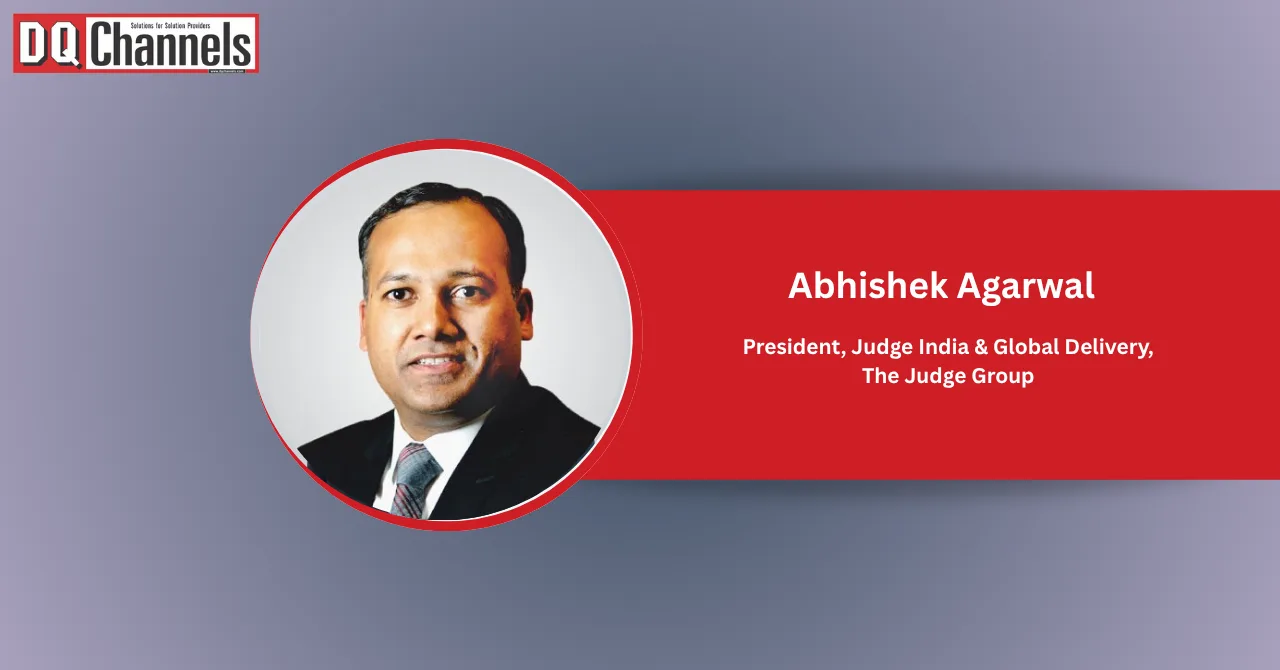
Speaking on this transition, Abhishek Agarwal, President, Judge India & Global Delivery, The Judge Group, said AI is simultaneously opening new avenues for growth while forcing organisations to rethink how they create long-term customer value.
"AI is genuinely doing both things at once for us. It has opened doors we simply could not have walked through before, but it has also forced uncomfortable questions about our own business model."
He believes organisations that embrace this disruption early will be better positioned than those trying to protect legacy revenue models.
"The partners who survive this decade will be those who made the same choice."
Industry-specific AI is creating stronger customer demand
According to Agarwal, enterprise demand has moved well beyond generic AI deployments. Organisations increasingly want AI solutions designed around their industry requirements rather than broad technology platforms that require significant customisation later.
He pointed to banking and financial services as an example, where organisations are looking for fraud detection models that reflect Indian transaction patterns. Similarly, healthcare customers expect AI solutions that understand clinical workflows while complying with local regulatory requirements.
"Our SAP and ServiceNow practices have found natural extension points in generative AI, particularly around workflow automation and intelligent document processing."
Although consulting and implementation continue to generate business, Agarwal noted that these engagements increasingly lead to longer managed services relationships, where continuous optimisation becomes more valuable than the initial deployment itself.
"Sector-specific depth is what moves us from being a vendor to becoming a preferred long-term partner."
Enterprise AI is now measured by business outcomes
Agarwal believes the era of AI proof-of-concept projects has largely ended. Organisations that experimented with AI over the past two years are now evaluating its business impact and expecting tangible returns from future investments.
Rather than discussing technology capabilities, customers increasingly want measurable improvements linked directly to operational performance.
"Customers want cost reduction percentages, not projections. They want SLAs tied to outcomes, not effort hours."
This shift has fundamentally changed how The Judge Group approaches customer engagements. Instead of beginning with technical implementation, the company now spends considerably more time aligning on business objectives and measurable performance indicators before development begins.
"We invest significantly more time upfront, aligning on KPIs before a single line of code is written."
According to Agarwal, this slower beginning strengthens long-term customer relationships by creating realistic expectations and shared accountability from the outset.
Recurring revenue begins after deployment
One of the most significant lessons The Judge Group has learned is that recurring revenue depends on what happens after an AI solution goes live rather than during implementation itself.
Agarwal observed that many partners lose customer momentum once projects are completed, allowing competitors to return later with managed services offerings.
"We now treat deployment as the beginning of the engagement, not the finish line."
To maintain continuous customer value, the company incorporates model monitoring, retraining cycles and usage reporting into every deployment. This ensures AI systems continue improving after implementation instead of remaining static.
"Recurring revenue follows genuine post-deployment accountability."
He believes partners that view implementation as the start of an ongoing relationship will be significantly better positioned to retain customers over the long term.
Successful AI practices require business expertise alongside technical skills
While technical AI capabilities remain important, Agarwal argues that sustainable AI practices require multidisciplinary teams capable of understanding both technology and business operations.
He believes mathematically accurate AI models still fail if they do not address the underlying business problem they were designed to solve.
"A model that works mathematically but misunderstands the business problem it was built for is worse than no model at all."
To strengthen these capabilities, The Judge Group has invested in structured reskilling programmes covering generative AI, responsible AI and data governance while pairing AI specialists with experienced domain professionals.
However, Agarwal believes one capability continues to be underestimated across the industry.
"Deploying the technology is the relatively straightforward part. Helping people inside a client organisation actually trust and adopt it day to day is where most implementations quietly stall."
He sees AI change management as one of the largest remaining skill gaps across enterprise technology services.
Long-term success will depend on intellectual property and trust
Looking towards 2030, Agarwal expects enterprise AI leadership to be determined less by implementation capability and more by intellectual property, customer confidence and demonstrated business outcomes.
He believes deploying language models and automation workflows will become increasingly standard across the industry. The real differentiator will be an organisation's ability to develop proprietary industry accelerators while demonstrating measurable success across similar customer environments.
"By 2030, differentiation will come down to intellectual property and institutional trust, not implementation speed."
Organisations capable of combining strategic AI roadmaps with documented customer outcomes will be better positioned than partners competing primarily on project pricing.
"Documented outcomes from real deployments are the currency that buys lasting customer ownership going forward."
The future belongs to outcome-driven AI partnerships
Abhishek Agarwal's perspective reflects the broader evolution taking place across enterprise AI. As customers move beyond experimentation, technology partners are increasingly expected to deliver measurable business value rather than isolated implementation projects. Managed AI services, industry-specific expertise and continuous optimisation are emerging as the foundations of long-term customer relationships. For channel partners and enterprise service providers alike, sustained growth will depend on combining technical capability with business insight, post-deployment accountability and the ability to translate AI investments into measurable outcomes.
Read More:
HP showcases AI PCs and enterprise AI strategy with Delta IT Network
AI Appreciation Day: Beyond the AI hype, where the real enterprise opportunities are emerging
Cabinet approves Mobile Phone Manufacturing Scheme with Rs 62,500 crore outlay
Why Dell believes AI PCs need consultative selling, not hardware transactions







 2 Min read